
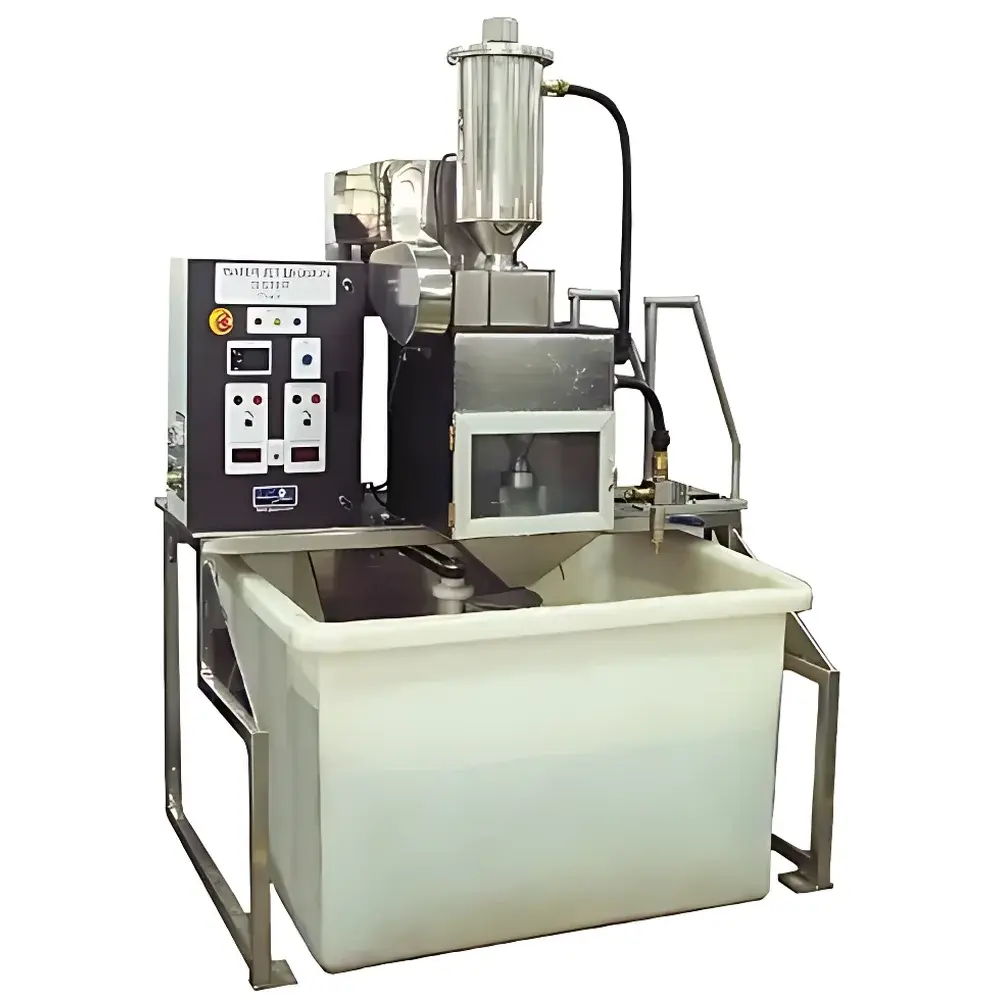
Ducom SJET Slurry Jet Erosion and Abrasive Wear Tester
| Brand | Ducom |
|---|---|
| Origin | USA |
| Manufacturer Type | Authorized Distributor |
| Origin Category | Imported |
| Model | SJET |
| Instrument Type | High-Temperature Tribological Tester |
| Maximum Friction Force | 2000 N |
| Friction Force Resolution | 0.1 mN |
| Maximum Operating Temperature | 1000 °C |
| Jet Velocity | 10–50 m/s |
| Jet Diameter | 4 mm (fixed) |
| Maximum Erosion Flux | 100–2000 cc/min |
| Impact Angle | 15–90° (adjustable in 15° increments) |
| Specimen Dimensions | 25 × 25 × 4.8 mm (custom sizes available) |
| Sample Chamber Volume | 150 × 150 × 150 mm |
| Nozzle-to-Specimen Distance | 50 mm |
| Water Tank Capacity | 1200 L |
| Slurry Tank Capacity | 60 L |
| Closed-Loop Slurry Recirculation System | Yes |
Overview
The Ducom SJET Slurry Jet Erosion and Abrasive Wear Tester is a precision-engineered tribological testing system designed to quantify material degradation under controlled slurry impingement conditions. It operates on the principle of solid-particle-laden fluid jet impact, where abrasive particles suspended in liquid are accelerated through a converging nozzle and directed at a stationary or rotating specimen surface. This methodology replicates real-world erosion mechanisms encountered in oil & gas downhole tools, mining slurry pipelines, hydropower turbine components, and desalination plant valves. Unlike conventional pin-on-disk or reciprocating wear testers, the SJET enables direct simulation of directional, high-velocity, multi-phase erosion—critical for evaluating resistance to combined mechanical abrasion and chemical corrosion. The system supports operation up to 1000 °C, permitting high-temperature erosion studies relevant to thermal barrier coating validation and refractory material qualification.
Key Features
- High-fidelity slurry jet generation with precisely regulated velocity (10–50 m/s), impact angle (15°–90° in 15° steps), and particle flux (100–2000 cc/min)
- Integrated closed-loop slurry recirculation system with filtration and sedimentation control, minimizing water consumption and enabling extended-duration tests (≥72 h)
- Modular specimen holder with custom adapter interface—supports standard coupons (25 × 25 × 4.8 mm) as well as geometrically complex field-representative components (e.g., valve seats, pump impeller blades)
- High-resolution force sensing (0.1 mN resolution, 2000 N full scale) synchronized with mass loss measurement for concurrent friction and erosion kinetics analysis
- Heated test chamber with programmable temperature ramping (RT to 1000 °C) and inert atmosphere capability (N₂/Ar purge ports)
- Real-time digital image capture and post-test profilometry integration for volumetric wear depth mapping (compatible with ISO 8202 and ASTM G76 standards)
Sample Compatibility & Compliance
The SJET accommodates metallic alloys (e.g., duplex stainless steels, Ni-based superalloys), ceramics (Al₂O₃, SiC, ZrO₂), polymer composites, and thermal spray coatings. Specimen mounting complies with ASTM G76-22 (Standard Test Method for Determining Resistance to Erosion by Solid Particle Impingement Using Gas Jets) and ISO 8202:2023 (Erosion Testing — Slurry Jet Apparatus and Procedure). All mechanical, thermal, and data acquisition subsystems conform to CE Machinery Directive 2006/42/EC and IEC 61000-6-2/6-4 electromagnetic compatibility requirements. Optional GLP-compliant audit trail logging satisfies FDA 21 CFR Part 11 requirements for regulated R&D environments.
Software & Data Management
Ducom’s ErosionSuite™ v4.2 software provides deterministic test sequencing, real-time parameter monitoring (jet pressure, flow rate, temperature, mass loss), and automated report generation per ASTM G134 and ISO 14520-12 templates. Raw data—including time-stamped weight loss, friction force transients, and thermal profiles—is stored in HDF5 format with embedded metadata (operator ID, calibration timestamp, environmental conditions). Export options include CSV, PDF, and XML for LIMS integration. Version-controlled firmware updates ensure long-term traceability; all calibration certificates (force sensor, thermocouple, flow meter) are digitally linked to test records.
Applications
- Ranking candidate materials for slurry transport piping in mineral processing plants (per ISO 15156/NACE MR0175)
- Quantifying erosion-corrosion synergy in sour service environments using pH-controlled, H₂S-saturated slurries
- Validating thermal barrier coating adhesion and spallation resistance under cyclic thermal–mechanical loading
- Supporting failure analysis of offshore drilling mud motor stators exposed to abrasive cuttings
- Generating erosion maps for computational fluid dynamics (CFD) model validation (ANSYS Fluent, STAR-CCM+)
- Accelerated life prediction modeling via Archard-type erosion rate correlation with particle hardness, velocity exponent, and impact angle function
FAQ
What slurry compositions can be tested?
The SJET supports aqueous and non-aqueous slurries containing silica sand, alumina grit, crushed ore, coal fines, or engineered microspheres—particle size range: 10 µm to 1 mm. Viscosity limit: ≤200 cP.
Is the system compatible with third-party particle size analyzers?
Yes—integrated optical particle counter ports (ISO 11171 compliant) allow real-time slurry particle distribution monitoring upstream of the nozzle.
Can erosion testing be performed under vacuum or controlled partial pressure?
Vacuum operation is not supported; however, the chamber accepts inert gas backfill (N₂, Ar) at pressures from 0.1 to 2 bar gauge.
How is specimen temperature measured during high-temperature testing?
A Type-K thermocouple embedded <1 mm beneath the eroded surface, coupled with infrared pyrometry (±2 °C accuracy at 1000 °C), ensures spatially resolved thermal profiling.
Does the system meet ISO/IEC 17025 calibration traceability requirements?
All critical sensors (load cell, thermocouple, Coriolis flow meter) are calibrated annually against NIST-traceable standards; calibration certificates are supplied with each instrument shipment.



