
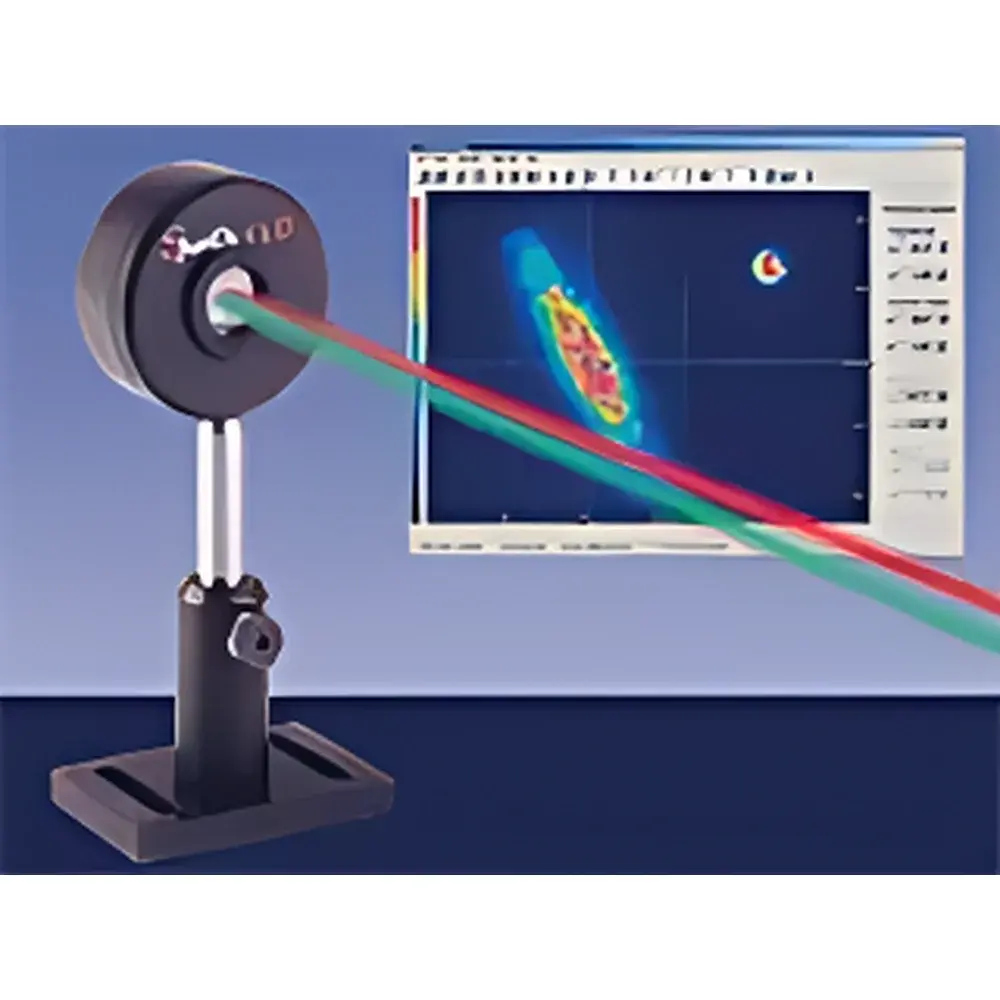
Duma Optronics SpotOn CCD High-Resolution Position-Sensitive Detection System
| Origin | Israel |
|---|---|
| Manufacturer Type | Authorized Distributor |
| Origin Category | Imported |
| Model | SpotOn CCD Series |
| Component Category | Optical Sensor Module |
| Spectral Range | 190–1550 nm |
| Position Accuracy | ±5 µm |
| Simultaneous Beam Tracking | Up to 3 beams |
| Interface Options | USB 2.0 or PCI |
| Detector Type | Monochrome CCD sensor |
Overview
The Duma Optronics SpotOn CCD High-Resolution Position-Sensitive Detection System is an engineered optical metrology platform designed for real-time, non-contact measurement of laser beam centroid position, displacement, and angular deviation. Based on high-sensitivity monochrome CCD imaging technology, the system operates across a broad spectral range—from deep ultraviolet (190 nm) to near-infrared (1550 nm)—with calibrated responsivity and linear pixel response. Unlike analog quadrant detectors, the SpotOn CCD employs full-frame spatial sampling to reconstruct beam profiles with sub-pixel interpolation, enabling position resolution down to ±5 µm under optimal illumination and signal-to-noise conditions. Its core architecture supports both static alignment verification and dynamic tracking of beam motion at frame rates up to 30 Hz (USB) or 60 Hz (PCI), making it suitable for closed-loop stabilization, optical path monitoring, and precision interferometric setup validation in research and industrial environments.
Key Features
- High-resolution CCD sensor with 12-bit digitization and programmable exposure control for optimized dynamic range across varying beam intensities
- Multi-beam analysis capability: simultaneous centroid calculation for up to three independent laser spots within the field of view
- Modular spectral configurations: dedicated models cover UV (190–1100 nm), VIS (350–1100 nm), NIR-I (350–1310 nm), and NIR-II (1500–1600 nm) bands
- Dual interface options: USB 2.0 for plug-and-play integration with laptops and portable workstations; PCI interface for low-latency, deterministic timing in embedded lab systems
- Onboard hardware triggering support for synchronization with external sources (e.g., pulsed lasers, motion stages, or data acquisition units)
- Robust mechanical housing with standard SM1 (1.035″-40) and C-mount threading for direct integration into optical breadboards and kinematic mounts
Sample Compatibility & Compliance
The SpotOn CCD system is compatible with continuous-wave (CW) and quasi-CW laser sources operating within its specified spectral bands, including HeCd (325 nm), Ar+ (488/514 nm), diode-pumped solid-state (DPSS) lasers (532/1064 nm), superluminescent diodes (SLDs), and telecom-grade DFB lasers (1310/1550 nm). It meets CE marking requirements for electromagnetic compatibility (EMC Directive 2014/30/EU) and low-voltage safety (LVD Directive 2014/35/EU). While not certified as medical or aerospace-grade hardware, its design adheres to ISO 10110-7 (optical component surface quality) and ISO 11146-1/-2 (laser beam width and divergence measurement standards) for traceable beam positioning metrology. The system supports GLP-compliant data logging when used with validated software workflows.
Software & Data Management
The system ships with Duma’s proprietary SpotOn Software Suite (v6.x), a Windows-based application offering real-time beam visualization, statistical trend analysis (position RMS, drift rate, ellipticity), and export of time-stamped XY coordinates in CSV, MATLAB (.mat), and HDF5 formats. API libraries (C/C++, .NET, Python) enable custom integration with LabVIEW, MATLAB, or Python-based automation frameworks. All measurement sessions include audit-trail metadata—user ID, timestamp, instrument serial number, exposure settings, and calibration file version—to support FDA 21 CFR Part 11 compliance where electronic records are subject to regulatory review. Firmware updates are delivered via signed binary packages with SHA-256 checksum verification.
Applications
- Laser cavity alignment and resonator mode optimization in ultrafast and frequency-stabilized laser systems
- Fiber coupling efficiency monitoring during active alignment of single-mode fibers and photonic integrated circuits
- Real-time vibration analysis of optical tables and mirror mounts using differential beam displacement tracking
- Flatness and collimation assessment of large-aperture optics via multi-point beam deflection mapping
- Beam pointing stability qualification for space-qualified laser communication terminals per ECSS-E-ST-32-01C
- Teaching laboratories for hands-on instruction in optical metrology, Gaussian beam propagation, and error signal generation
FAQ
What is the minimum detectable beam diameter for accurate centroid calculation?
For reliable sub-5 µm position accuracy, the beam’s full-width-at-half-maximum (FWHM) should exceed 10 pixels (~20 µm at native pixel pitch); smaller beams require magnification optics or image binning trade-offs.
Can the system measure elliptical or astigmatic beams?
Yes—the software computes major/minor axes, orientation angle, and ellipticity ratio from second-moment analysis of the intensity distribution.
Is recalibration required after changing wavelength ranges?
Each model is factory-calibrated per spectral band; switching between UV/VIS/IR models requires physical replacement—not software reconfiguration.
Does the system support triggering from TTL-compatible external devices?
Yes—both USB and PCI variants feature SMA-trigger input with configurable polarity and delay compensation.
How is thermal drift compensated during long-duration measurements?
The CCD sensor includes thermistor feedback and optional Peltier stabilization (available on IR models); ambient temperature logging is embedded in all exported datasets.



