
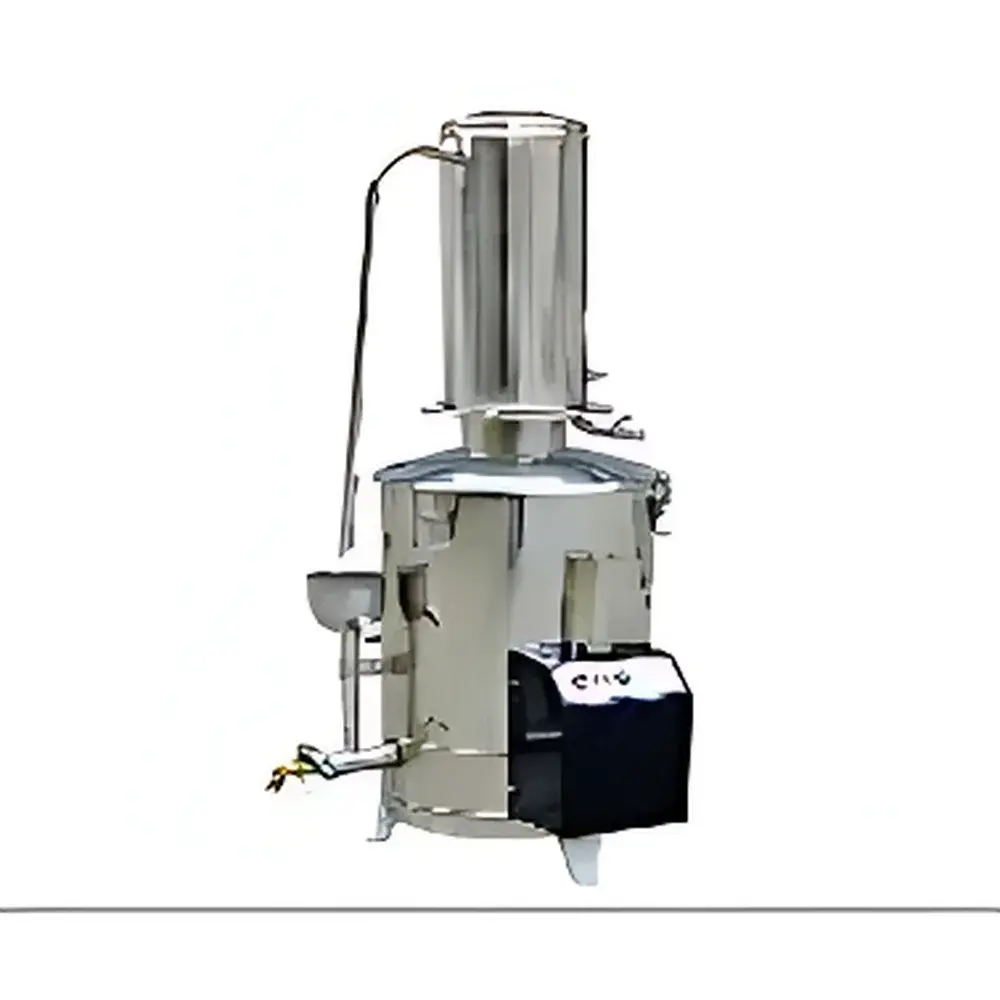
DZ-10 Stainless Steel Automatic Distillation Apparatus with Dry-Run Protection
| Origin | Beijing, China |
|---|---|
| Manufacturer Type | Authorized Distributor |
| Country of Origin | China |
| Model | DZ-10 |
| Output Capacity | 10 L/h |
| Heating Power | 7.5 kW |
| Input Voltage | 380 V AC |
| Construction Material | AISI 304 Stainless Steel |
| Compliance | Meets GB/T 6682–2008 Grade III Water Specifications |
| Safety Features | Auto shut-off on low water level, audible alarm, auto-refill & restart logic |
Overview
The DZ-10 Stainless Steel Automatic Distillation Apparatus with Dry-Run Protection is a bench- or floor-standing electrically heated steam-distillation system engineered for continuous, unattended production of laboratory-grade purified water. It operates on the fundamental principle of phase separation via controlled boiling and condensation: feed water is heated to vaporization in a stainless steel evaporation chamber; steam rises through a vapor pathway into a double-walled, air-cooled condenser where thermal exchange yields condensed distillate collected in a sterile receiving vessel. This physical separation process effectively removes non-volatile ions, organic contaminants, particulates, and microorganisms—delivering water compliant with Chinese National Standard GB/T 6682–2008 Grade III specifications (electrical resistivity ≥ 0.5 MΩ·cm at 25 °C, total silica ≤ 0.1 mg/L, oxidizable substances ≤ 0.4 mg/L). Designed for stable operation in pharmaceutical QC labs, chemical synthesis support areas, and academic research facilities, the DZ-10 integrates fail-safe thermal and hydraulic controls to mitigate operational risk during extended runs.
Key Features
- Construction from certified AISI 304 stainless steel throughout all wetted surfaces—including evaporator chamber, condenser jacket, and collection tank—to ensure corrosion resistance against chloride-rich feed water and long-term structural integrity under cyclic thermal stress.
- Intelligent dry-run protection system: integrated level sensors continuously monitor reservoir volume; upon detection of critically low water level, the unit immediately de-energizes the heating elements, activates an audible alarm, and initiates automatic refill via solenoid-controlled inlet valve before resuming heating sequence—eliminating risk of element burnout or chamber deformation.
- Dedicated status indication panel featuring discrete LED indicators for power-on, active heating, and low-water condition—enabling rapid visual diagnostics without instrumentation software.
- Thermally optimized double-tube condenser design with ambient-air cooling (no external coolant required), minimizing energy overhead while maintaining consistent condensate temperature below 35 °C to prevent re-evaporation losses.
- Modular electrical architecture rated for industrial 380 V AC three-phase supply, supporting stable performance in environments with variable grid conditions common in regional laboratory infrastructure.
Sample Compatibility & Compliance
The DZ-10 accepts municipal tap water, softened water, or pre-filtered feed sources with total dissolved solids (TDS) ≤ 500 ppm. It is not intended for seawater, high-hardness well water (>300 ppm CaCO₃), or chemically pretreated water containing volatile organics (e.g., chloramines, alcohols), which may carry over into distillate. Output water meets GB/T 6682–2008 Grade III requirements—suitable for general lab applications including buffer preparation, media autoclaving, glassware rinsing, and non-critical analytical dilutions. While not certified to ISO 3696 or ASTM D1193 Type III, its output is routinely validated in-house by end users via conductivity monitoring per USP guidelines. The apparatus supports GLP-aligned documentation practices through manual logbook recording of batch start/stop times, feed water source ID, and operator signature.
Software & Data Management
The DZ-10 operates as a standalone hardware system with no embedded microcontroller, firmware, or digital interface. All control logic is implemented via electromechanical relays, bimetallic thermostats, and analog level switches—ensuring deterministic behavior, immunity to electromagnetic interference, and full transparency for audit purposes. No software validation (e.g., FDA 21 CFR Part 11) is applicable; however, its mechanical simplicity facilitates straightforward IQ/OQ execution per GMP Annex 15 protocols. Maintenance records, calibration of temperature cutoff points, and verification of alarm response latency are documented manually using facility-approved forms.
Applications
- Production of rinse water for volumetric glassware cleaning prior to titration or spectrophotometric analysis.
- Preparation of aqueous reagents and culture media in microbiology and cell biology laboratories.
- Supply of feed water to ultrapure water systems (e.g., Milli-Q, ELGA) where primary purification relies on reverse osmosis followed by distillation polishing.
- Support of sterilization cycles in autoclaves and depyrogenation tunnels requiring non-pyrogenic water inputs.
- Teaching laboratories demonstrating classical separation techniques and thermodynamic principles of phase change.
FAQ
What feed water quality is recommended for optimal performance and longevity?
Use municipally treated water with TDS < 300 ppm and hardness < 150 ppm CaCO₃. Pre-filtration through 5 µm sediment and activated carbon cartridges is advised if feed contains particulates or chlorine residuals.
Does the unit require periodic descaling?
Yes—scale accumulation in the evaporator chamber depends on feed water hardness. Descaling every 200–300 operating hours using 5% citric acid solution is recommended; procedure is outlined in the maintenance manual.
Can the DZ-10 be integrated into a centralized lab water network?
No—it is a self-contained, gravity-fed still with fixed output port. Integration requires external pressure-rated storage tanks and booster pumps, which are outside its OEM scope.
Is distilled water from this unit suitable for HPLC mobile phase preparation?
Not without additional polishing. Grade III water lacks the low TOC (< 50 ppb) and sub-ppb ion content required for HPLC; downstream treatment via UV oxidation and mixed-bed ion exchange is necessary.
What safety certifications does the apparatus hold?
It conforms to GB 4706.1–2005 (Chinese household/industrial appliance safety standard) and carries CCC mark for electrical safety. CE or UL listing is not available.



