
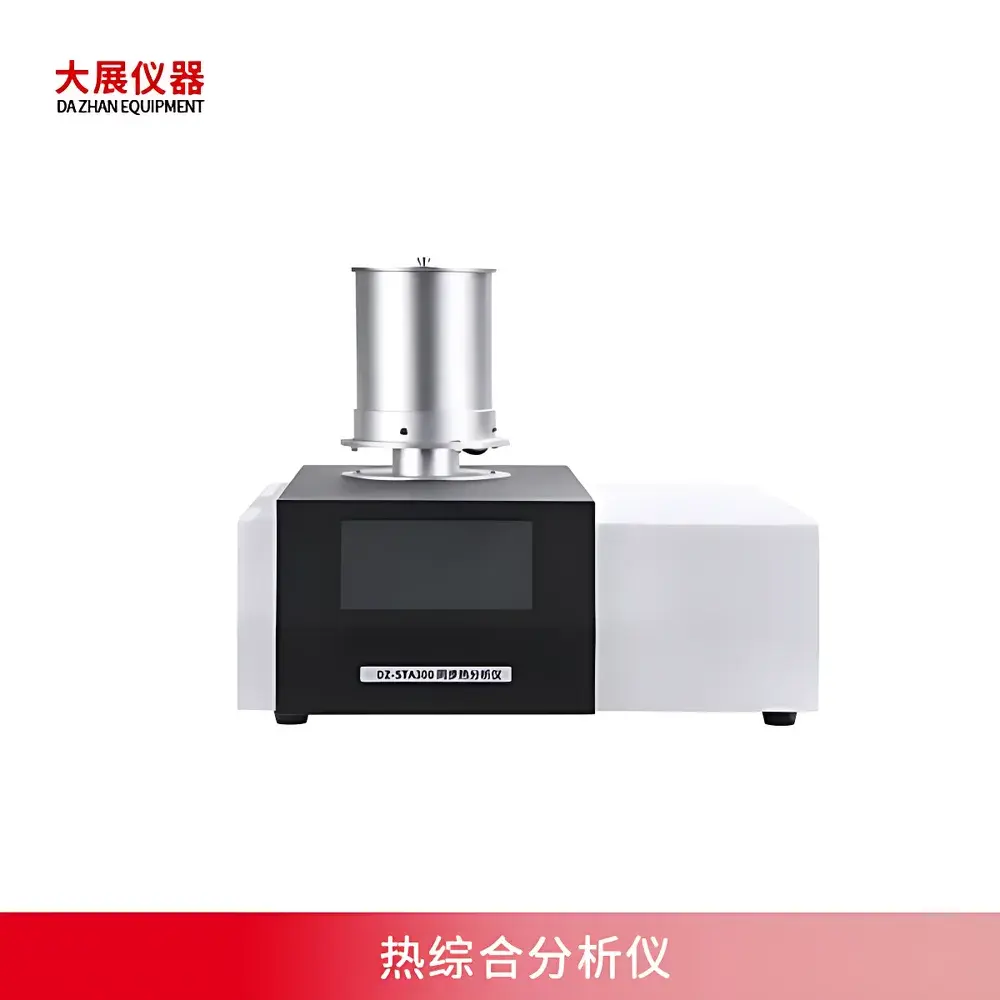
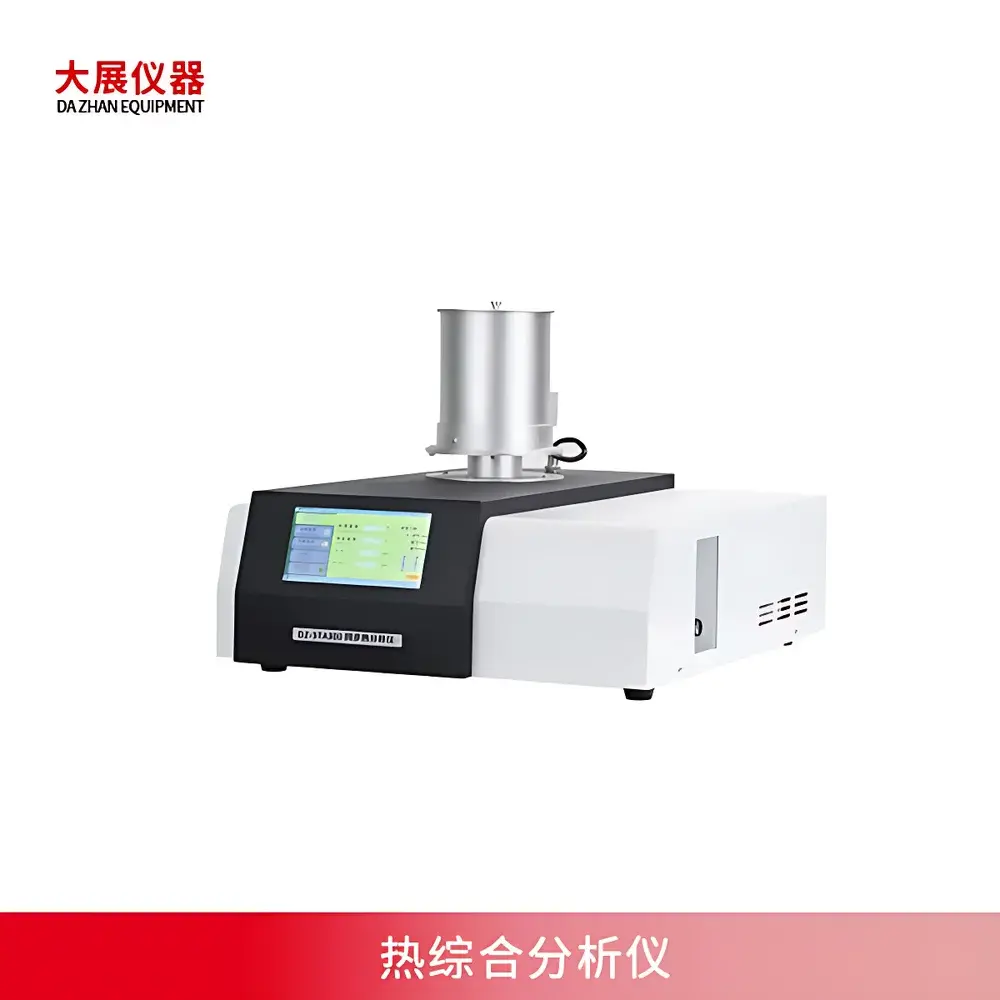
DZ-STA200 Simultaneous Thermal Analyzer (TGA-DSC) by NANJING DAZHAN
| Brand | NANJING DAZHAN |
|---|---|
| Origin | Jiangsu, China |
| Manufacturer Type | Manufacturer |
| Country of Origin | China |
| Model | DZ-STA200 |
| Temperature Range | Ambient to 1550 °C |
| Heating Rate | 0.1–100 °C/min |
| Max Sample Mass | 5 g |
| Atmosphere Options | Inert, Oxidizing, Reducing |
Overview
The DZ-STA200 Simultaneous Thermal Analyzer (TGA-DSC) is a high-temperature, dual-signal thermal analysis system engineered for precision measurement of mass change (thermogravimetry, TGA) and heat flow (differential scanning calorimetry, DSC) under controlled atmospheric conditions. Operating on the principle of simultaneous thermogravimetric and differential thermal analysis, the instrument enables real-time, correlated interpretation of thermal events—such as decomposition, oxidation, phase transitions, crystallization, glass transition, and reaction enthalpy—within a single experimental run. With an operational temperature range extending from ambient to 1550 °C, the DZ-STA200 is specifically designed for advanced characterization of refractory metals, high-performance ceramics, aerospace alloys, inorganic oxides, and thermally stable polymers where conventional instruments fail to deliver reliable data above 1200 °C.
Key Features
- High-temperature furnace architecture utilizing dual-row wound noble-grade Ni-Cr alloy heating elements, ensuring uniform thermal distribution, extended service life, and minimal electromagnetic interference.
- Integrated micro-balance with 0.1 µg resolution and ±0.01 mg accuracy over a 0.1 mg–5 g dynamic range, isolated from thermal and mechanical perturbations via dedicated air-cooled power supply and structural thermal shielding.
- Top-opening furnace design eliminates vertical sample insertion—reducing risk of sensor rod damage and improving operator ergonomics and throughput.
- Modular gas control system with dual mass flow controllers (MFCs), integrated digital flow meters, and programmable switching between inert (N₂, Ar), oxidizing (air, O₂), and reducing (H₂/N₂, CO) atmospheres—supporting both static and dynamic purge modes.
- 7-inch 24-bit color capacitive touchscreen interface with embedded firmware for real-time curve visualization (TG, DTG, DSC, and TG-DSC overlays), local data storage, and USB export functionality.
- Comprehensive calibration suite supporting multi-point temperature and heat-flow calibration across the full operating range, traceable to NIST-traceable reference materials (e.g., Al, In, Zn, Ag, Ni, and synthetic sapphire).
Sample Compatibility & Compliance
The DZ-STA200 accommodates standard crucible formats—including high-purity alumina, platinum, and quartz—with optional custom holders for fiber, powder, thin-film, or pelletized samples up to 5 g. Its robust thermal management and low-drift balance support GLP-compliant workflows in regulated environments. The system meets essential requirements for ISO 11358 (polymers—TGA), ISO 11357 (DSC), ASTM E1131 (TGA), ASTM E1269 (heat capacity), and ASTM E1858 (oxidative induction time). While not pre-certified for FDA 21 CFR Part 11, its audit trail-capable software architecture allows integration into validated laboratory information management systems (LIMS) when configured with timestamped user logins, electronic signatures, and immutable raw-data archiving.
Software & Data Management
The proprietary thermal analysis software provides synchronized acquisition and post-processing of TG, DTG, DSC, and derivative signals. Users can perform baseline correction, peak deconvolution, kinetic modeling (e.g., Kissinger, Ozawa-Flynn-Wall), onset/melting point determination, enthalpy integration, and multi-step decomposition fitting. Export options include CSV, Excel (.xlsx), PDF report generation with customizable templates, and direct printing of annotated thermograms. All raw data files are stored in vendor-neutral binary format with embedded metadata (instrument ID, operator, date/time, atmosphere, heating rate, calibration history), enabling long-term reproducibility assessment and inter-laboratory comparison.
Applications
The DZ-STA200 delivers critical insights across R&D and QA/QC domains: quantifying ceramic sintering behavior and binder burnout kinetics; evaluating thermal stability and oxidative degradation thresholds of carbon composites and battery cathode materials; determining metal oxide reduction profiles in metallurgical process development; assessing polymer degradation mechanisms and filler dispersion effects in engineering plastics; validating excipient compatibility and active pharmaceutical ingredient (API) polymorphic transitions per ICH Q5A guidelines; and characterizing food matrix decomposition during roasting or extrusion. Its wide dynamic range and atmospheric flexibility make it suitable for academic research, national metrology institutes, and industrial process optimization labs.
FAQ
What is the maximum recommended continuous operating temperature for long-term stability?
The furnace is rated for continuous operation up to 1500 °C; 1550 °C is specified as the short-term upper limit (≤30 min) under inert atmosphere.
Can the system perform isothermal TGA or DSC holds at high temperature?
Yes—programmable isothermal segments are supported from ambient to 1500 °C, with duration configurable from 0 to 300 minutes (extendable to 72 hours via firmware update).
Is automatic baseline correction available during data analysis?
Yes—the software includes interactive and algorithmic baseline subtraction tools for both TG and DSC curves, with manual anchor-point adjustment and polynomial fitting options.
Does the instrument support purge gas flow ramping during a single experiment?
Yes—gas flow rate and composition can be dynamically modulated mid-run via time-based program steps, enabling staged oxidation or multi-atmosphere reaction studies.
Are calibration certificates provided with the system?
NANJING DAZHAN supplies factory calibration reports for temperature (using metal standards) and mass (with certified weights); users may perform additional in-house calibrations using supplied reference materials and procedures compliant with ISO/IEC 17025 guidance.



