
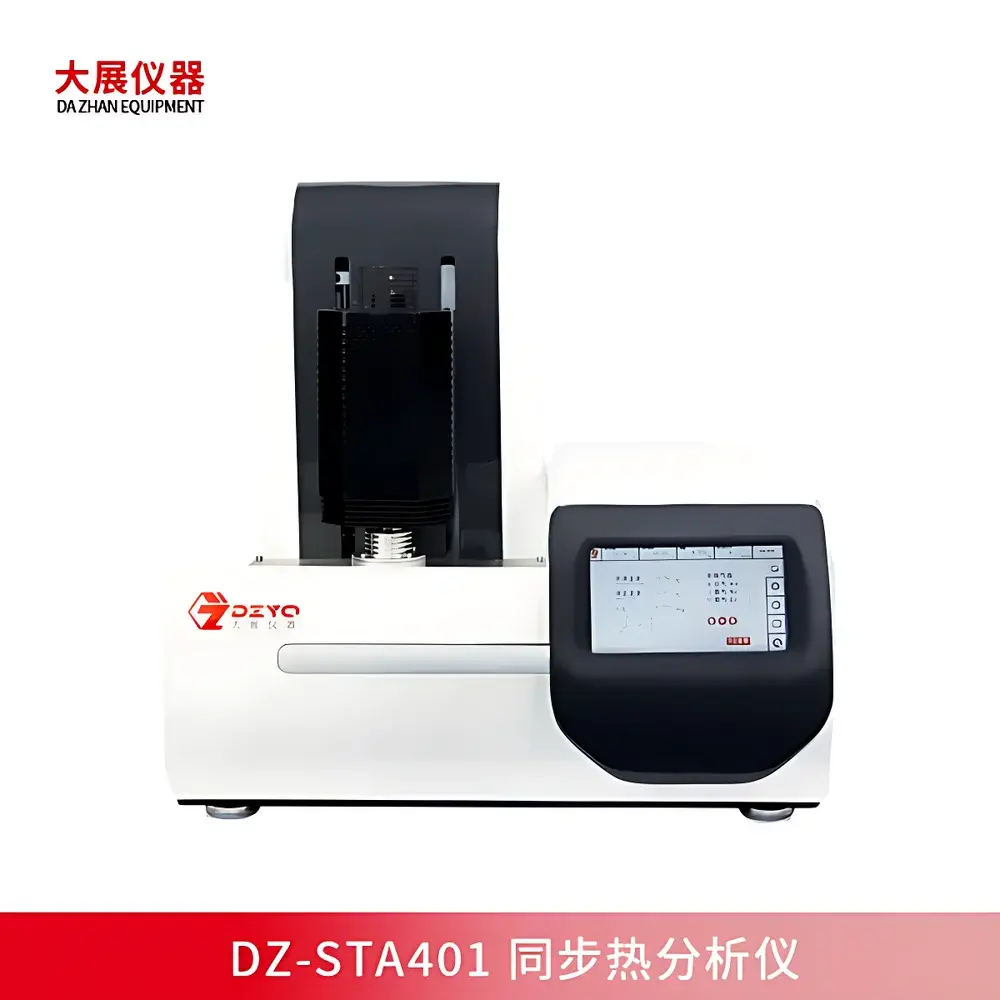
DZ-STA401 Simultaneous Thermal Analyzer (TG-DSC) by DAZHAN Instruments
| Brand | DAZHAN |
|---|---|
| Origin | Jiangsu, China |
| Manufacturer Type | Authorized Distributor |
| Country of Origin | China |
| Model | DZ-STA401 |
| Coupling Technology | TG-DSC |
| Temperature Range | Ambient to 1250 °C |
| Heating Rate | 0.1–100 °C/min |
| Temperature Stability | ±0.01 °C |
| Maximum Sample Mass | 30 g |
| Atmosphere Control | N₂ (digital mass flow controller) |
| Weight Resolution | 0.1 µg |
| DSC Sensitivity | ±1000 mW |
| Weighing Range | 0.01 mg–3 g (expandable to 50 g) |
| Weight Accuracy | 1 µg |
| Cooling Time (1000 °C → 50 °C) | ≤20 min |
| Temperature Resolution | 0.1 °C |
| Control Method | Intelligent PID |
Overview
The DZ-STA401 Simultaneous Thermal Analyzer (TG-DSC) by DAZHAN Instruments is a precision-engineered thermal analysis platform designed for concurrent measurement of thermogravimetric (TG) and differential scanning calorimetry (DSC) signals under controlled atmospheric conditions. Based on the principle of simultaneous dual-signal acquisition—monitoring mass change (via high-resolution microbalance) and heat flow (via symmetrical thermocouple-based sensor)—the instrument enables rigorous characterization of thermal transitions, decomposition pathways, oxidative stability, and phase transformations in solid and powdered materials. Its operational range spans ambient temperature to 1250 °C, supporting both dynamic heating and controlled cooling protocols with programmable ramp rates from 0.1 to 100 °C/min. The system employs a vertically actuated furnace architecture, allowing rapid thermal equilibration and minimizing thermal lag between sample and reference positions—a critical design factor for high-fidelity kinetic analysis and reproducible baseline stability.
Key Features
- Automated vertical furnace lift mechanism enabling rapid sample insertion, thermal isolation during loading, and accelerated cooling (≤20 min from 1000 °C to 50 °C)
- Dual-layer insulated platinum-rhodium alloy heating element with bi-directional winding configuration, ensuring uniform radial temperature distribution and extended service life at elevated temperatures
- High-stability microbalance system with 0.1 µg resolution and 1 µg accuracy over a 0.01 mg–3 g dynamic range (extendable to 50 g with optional upgrade)
- Integrated digital mass flow controller for precise, software-regulated inert gas delivery (N₂ standard; compatible with other purge gases upon hardware validation)
- Corrosion-resistant, high-purity noble metal sensor assembly engineered for long-term stability under repeated thermal cycling and reactive atmospheres
- Dedicated exhaust port configured for seamless hyphenation with Fourier-transform infrared (FTIR) or quadrupole mass spectrometry (QMS) systems for evolved gas analysis (EGA)
Sample Compatibility & Compliance
The DZ-STA401 accommodates a broad spectrum of inorganic, organic, polymeric, pharmaceutical, and ceramic samples—including powders, granules, thin films, and small-volume solids—within a maximum mass limit of 30 g. Its robust construction and inert N₂ environment support analyses compliant with ASTM E1131 (standard test method for compositional analysis by thermogravimetry), ISO 11358 (polymers—thermogravimetry), and USP (residual solvents). Data acquisition and reporting meet GLP/GMP documentation requirements, with audit-trail-capable software supporting 21 CFR Part 11 readiness when deployed with validated user access controls and electronic signature modules.
Software & Data Management
Bundled with DAZHAN’s proprietary STAControl™ v4.x analysis suite, the DZ-STA401 provides real-time signal synchronization, multi-step temperature programming, automatic baseline correction, and derivative (DTG) calculation. The software supports quantitative kinetic modeling (e.g., Kissinger, Ozawa-Flynn-Wall methods), peak deconvolution, and comparative overlay of up to 16 curves. All raw data are stored in vendor-neutral ASCII format with embedded metadata (time stamp, operator ID, method file hash), facilitating third-party integration with LIMS platforms and statistical process control (SPC) tools. Export options include CSV, PDF reports with customizable templates, and image-ready SVG/PNG graphics suitable for peer-reviewed publication.
Applications
- Determination of thermal degradation onset, decomposition enthalpy, and residual ash content in polymers and composites
- Quantification of crystallinity, glass transition (Tg), cold crystallization, and melting behavior in semi-crystalline thermoplastics
- Assessment of oxidation induction time (OIT) and thermal stability of antioxidants in lubricants and packaging resins
- Investigation of dehydration, decarbonation, and redox reactions in mineralogical and catalytic materials
- Supporting ICH Q5C stability studies for biopharmaceutical formulations via moisture loss profiling and excipient compatibility screening
- Validation of sintering profiles and phase evolution in advanced ceramics and battery electrode materials
FAQ
What atmosphere options are supported beyond nitrogen?
The base configuration includes a digitally regulated N₂ supply. Optional hardware upgrades enable switching to synthetic air, argon, helium, or forming gas (5% H₂/95% N₂), subject to sensor and furnace material compatibility verification.
Is the DZ-STA401 compatible with evolved gas analysis (EGA)?
Yes—the dedicated exhaust port features standardized 6 mm OD stainless-steel tubing connections and pressure-rated fittings, enabling direct coupling to FTIR or QMS systems without intermediate condensation traps.
Can the instrument perform isothermal holds and multi-segment temperature programs?
Yes—STAControl™ supports up to 20 independent program segments per run, including ramp, hold, and cooling steps, with full control over dwell time, rate, and final temperature.
How is temperature calibration verified?
The system supports multi-point calibration using certified reference materials (e.g., In, Sn, Zn, Al, Ag) traceable to NIST SRMs, with automated calibration curve generation and deviation reporting per ASTM E967.
What maintenance intervals are recommended for routine operation?
Standard preventive maintenance includes quarterly balance verification, biannual furnace insulation inspection, and annual thermocouple calibration—documented in the included Maintenance Logbook and aligned with ISO/IEC 17025 laboratory quality management expectations.
Related Products



