
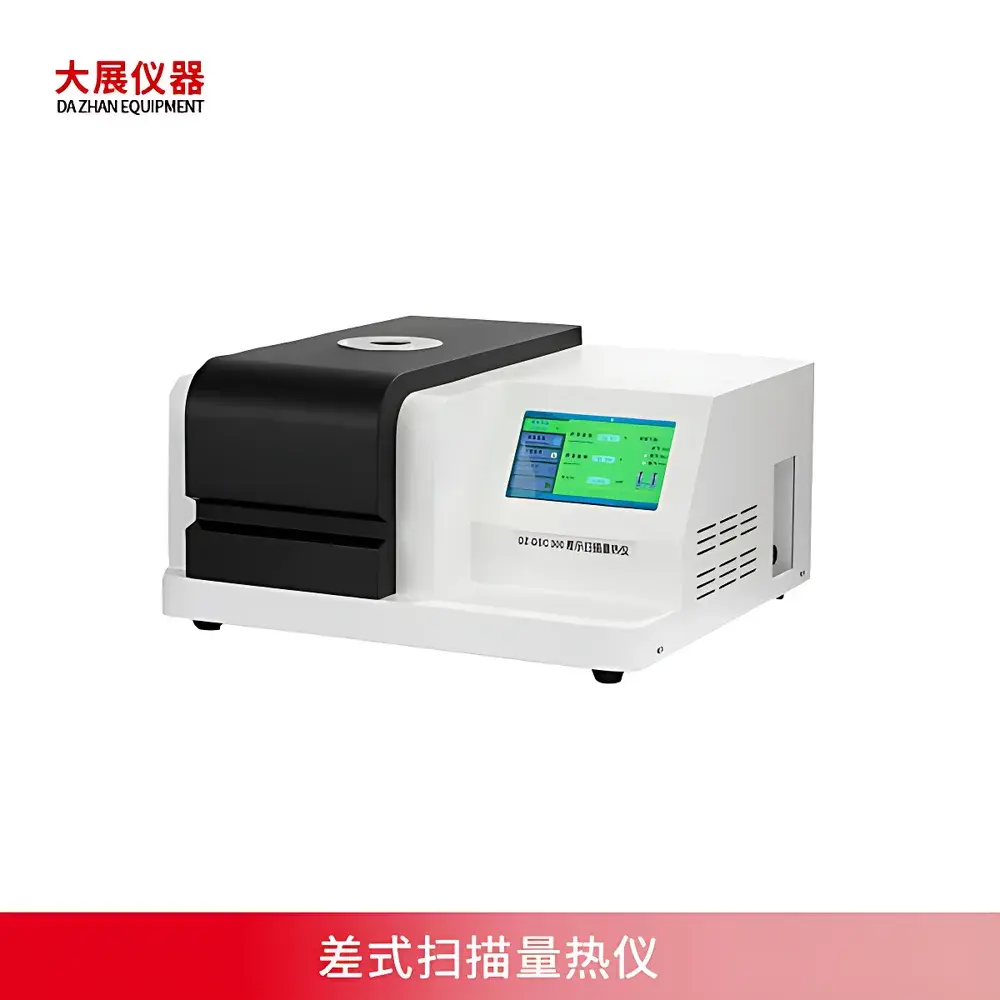
DZHAN DZ-DSC300 Differential Scanning Calorimeter
| Brand | DZHAN |
|---|---|
| Origin | Jiangsu, China |
| Manufacturer Type | Authorized Distributor |
| Country of Origin | China |
| Model | DZ-DSC300 |
| Sample Capacity | Single-sample |
| Instrument Type | Differential Scanning Calorimeter (DSC) |
| Temperature Range | Ambient to 600 °C |
| Heating/Cooling Rate | 0.1–100 K/min |
| DSC Signal Range | 0–±800 mW (expandable) |
| Temperature Stability | ±0.01 °C |
| Temperature Resolution | 0.001 °C |
| DSC Sensitivity | 0.001 mW |
| Atmosphere Control | Dual-gas automatic switching (N₂, Ar, air), flow rate 0–200 mL/min, max pressure 0.5 MPa |
| Thermal Program | Up to 6-segment ramp/hold/cool sequences, isothermal duration ≤24 h |
| Display | 7-inch 24-bit color TFT touchscreen |
| Data Interface | Standard USB 2.0 |
| Calibration Standards Included | Indium, Tin, Lead |
Overview
The DZHAN DZ-DSC300 Differential Scanning Calorimeter is a precision thermal analysis instrument engineered for quantitative measurement of heat flow differences between a sample and inert reference as a function of temperature or time. Based on the heat-flux DSC principle, it employs a symmetric furnace architecture with integrated high-efficiency insulation and dual-sensor thermal compensation to ensure exceptional baseline stability and signal fidelity. Designed for rigorous laboratory environments, the DZ-DSC300 delivers high reproducibility in determining thermodynamic transitions—including glass transition (Tg), crystallization onset (Tc), melting point (Tm), enthalpy of fusion (ΔHf), oxidative induction time (OIT), and specific heat capacity (Cp). Its operational range from ambient to 600 °C supports characterization of polymers, pharmaceuticals, metals, composites, and energy materials under controlled atmospheres.
Key Features
- Optimized furnace design with enhanced thermal homogeneity and minimized radial temperature gradients, contributing to improved peak resolution and baseline flatness.
- Thermally fused sensor assembly—replacing conventional spot-welded junctions—enables higher thermal coupling efficiency and long-term signal consistency.
- Programmable multi-stage thermal protocols: up to six independent ramp/hold/cool segments with isothermal durations configurable up to 24 hours.
- Dual-control architecture: fully functional operation via integrated 7-inch capacitive touchscreen interface or external PC-based software—both supporting identical parameter sets and real-time data visualization.
- Electromagnetic interference (EMI)-hardened signal acquisition circuitry with multi-layer shielding, ensuring low-noise DSC output even in shared lab environments.
- Automated dual-gas manifold with pressure-regulated flow control (0–200 mL/min) and programmable gas-switching logic synchronized to thermal events.
Sample Compatibility & Compliance
The DZ-DSC300 accommodates standard aluminum, gold, or platinum crucibles (hermetic or vented) with sample masses ranging from 1 to 25 mg. It complies with core methodological requirements outlined in ASTM E794 (melting and crystallization temperatures), ASTM E1356 (glass transition), ISO 11357 series (polymer thermal behavior), and USP (pharmaceutical thermal analysis). While not pre-certified for 21 CFR Part 11 compliance, the system supports audit-trail-ready data logging when used with validated third-party software; raw data files (.dsc, .csv) retain full metadata including instrument ID, calibration history, operator input, and timestamped thermal events. All calibration standards (indium, tin, lead) are traceable to NIST SRMs and supplied with documented purity and uncertainty values.
Software & Data Management
The included Windows-compatible analysis suite provides baseline correction, peak integration, kinetic modeling (e.g., Ozawa-Flynn-Wall), Cp calculation, and comparative overlay of multiple runs. Data export supports CSV, TXT, and universal ASCII formats for downstream processing in MATLAB, Origin, or Python-based analytical workflows. The software implements user-level access control (administrator/operator modes), electronic signature prompts for critical actions, and optional encrypted storage for GLP/GMP-aligned environments. Raw thermograms are stored with embedded calibration coefficients, enabling retrospective recalibration without reacquisition.
Applications
- Materials Science: Quantification of crystallinity in semi-crystalline polymers, thermal degradation kinetics of composites, and phase transformation behavior in shape-memory alloys.
- Pharmaceutical Development: Polymorph screening, excipient compatibility assessment, stability-indicating assay validation, and lyophilized product residual moisture correlation.
- Food Science: Gelatinization enthalpy of starches, fat crystallization profiles, and shelf-life prediction via oxidative stability testing (OIT).
- Energy Materials: Characterization of phase-change materials (PCMs), thermal runaway onset in battery electrode formulations, and binder decomposition in solid-state electrolytes.
- Quality Control: Batch-to-batch consistency verification per internal specifications or industry standards such as ISO 9001 Annex A.2.2 (analytical equipment validation).
FAQ
What calibration standards are provided with the DZ-DSC300?
Indium (99.999% pure), tin (99.999%), and lead (99.998%) reference materials are included, each accompanied by certified transition temperatures and enthalpies traceable to NIST SRMs.
Can the DZ-DSC300 perform heat capacity (Cp) measurements?
Yes—using the sapphire calibration method per ASTM E1269, the instrument calculates Cp with an accuracy of ±2% across its operating range when configured with appropriate crucible geometry and purge gas flow.
Is remote operation supported?
The system supports LAN-enabled remote monitoring and basic control via VNC or RDP when connected to a local network; full protocol editing and advanced analysis require local software installation.
What maintenance intervals are recommended?
Furnace alignment verification every 6 months; sensor sensitivity check using indium calibration annually; gas line filter replacement every 12 months under continuous use.
Does the instrument meet GMP documentation requirements?
Out-of-the-box, it meets ALCOA+ data integrity principles when operated with version-controlled software and defined SOPs; formal 21 CFR Part 11 compliance requires site-specific validation documentation and electronic signature implementation.



