
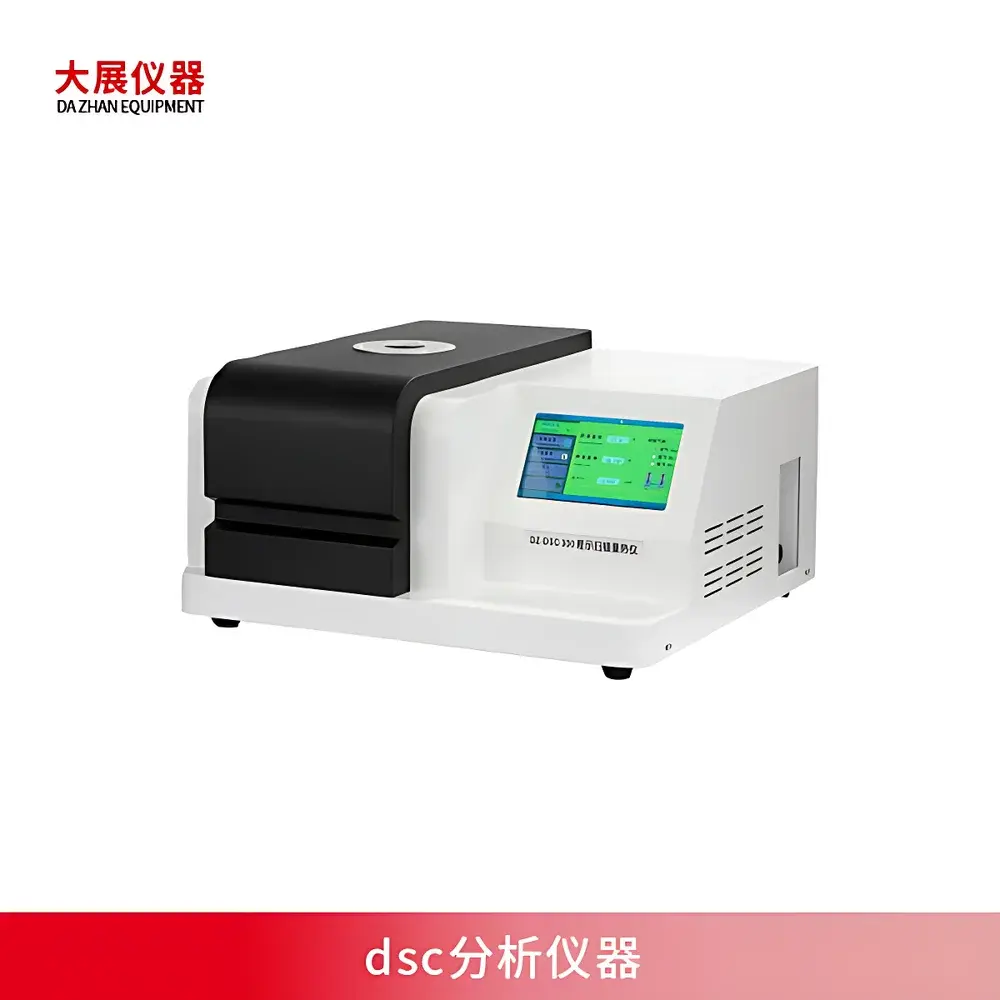
DZHAN DZ-DSC300 Differential Scanning Calorimeter
| Brand | DZHAN |
|---|---|
| Origin | Jiangsu, China |
| Model | DZ-DSC300 |
| Sample Capacity | Single |
| Instrument Type | DSC |
| Temperature Range | Ambient to 600 °C |
| Heating/Cooling Rate | 0.1–100 K/min |
| DSC Signal Range | 0–±800 mW (expandable) |
| Temperature Stability | ±0.01 °C |
| Temperature Resolution | 0.001 °C |
| DSC Sensitivity | 0.001 mW |
| Gas Control | Dual-channel automatic switching, flow 0–200 mL/min, pressure ≤0.5 MPa |
| Thermal Program | Up to 6 segments (ramp/hold/cool), max hold time ≤24 h |
| Display | 7-inch 24-bit color LCD touchscreen |
| Interface | Standard USB |
| Calibration Standards Included | Indium, Tin, Lead |
| Compliance | ASTM E794, ISO 11357-1, USP <1163>, GLP-ready software audit trail |
Overview
The DZHAN DZ-DSC300 is a high-precision differential scanning calorimeter engineered for rigorous thermal characterization of solid and semi-crystalline materials under controlled atmospheric conditions. It operates on the heat-flux principle: two identical sample pans—one containing the test specimen and the other serving as an inert reference—are subjected to identical, programmable temperature profiles within a symmetric furnace. The instrument continuously measures the differential power required to maintain both pans at the same temperature, thereby quantifying endothermic or exothermic transitions with high baseline stability and signal-to-noise ratio. Designed for laboratory environments requiring reproducible thermodynamic data acquisition, the DZ-DSC300 delivers robust performance across R&D, quality assurance, and regulatory-compliant testing workflows in polymer science, pharmaceutical development, food chemistry, and advanced materials engineering.
Key Features
- Thermally Isolated Furnace Architecture: A three-layer insulated furnace housing minimizes radial heat loss and external thermal interference, ensuring exceptional temperature uniformity and long-term baseline stability (±0.01 °C drift over 24 h).
- High-Resolution Thermal Control: Programmable heating and cooling rates from 0.1 to 100 K/min, with sub-millikelvin temperature resolution (0.001 °C) and micro-watt-level DSC sensitivity (0.001 mW), enabling detection of subtle phase transitions and low-energy relaxation events.
- Dual-Gas Atmosphere Management: Integrated dual-gas manifold supports automatic switching between inert (N₂, Ar) and reactive (O₂, air) atmospheres, with digitally regulated flow control (0–200 mL/min) and pressure monitoring (≤0.5 MPa) to meet ASTM E1269 and ISO 11357-2 oxidation stability protocols.
- Intuitive Human-Machine Interface: 7-inch capacitive touchscreen display with 24-bit color rendering provides real-time thermogram visualization, direct parameter editing, and local data storage—complemented by full remote operation via USB-connected PC.
- GLP-Compliant Software Suite: Includes multi-point temperature calibration routines using certified standards (Indium, Tin, Lead), automated baseline correction, peak deconvolution algorithms, and audit-trail-enabled data logging compliant with FDA 21 CFR Part 11 requirements for electronic records.
Sample Compatibility & Compliance
The DZ-DSC300 accommodates standard aluminum, gold-coated aluminum, or hermetic stainless-steel crucibles (up to 100 µL volume), supporting solids, powders, thin films, and viscous pastes. Its thermal program flexibility—including up to six user-defined ramp/hold/cool segments with customizable dwell times (≤24 h per step)—enables conformance with key international standards: ASTM E794 (melting point), ASTM E1269 (heat capacity), ISO 11357-1 through -7 (polymer thermal analysis), USP (thermal analysis in pharmaceuticals), and ICH Q5C (stability of biotechnological products). All calibration and validation procedures are traceable to NIST-certified reference materials.
Software & Data Management
The instrument is supplied with DZHAN-ThermoAnalysis v3.x software, a Windows-based platform supporting real-time data acquisition at ≥10 Hz sampling rate, dynamic baseline subtraction, and quantitative integration of enthalpy changes (J/g). Raw data files (.dsc) are stored in ASCII-compatible format for third-party analysis (Origin, MATLAB, TA Universal Analysis). The software implements role-based access control, electronic signatures, and immutable audit trails—including operator ID, timestamp, method version, and environmental metadata—for full compliance with GLP and GMP documentation requirements. Export options include PDF reports with embedded calibration certificates and CSV/Excel datasets for LIMS integration.
Applications
- Determination of glass transition temperature (Tg), melting point (Tm), crystallization onset (Tc), and degradation onset (Td) in thermoplastics, elastomers, and composites.
- Quantification of degree of crystallinity in polyethylene, polypropylene, and PET using enthalpy-of-fusion referencing.
- Stability assessment of active pharmaceutical ingredients (APIs) and excipients under oxidative stress (e.g., accelerated shelf-life testing per ICH Q1A).
- Characterization of curing kinetics in epoxy resins and UV-curable coatings via isothermal DSC.
- Thermal profiling of food matrices (e.g., fat polymorphism in chocolate, starch gelatinization in cereals) and cosmetic emulsions (e.g., wax crystallization behavior).
- Validation of thermal interface materials (TIMs) and battery electrode formulations under controlled gas environments.
FAQ
What calibration standards are included with the DZ-DSC300?
Certified reference materials for temperature calibration—indium (Tm = 156.60 °C), tin (Tm = 231.93 °C), and lead (Tm = 327.50 °C)—are supplied with each unit. Additional standards (e.g., zinc, bismuth) can be ordered separately.
Does the system support purge gas flow regulation during isothermal holds?
Yes—the dual-gas controller maintains precise, uninterrupted flow (0–200 mL/min) throughout all thermal program phases, including extended isothermal segments up to 24 hours.
Can the DZ-DSC300 operate under vacuum conditions?
No. The instrument is designed for ambient-pressure operation with inert or reactive gas purging only. Vacuum compatibility requires optional accessory modules not included in the base configuration.
Is the software compatible with networked laboratory environments?
The software supports LAN-based deployment via shared folder mapping and integrates with common LIMS platforms through standardized CSV export and ODBC drivers—though native network licensing is not provided.
What is the recommended maintenance interval for sensor recalibration?
Annual verification against certified standards is recommended for GLP/GMP environments; biannual checks suffice for routine QC applications. Full sensor recalibration must be performed by authorized DZHAN service engineers.



