
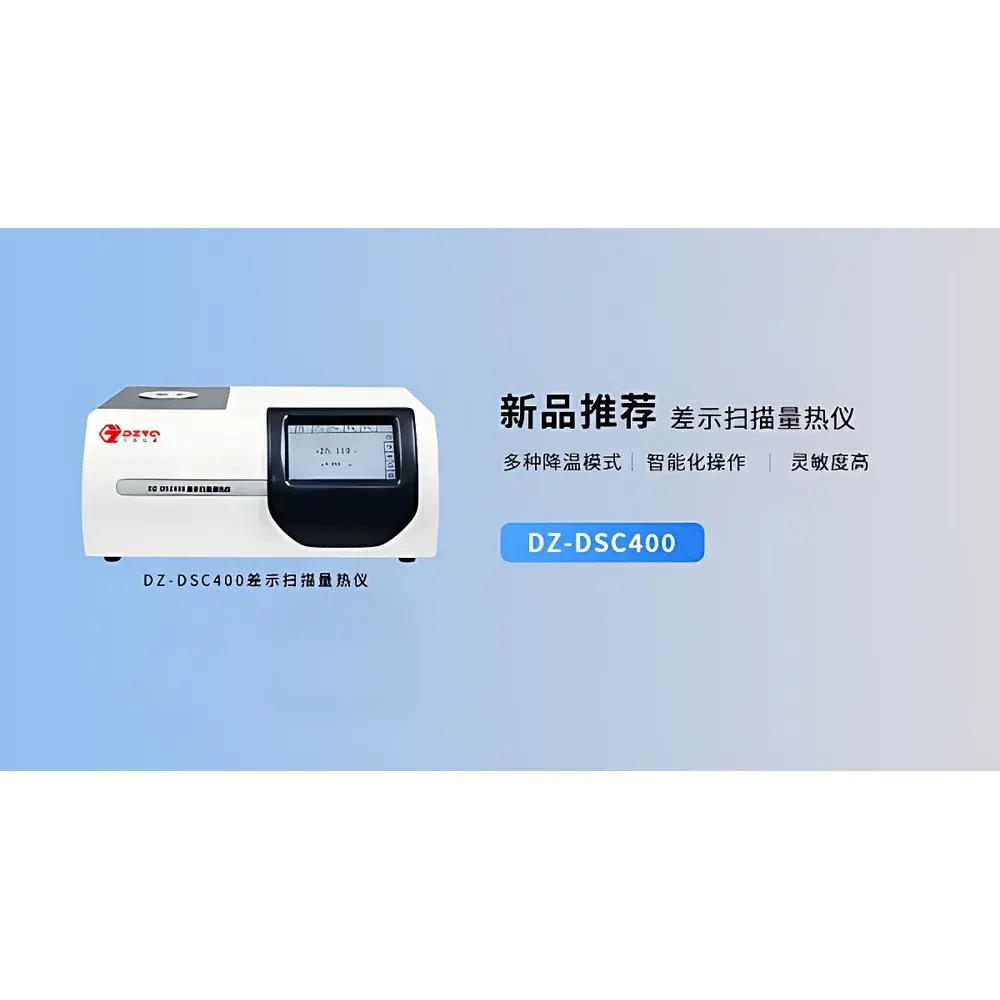
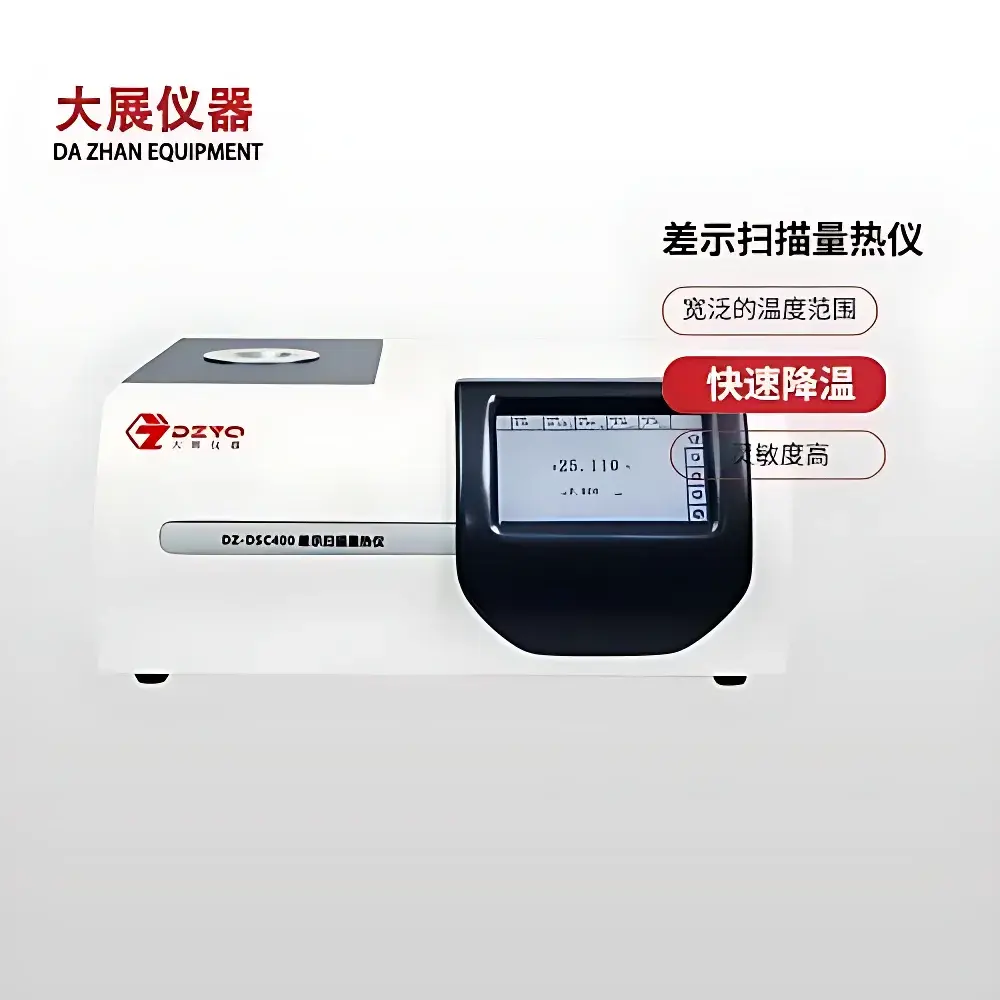
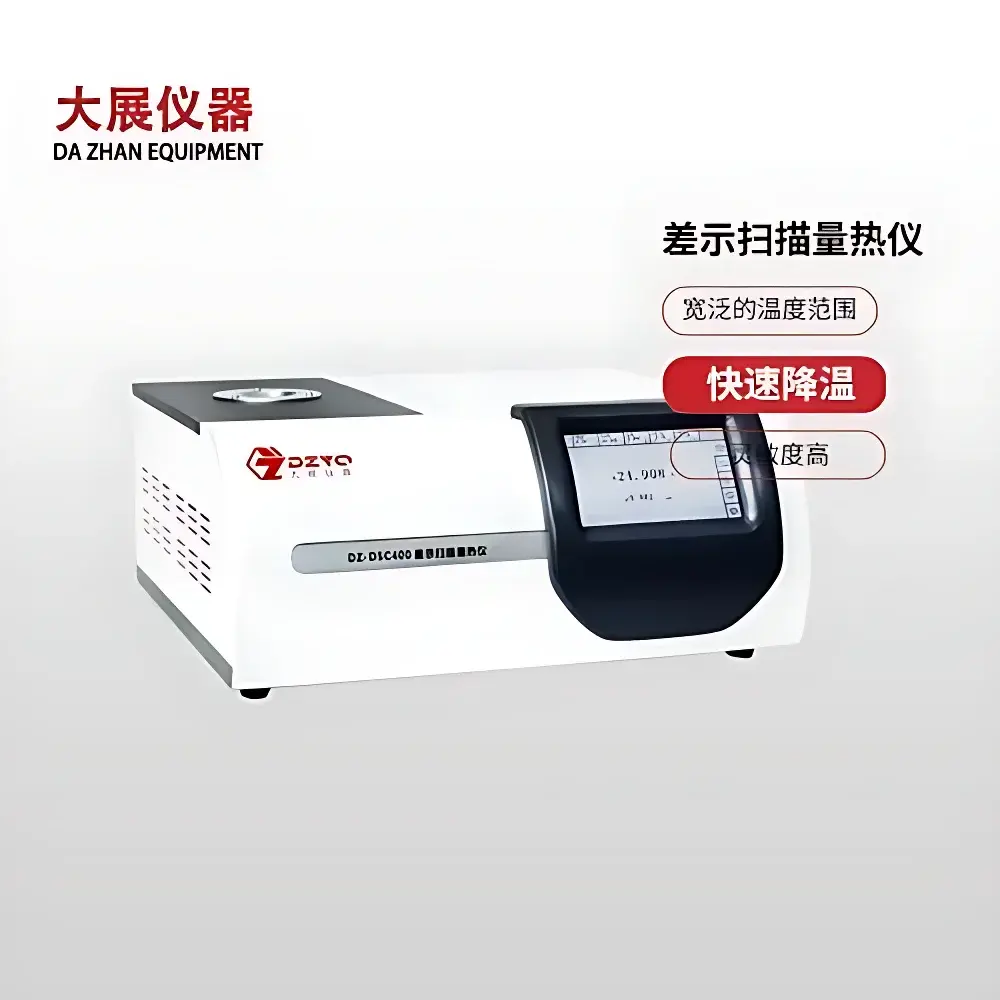
DZHAN DZ-DSC400 Differential Scanning Calorimeter
| Brand | DZHAN |
|---|---|
| Origin | Jiangsu, China |
| Model | DZ-DSC400 |
| Temperature Range | Ambient to 600 °C |
| DSC Measurement Range | ±800 mW |
| Temperature Accuracy | ±0.0001 °C |
| Temperature Precision | ±0.0001 °C |
| Heating Rate | 0.1–100 K/min |
| Cooling Rate | −0.1–20 K/min |
| Temperature Stability | ±0.1 °C |
| DSC Sensitivity | 0.0001 mW |
| Temperature Resolution | 0.001 °C |
| DSC Noise Level | 0.1 µW |
| Gas Flow Control | Dual-channel mass flow controller (0–200 mL/min), with auxiliary purge gas inlet |
| Cooling Options | Forced-air cooling (standard), optional Peltier and liquid nitrogen cooling modules |
Overview
The DZHAN DZ-DSC400 Differential Scanning Calorimeter is a high-performance thermal analysis instrument engineered for precision measurement of heat flow differences between a sample and inert reference as a function of temperature or time. Based on the heat-flux DSC principle, it employs a symmetric furnace design with indirect conductive heating—eliminating radiative pulsation and enhancing thermal uniformity across the sensor platform. This architecture delivers superior baseline stability, reduced thermal lag, and improved reproducibility in enthalpic measurements. Designed for routine and research-grade applications in polymer science, pharmaceutical development, materials engineering, and quality control laboratories, the DZ-DSC400 supports quantitative determination of glass transition temperature (Tg), melting point (Tm), crystallization onset and peak temperatures, enthalpy of fusion/crystallization, oxidative induction time (OIT), cure kinetics, and specific heat capacity (Cp). Its operational range spans from ambient to 600 °C, accommodating thermally robust inorganic compounds, high-performance polymers, and metal-organic frameworks without sensor degradation.
Key Features
- Optimized furnace architecture featuring dual-symmetric sensor plates and indirect conductive heating—minimizing thermal gradients and improving baseline flatness over extended scan durations.
- Multi-mode cooling system: standard forced-air cooling supplemented by optional Peltier and liquid nitrogen modules, enabling programmable cooling rates up to 20 K/min and sub-ambient operation down to −50 °C (with LN2).
- High-resolution thermal sensing with 0.0001 mW DSC sensitivity and 0.1 µW noise floor, supporting detection of subtle thermal events in low-mass or low-enthalpy samples.
- Dual independent mass flow controllers (MFCs) for precise, automated switching between reactive (e.g., O2, N2) and inert (e.g., Ar, He) atmospheres; third dedicated purge line ensures consistent crucible environment during dynamic scans.
- Intelligent PID temperature control integrated with adaptive self-tuning algorithms—combining dynamic response and static stability to maintain ±0.0001 °C accuracy across ramp, hold, and step-isothermal segments.
- Corrosion-resistant, EMI-shielded sensor assembly with enhanced long-term drift stability—validated over >5,000 thermal cycles under GLP-compliant usage conditions.
Sample Compatibility & Compliance
The DZ-DSC400 accommodates standard aluminum, gold-plated aluminum, and high-temperature ceramic crucibles (up to 600 °C), supporting solid powders, films, granules, gels, and small-volume liquids (≤30 mg). It complies with ISO 11357 series (Plastics — Differential Scanning Calorimetry), ASTM E794 (Melting and Crystallization Temperatures), ASTM E1269 (Heat Capacity), and USP (Thermal Analysis in Pharmaceutical Development). All measurement protocols align with GB/T 19466.1–4 (Chinese national standards for DSC), ensuring regulatory acceptability in APAC markets. Data integrity meets FDA 21 CFR Part 11 requirements via audit-trail-enabled software with electronic signatures, role-based access control, and immutable raw-data archiving.
Software & Data Management
The proprietary DSCAnalysis Suite provides intuitive workflow-driven operation—from method setup and real-time visualization to multi-step data deconvolution and comparative kinetic modeling (e.g., Ozawa-Flynn-Wall, Kissinger). Raw thermograms are stored in vendor-neutral ASCII format with full metadata embedding (instrument ID, operator, calibration history, gas composition, ramp rate). Batch processing supports automated peak integration, baseline correction (tangent, linear, polynomial), Tg inflection analysis per ASTM E1356, and OIT calculation per ASTM D3895. Export options include CSV, PDF reports with embedded calibration certificates, and direct import into MATLAB, Origin, or Thermo Scientific™ OMNIC™ platforms.
Applications
- Polymer characterization: quantification of Tg, degree of crystallinity, cold crystallization behavior, and thermal aging effects in polyolefins, polyesters, and biodegradable plastics.
- Pharmaceutical solid-state analysis: polymorph screening, amorphous content estimation, excipient compatibility studies, and stability-indicating assays under ICH Q1A–Q5C guidelines.
- Materials R&D: evaluation of phase transitions in shape-memory alloys, latent heat storage media, and battery electrode materials (e.g., LiCoO2 decomposition onset).
- Quality assurance: batch-to-batch consistency verification of resins, adhesives, and composites using enthalpy ratio metrics and peak shape parameters.
- Food science: determination of fat crystallization profiles, starch gelatinization enthalpies, and moisture-induced glass transitions in dried matrices.
FAQ
What cooling methods are supported, and what is the lowest achievable temperature?
The DZ-DSC400 includes standard forced-air cooling (down to ambient). Optional Peltier and liquid nitrogen cooling modules extend the lower limit to −50 °C and −120 °C respectively.
Is the instrument compliant with 21 CFR Part 11 for regulated environments?
Yes—when operated with the validated DSCAnalysis Suite v3.2+, it provides full electronic signature support, audit trails, and data encryption meeting FDA requirements for GxP workflows.
Can the system perform heat capacity (Cp) measurements?
Yes—using the ASTM E1269 three-step method (empty pan, sapphire standard, sample), with automatic Cp calculation and uncertainty propagation reporting.
What crucible types are compatible, and what is the maximum sample mass?
Standard 40 µL aluminum pans (hermetic or vented), gold-coated variants, and alumina crucibles (for >400 °C). Maximum recommended mass is 30 mg for optimal signal-to-noise ratio and thermal equilibration.
Does the software support kinetic modeling of curing or decomposition reactions?
Yes—built-in isoconversional analysis (Friedman, Ozawa-Flynn-Wall) and model-fitting tools (n-order, autocatalytic) enable activation energy and reaction mechanism assessment from multi-heating-rate data.
Related Products



