
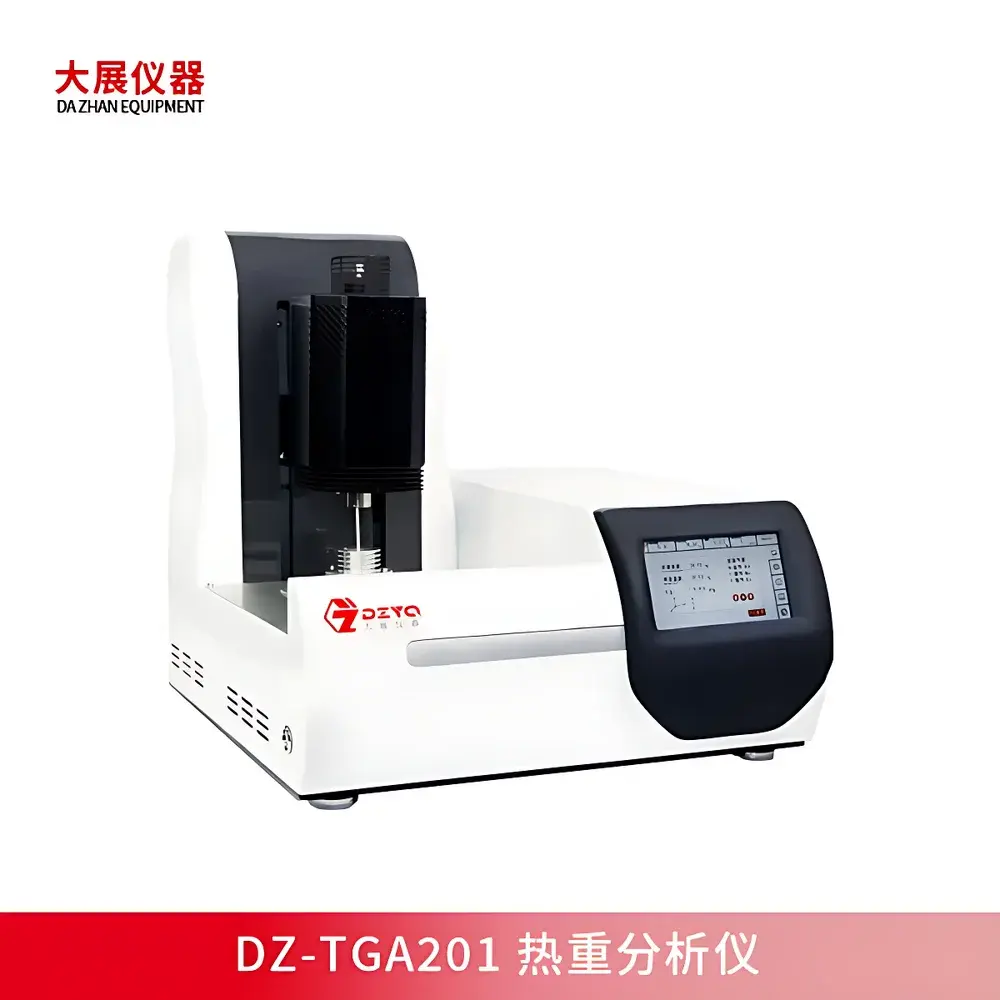
DZHAN DZ-TGA201 Automated Elevating Thermogravimetric Analyzer
| Brand | DZHAN |
|---|---|
| Origin | Jiangsu, China |
| Manufacturer Type | Authorized Distributor |
| Regional Classification | Domestic (China) |
| Model | DZ-TGA201 |
| Structural Design | Top-loading (elevating furnace) |
| Operating Environment | Ambient pressure |
| Sample Capacity | Single sample |
| Instrument Class | General-purpose TGA |
| Temperature Range | Ambient to 1250 °C |
| Temperature Resolution | 0.1 °C |
| Temperature Stability | ±0.01 °C |
| Heating/Cooling Rate | 0.1–100 °C/min |
| Dynamic Weighing Range | 0.01 mg to 3 g (extendable to 50 g) |
| Balance Sensitivity | 1 µg |
| Mass Accuracy | ±1 µg |
| Mass Repeatability | ±1 µg |
| Maximum Sample Mass | 50 g |
| Atmosphere Control | Triple-gas mass flow control (inert, oxidative, reducing) |
| Cooling Time | ≤20 min (1000 °C → 50 °C) |
| Temperature Control Algorithm | Adaptive PID with self-tuning and memory-based multi-segment programming |
| Exhaust Interface | Dedicated outlet for coupling with FTIR, MS, or GC-MS |
Overview
The DZHAN DZ-TGA201 is a precision-engineered, automated elevating thermogravimetric analyzer designed for rigorous thermal stability, decomposition kinetics, compositional quantification, and reaction pathway analysis across academic, industrial, and regulatory laboratories. It operates on the fundamental principle of thermogravimetry—measuring real-time mass change of a solid or liquid sample as a function of controlled temperature or time under defined atmospheric conditions. The instrument integrates a high-stability microbalance with a vertically actuated platinum-rhodium alloy furnace, enabling rapid thermal equilibration, minimized thermal lag, and exceptional signal-to-noise ratio in mass detection. Its dual-layer insulated furnace architecture, combined with physically isolated power supply and forced-air cooling modules, ensures mechanical and thermal decoupling between the weighing system and heat source—critical for achieving sub-microgram mass resolution (<1 µg) and long-term baseline stability during extended dynamic runs.
Key Features
- Automated furnace elevation mechanism: Enables safe, reproducible sample loading/unloading without manual handling near hot zones; reduces operator exposure and improves throughput.
- Platinum-rhodium (Pt/Rh) dual-wound heating element: Delivers uniform radial temperature distribution up to 1250 °C, minimizes electromagnetic interference, and extends service life under cyclic thermal stress.
- Dual-stage thermal insulation: Optimized ceramic fiber + reflective foil configuration enhances temperature linearity and reduces axial thermal gradients across the crucible zone.
- Modular thermal management: Separate power supply, air-cooling unit, and vibration-isolated base minimize mechanical drift and thermal crosstalk into the microbalance assembly.
- Triple-channel mass flow controller (MFC): Supports independent, programmable delivery of inert (N₂, Ar), oxidative (air, O₂), or reducing (H₂, CO) atmospheres—enabling oxidation-reduction studies, pyrolysis under controlled partial pressures, and evolved gas analysis (EGA) compatibility.
- Integrated exhaust port: Standard 6-mm stainless-steel outlet facilitates direct coupling with Fourier-transform infrared (FTIR), quadrupole mass spectrometry (QMS), or gas chromatography–mass spectrometry (GC-MS) systems for real-time evolved gas identification.
Sample Compatibility & Compliance
The DZ-TGA201 accommodates standard alumina, platinum, or graphite crucibles (typically 70–100 µL volume) and supports solids, powders, fibers, thin films, and viscous liquids. Its single-sample configuration ensures unambiguous thermal history tracking and eliminates cross-contamination risks inherent in multi-position systems. The instrument complies with core methodology standards referenced in ASTM E1131, ISO 11358-1, and USP , and its hardware/software architecture supports GLP/GMP-aligned workflows—including user access levels, electronic signatures, and audit-trail-enabled data logging. While not pre-certified for FDA 21 CFR Part 11, the system’s data integrity framework (timestamped raw files, metadata-rich .tga export, and non-erasable operation logs) enables straightforward validation for regulated environments.
Software & Data Management
The DZ-TGA201 is operated via DZHAN’s proprietary TGAControl Suite—a Windows-based application supporting full instrument control, method development, real-time visualization, and post-run kinetic analysis. Users define multi-step temperature programs (ramp/hold/cool cycles), set gas switching sequences synchronized with thermal events, and configure automatic baseline correction routines. Raw data are stored in vendor-neutral ASCII format (.txt) and native binary (.tga), both embedding full metadata (operator ID, calibration timestamps, atmosphere settings, furnace position status). Kinetic modules include Ozawa-Flynn-Wall, Kissinger, and Friedman methods for activation energy estimation; derivative thermogravimetry (DTG) curves are computed with adjustable smoothing kernels. All reports generate PDF output with embedded trace plots, annotated event markers, and customizable headers compliant with internal QA documentation requirements.
Applications
- Quantitative residue analysis in polymer composites and filled elastomers (e.g., carbon black, silica, CaCO₃ content determination).
- Thermal degradation profiling of pharmaceutical active ingredients and excipients under ICH Q1A(R3) stress conditions.
- Oxidative induction time (OIT) measurement per ASTM D3895 for polyolefin stabilization assessment.
- Decomposition onset temperature (Td) and char yield evaluation in battery cathode materials (e.g., NMC, LFP) under N₂ and air.
- Moisture/volatile loss quantification in catalysts, zeolites, and metal–organic frameworks (MOFs).
- Reaction stoichiometry validation in solid-state synthesis (e.g., carbonate decomposition, hydroxide dehydration, nitrate reduction).
FAQ
What is the maximum operating temperature and certified accuracy at high end?
The DZ-TGA201 is rated for continuous operation up to 1250 °C. Temperature accuracy is validated per DIN 51007 at ±0.5 °C at 1000 °C using calibrated Pt/Pt–10%Rh thermocouples traceable to NIST standards.
Can the balance be recalibrated in situ without disassembly?
Yes—the system includes internal reference weight compensation and supports two-point linear calibration (zero and span) directly from the software interface, with verification logs automatically archived.
Is the instrument compatible with purge gas humidification for controlled humidity TGA?
While the standard triple-MFC does not include integrated humidity generation, the exhaust and inlet ports support external vapor-saturation modules (e.g., VTI HumiGas™ or Setaram RH-Control) via custom manifold integration.
How is thermal lag compensated during fast ramping?
The adaptive PID algorithm incorporates dynamic thermal inertia modeling based on real-time furnace thermocouple feedback and historical ramp performance, adjusting power delivery to maintain programmed rate within ±1% deviation above 100 °C.
Does the software support ASTM-compliant report generation out-of-the-box?
Preconfigured report templates align with ASTM E1131 Annex A1 (data presentation) and include mandatory fields: sample ID, crucible type/mass, atmosphere composition, heating rate, and derivative peak annotations—with optional inclusion of statistical uncertainty bands for mass loss steps.
Related Products



