
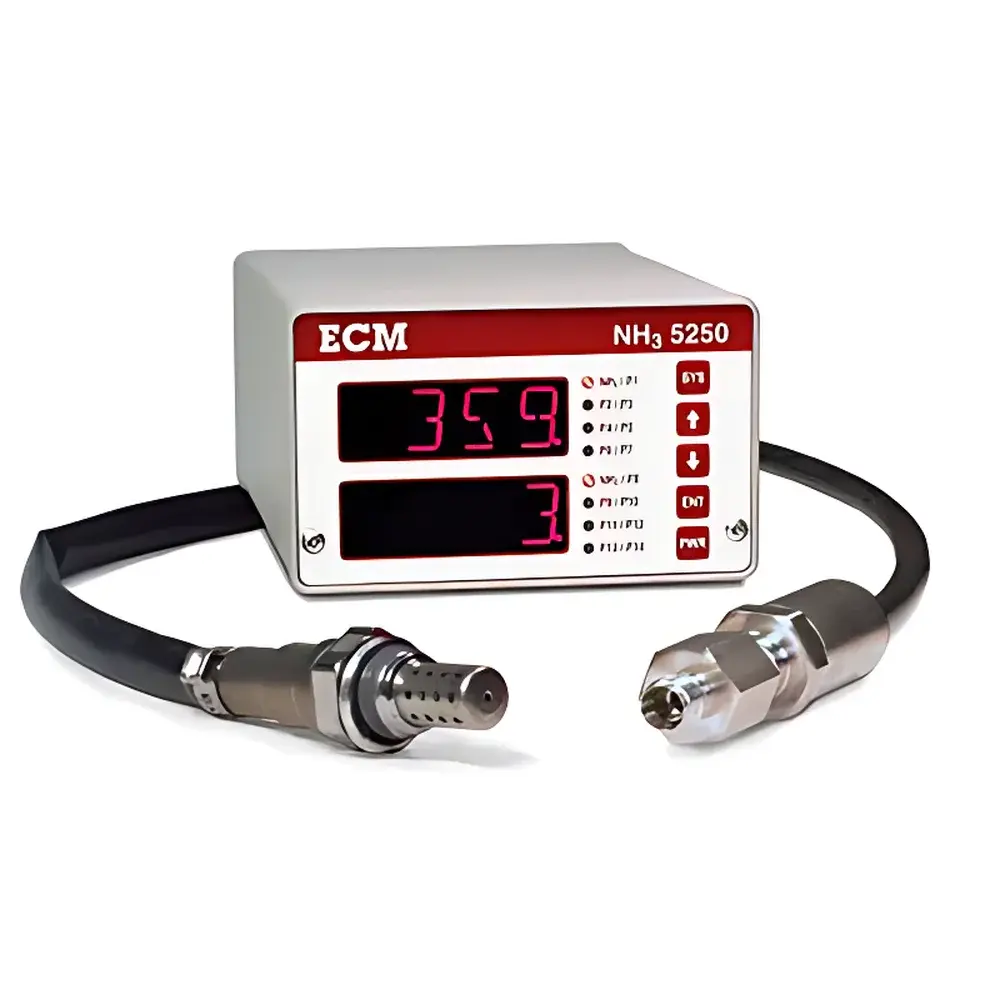
ECM NH3 5250 Fast Ammonia Analyzer
| Brand | ECM |
|---|---|
| Origin | USA |
| Model | NH3 5250 |
| Detection Principle | Electrochemical |
| Measurement Range | 0–2000 ppm NH₃ (λ > 1 only) |
| Pressure Range | 0–517 kPa (0–75 psia) |
| Accuracy | ±5 ppm NH₃ (0–200 ppm), ±5.2 kPa pressure |
| Response Time | <1 s |
| Analog Outputs | Six 0–5 V linearized channels |
| Communication Interfaces | High-speed CAN (configurable protocol), USB, RS232 |
| Power Supply | 11–28 VDC |
| Sensor Thread | M18×1.5 |
| Dimensions (H×W×D) | 64 mm × 105 mm × 165 mm |
| Weight | 676 g (main unit), 244 g (sensor module) |
| Operating Temperature | −40 to +85 °C (electronics), up to 450 °C (sensor tip) |
| Optional Accessories | Dual-channel NH₃ module, pressure compensation kit, mounting bracket, calibration tool, NH₃ sensor simulator, extended cable (up to 100 m), AC/DC adapter |
Overview
The ECM NH3 5250 Fast Ammonia Analyzer is a purpose-built, electrochemical-based real-time gas analyzer engineered for high-fidelity NH₃ monitoring in diesel and lean-burn engine exhaust streams—specifically within Selective Catalytic Reduction (SCR) aftertreatment systems. Unlike extractive sampling analyzers requiring heated sample lines, pumps, and conditioning systems, the NH3 5250 employs a direct-mount, high-temperature ceramic electrochemical sensor installed directly into the exhaust pipe. This in-situ configuration eliminates transport delay and condensation artifacts, delivering sub-second response times (<1 s T₉₀) critical for closed-loop urea dosing control during transient engine operation. The sensor’s integrated micro-heater and robust zirconia-based sensing element operate continuously at up to 450 °C, ensuring stable performance under aggressive thermal cycling and particulate-laden exhaust environments. Designed for both engine test bench and on-vehicle deployment, the NH3 5250 meets the stringent demands of R&D engineers validating SCR control algorithms, optimizing NH₃ slip mitigation strategies, and supporting regulatory compliance testing per EPA Tier 4, Euro VI, and China VI standards.
Key Features
- In-situ measurement via M18×1.5 threaded ceramic electrochemical sensor—no sample pump, no heated line, no gas conditioning required
- Real-time response time <1 second (T₉₀), enabling dynamic feedback control of urea injection in transient engine cycles
- Dual-channel capability available: supports simultaneous measurement from two independent NH₃ sensors with synchronized output
- Embedded calibration memory: all zero/span calibration data stored onboard the sensor connector’s EEPROM—no host reprogramming needed
- Full sensor diagnostics accessible in real time: sensor voltage, internal resistance, heater voltage, and temperature reported via digital interface
- Integrated pressure compensation option (optional kit) corrects NH₃ readings for exhaust backpressure up to 517 kPa (75 psia)
- Automotive-grade power management: auto-on/auto-off triggered by ignition-switch signal (12/24 V vehicle bus compatible)
- Six isolated 0–5 V analog outputs with user-defined scaling—each channel independently configurable for NH₃, pressure, or diagnostic parameters
Sample Compatibility & Compliance
The NH3 5250 is validated for continuous operation in raw diesel and natural gas engine exhaust containing water vapor, CO₂, NOₓ, SO₂ (≤50 ppm), and particulate matter—without filter degradation or cross-sensitivity interference. Its ceramic sensor architecture exhibits minimal drift in λ > 1 (oxygen-rich) exhaust conditions, aligning with typical SCR operating windows. The analyzer complies with CE marking requirements for electromagnetic compatibility (EN 61326-1) and environmental robustness (EN 60068-2 series). While not certified as intrinsic safety (ATEX/IECEx), its design satisfies functional safety considerations for non-hazardous zone installation (e.g., engine bay, dyno cell, or tailpipe mounting). Data integrity adheres to GLP-aligned practices: all calibrations are timestamped and traceable; audit logs (via USB/RS232) record operator ID, calibration values, and system status—supporting 21 CFR Part 11 readiness when paired with validated lab software.
Software & Data Management
The NH3 5250 communicates natively via high-speed CAN 2.0B (ISO 11898-2), with configurable message IDs, baud rates (125 kbps to 1 Mbps), and data frame structure—including support for J1939 PGNs upon request. USB and RS232 interfaces provide bidirectional access for firmware updates, real-time parameter readout, and raw sensor diagnostics using ECM’s PC-based configuration utility (Windows/Linux compatible). All six analog outputs are fully linearized and temperature-compensated internally—no external signal conditioning required. Output scaling is programmable per channel (e.g., 0–2000 ppm NH₃ → 0–5 V; 0–517 kPa → 0–5 V). Timestamped binary data logging is supported over USB at up to 100 Hz, formatted for direct import into MATLAB, LabVIEW, or ETAS INCA. Optional CAN database (.dbc) files enable seamless integration into automotive HIL and SIL validation environments.
Applications
- SCR system development: real-time NH₃ slip quantification during cold-start, load-step, and ramp-cycle testing
- Urea dosing algorithm validation: correlation of injector pulse width, exhaust temperature, and measured NH₃ concentration
- Aftertreatment durability studies: long-term sensor stability assessment under accelerated aging protocols
- On-vehicle OBD-II supplemental monitoring: NH₃ slip detection for future regulatory reporting frameworks
- Stationary power generation: NH₃ monitoring in dual-fuel (diesel/natural gas) generator exhaust
- Emissions certification support: supplementary NH₃ data acquisition aligned with FTP, WHSC, or RMC test cycles
FAQ
Is the NH3 5250 suitable for measuring NH₃ in rich (λ < 1) exhaust conditions?
No. The electrochemical sensor requires oxygen for stable operation and is specified for use only in λ > 1 exhaust environments—consistent with standard SCR operating conditions.
Can the sensor be cleaned or regenerated in-field?
The ceramic sensor is not serviceable or cleanable by end users. Exposure to oil mist, heavy soot loading, or sulfur concentrations exceeding 50 ppm may cause irreversible sensitivity loss; periodic replacement per maintenance schedule is recommended.
Does the 100-meter cable option affect measurement accuracy or latency?
No. The sensor-to-host communication uses shielded twisted-pair with active signal conditioning; full accuracy and <1 s response are maintained across the entire 100 m range.
What calibration gases are required for field span adjustment?
A certified 100 ppm NH₃/N₂ standard (±2% uncertainty) is recommended for span verification; zero air (hydrocarbon-free, <0.1 ppm NH₃) is used for zero calibration—both traceable to NIST standards.
Is pressure compensation mandatory for all applications?
Pressure compensation is optional but strongly advised for engines with peak exhaust backpressure >100 kPa (e.g., turbocharged diesels, EGR-rich operation), as uncorrected pressure variation introduces measurable NH₃ partial pressure error.







