
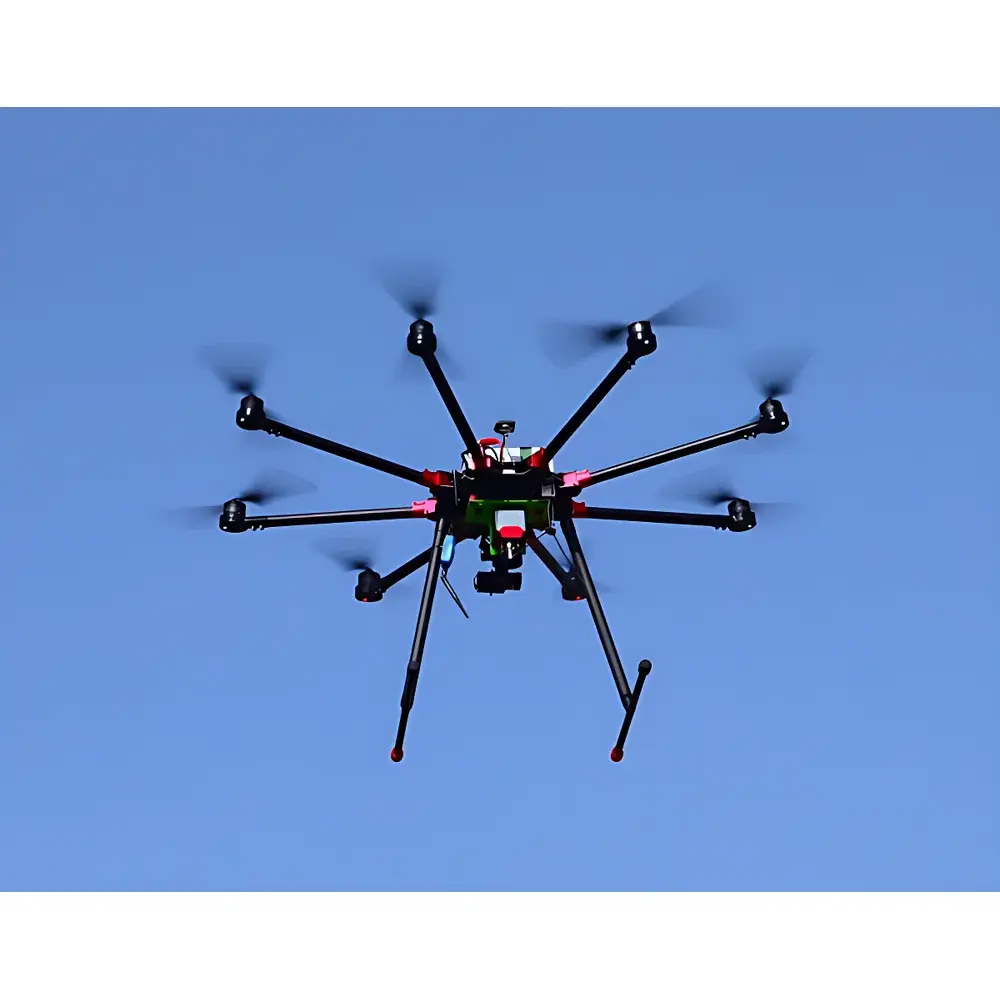
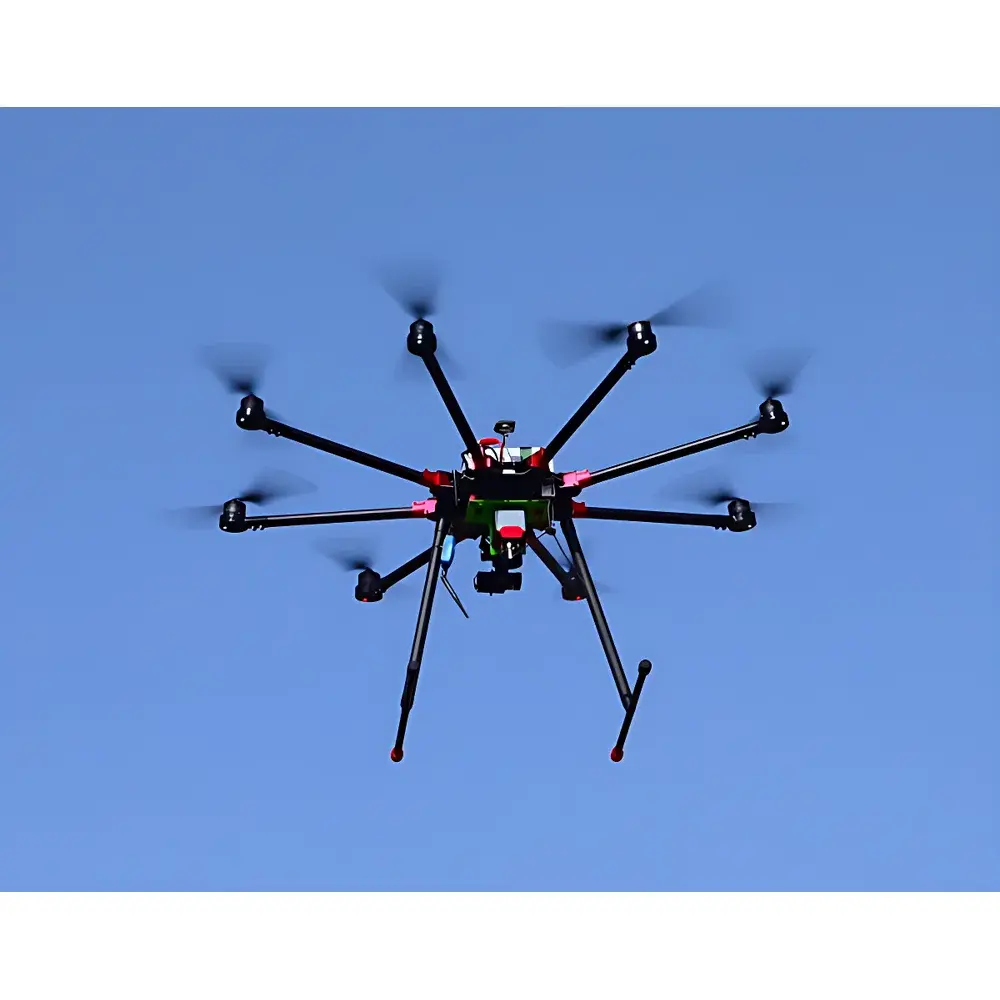
Ecodrone® UAS-8 Forest Fire Early Warning and Thermal Surveillance UAV System
| Origin | Beijing, China |
|---|---|
| Manufacturer Type | Authorized Distributor |
| Origin Category | Domestic (PRC) |
| Model | Ecodrone® UAS-8 UAV Platform |
| Quotation | Upon Request |
| Payload Capacity | ≥5000 g |
| Max Takeoff Weight | ≥15000 g |
| Empty Weight | ≤5000 g |
| Rotor Span (Symmetrical) | 1200 mm |
| Hover Time (No Payload) | ≥50 min |
| Operational Flight Time (with Multispectral Sensor) | 30 min |
| Cruise Speed | 10 m/s |
| GNSS Support | Dual-band GPS/BeiDou |
| Positioning Accuracy | 1 cm (Barometric + GNSS Altitude Hold) |
| RGB Camera | 4K @ 30 FPS, 16 MP, f/2.8, 120° HFOV (optional 82° low-distortion lens) |
| Remote Control | Dual-antenna, 2.400–2.483 GHz DSSS, 16/32 channels, FCC EIRP 100 dBm, max control range 2.7 km (7 km with extended-range mode) |
| FPV Transmission | Dual-path analog + digital 5.8 GHz, 1080p real-time streaming (visible + thermal), 5 km range, 1920×1080 display resolution |
| Data Telemetry | Real-time transmission of latitude/longitude, altitude, ambient temperature/humidity, solar radiation, ground surface temperature |
| Ground Station | Ruggedized laptop in portable case, multi-map support (Google/Bing/AMap), mission planning, telemetry logging, Follow-Me mode |
| Battery | 22000 mAh LiPo, dual-channel charger (12 A, 1400 W max) |
| Thermal Imager | GIS-320, 320×240 InSb FPA, spectral band 3.2–3.4 μm, NETD ≤15 mK, frame rate 30 Hz, auto/manual focus, 1–8× motorized zoom, temperature ranges selectable: −25°C to 150°C / −40°C to 550°C / 400°C to 1500°C |
| Visible Camera (co-mounted) | 1280×960, 14× digital zoom, auto-focus |
| Video Output | 720p via mini-HDMI |
| Storage | Internal 64 GB SD card |
| Radiometric Formats | Radiometric JPEG, non-radiometric JPEG, synchronized IR+RGB video (30 Hz) |
| Gas Detection Capability | Benzene, ethanol, toluene, xylene isomers, methane, propane, ethylene, propylene, methanol, MEK, MIBK, hexane, heptane, octane, pentane, 1-pentene, isoprene, butane, ethylbenzene, etc. |
| Power Input | 12–19 VDC |
| Dimensions (GIS-320) | 257×117×126 mm |
| Weight (GIS-320) | <1.7 kg |
Overview
The Ecodrone® UAS-8 Forest Fire Early Warning and Thermal Surveillance UAV System is an integrated aerial remote sensing platform engineered for precision wildfire risk assessment, real-time fire detection, and post-ignition incident response in complex forested and mountainous terrain. Built upon a robust rotary-wing unmanned aerial vehicle architecture, the system combines high-fidelity thermal infrared imaging with synchronized visible-spectrum acquisition, georeferenced telemetry, and automated flight operations to deliver actionable intelligence under operational constraints typical of forestry management and emergency response scenarios. Its core measurement principle relies on mid-wave infrared (MWIR) radiometry—specifically calibrated InSb focal plane array detection within the 3.2–3.4 μm atmospheric transmission window—to resolve sub-degree thermal anomalies associated with smoldering combustion, latent ignition sources, and early-stage smoke plume development. Unlike passive optical surveillance, this MWIR capability enables reliable detection through obscurants such as light canopy cover, haze, or low-contrast daylight conditions—critical advantages where conventional manned patrols or fixed-sensor networks exhibit spatial or temporal limitations.
Key Features
- Heavy-lift UAV platform (≥15 kg MTOW) with modular sensor integration architecture supporting concurrent deployment of thermal infrared, multispectral, hyperspectral, LiDAR, and RGB payloads
- High-stability flight control system featuring dual GNSS (GPS + BeiDou), centimeter-level altitude hold (barometric + GNSS fusion), and fail-safe protocols including automatic return-to-home, low-voltage cutoff, and RF interference mitigation
- Real-time dual-stream FPV telemetry: simultaneous 1080p digital transmission of co-registered thermal and visible imagery over 5.8 GHz band, enabling live situational awareness without latency-induced decision lag
- Onboard radiometric data acquisition with full-frame thermal video (30 Hz), embedded GPS tagging (MavLink/serial), and synchronized environmental metadata (ambient T/RH, solar irradiance, surface temperature)
- GIS-320 thermal imager with 320×240 InSb detector, NETD ≤15 mK, motorized 1–8× zoom, and field-selectable calibration ranges (−40°C to 550°C standard; optional high-temp variants up to 1500°C)
- Integrated gas identification algorithm suite leveraging spectral absorption signatures across C–H and O–H vibrational bands, validated against ASTM D6645 and ISO 16000-23 reference methodologies for volatile organic compound (VOC) screening
- Portable ground station with offline-capable mission planning software, multi-basemap support (including topographic layers), automated log export, and Follow-Me tracking functionality
Sample Compatibility & Compliance
The Ecodrone® UAS-8 system is designed for unattended operation across diverse ecological zones—including boreal, temperate deciduous, subtropical evergreen, and arid-steppe forest ecosystems—without requiring site-specific recalibration. Its thermal payload meets IEC 62906-3-2:2019 requirements for airborne infrared thermography systems used in environmental hazard monitoring. Radiometric calibration traceability aligns with NIST SRM 1901b standards via factory-certified blackbody validation. All telemetry and image metadata comply with EXIF 2.31 and GeoTIFF 1.1 specifications, ensuring interoperability with ESRI ArcGIS, QGIS, and ENVI processing workflows. The platform adheres to CAAC Part 91 and EASA UAS Regulation (EU) 2019/947 operational frameworks for BVLOS-capable Class C2 drones conducting safety-critical missions. Data integrity protocols satisfy GLP-compliant audit trail requirements per ISO/IEC 17025:2017 Annex A.2.10 for environmental monitoring instrumentation.
Software & Data Management
Flight planning, real-time telemetry visualization, and post-mission analytics are unified within the proprietary EcoFlight Mission Suite—a Windows-based application supporting ISO 19115-compliant metadata embedding, orthomosaic generation (via SfM photogrammetry engine), and time-series thermal anomaly clustering. Raw radiometric datasets are stored in vendor-neutral HDF5 format with embedded calibration coefficients and sensor pose parameters (pitch/yaw/roll, GPS timestamp, IMU quaternion). Thermal video exports include embedded radiance maps compliant with ASTM E1933-19 Annex A1 for quantitative temperature profiling. Smoke dispersion modeling leverages OpenFOAM-based CFD modules preconfigured for near-surface turbulent flow regimes, accepting boundary conditions from onboard meteorological sensors. All processed outputs generate PDF reports conforming to NFPA 901 fire incident documentation standards, including georeferenced hotspot coordinates, thermal gradient overlays, and VOC concentration heatmaps.
Applications
- Pre-emptive wildfire risk mapping via diurnal surface temperature differentials and moisture deficit indexing using thermal inertia analysis
- Real-time smoke plume tracking and source localization using spatiotemporal centroid drift algorithms applied to thermal sequence stacks
- Post-fire burn severity assessment via normalized burn ratio (NBR) derivation from co-acquired multispectral and thermal bands
- Forest health diagnostics including drought stress detection (via canopy temperature depression metrics), pest infestation early warning (through microthermal signature deviations), and invasive species boundary delineation
- Industrial perimeter monitoring for VOC leakage events at timber processing facilities, biofuel storage depots, and chemical transport corridors
- Integration into national forest service command-and-control infrastructure via MQTT/OPC UA gateways for automated alert dispatch to fire suppression units
FAQ
Does the GIS-320 thermal camera support quantitative temperature measurement?
Yes—the GIS-320 delivers fully radiometric output with NIST-traceable calibration. Each pixel encodes absolute radiance values convertible to object temperature using Planck’s law, with accuracy specified per selected range (e.g., ±2°C for −40°C to 550°C range).
Can the system operate beyond visual line of sight (BVLOS)?
The UAS-8 platform meets EASA Class C2 technical prerequisites for BVLOS operations; however, regulatory authorization must be obtained from the local aviation authority prior to deployment.
Is raw thermal data compatible with third-party analysis tools like MATLAB or Python?
All thermal video and stills are exported in HDF5 and TIFF formats with documented header structures, enabling direct ingestion into NumPy, SciPy, or ENVI-compatible toolchains without proprietary codec dependencies.
What maintenance intervals are recommended for long-term operational reliability?
Comprehensive inspection every 200 flight hours or annually (whichever occurs first), including IMU gyroscope recalibration, propeller balance verification, and thermal detector dewar vacuum integrity check per manufacturer service bulletin EC-UAS8-SV-2023-04.
How does the system handle GPS-denied environments such as deep canyons or dense forest understory?
The autopilot integrates visual-inertial odometry (VIO) fallback during GNSS outages, maintaining position hold within ±5 m horizontal error for up to 90 seconds using onboard stereo vision and MEMS IMU fusion.
Related Products







