
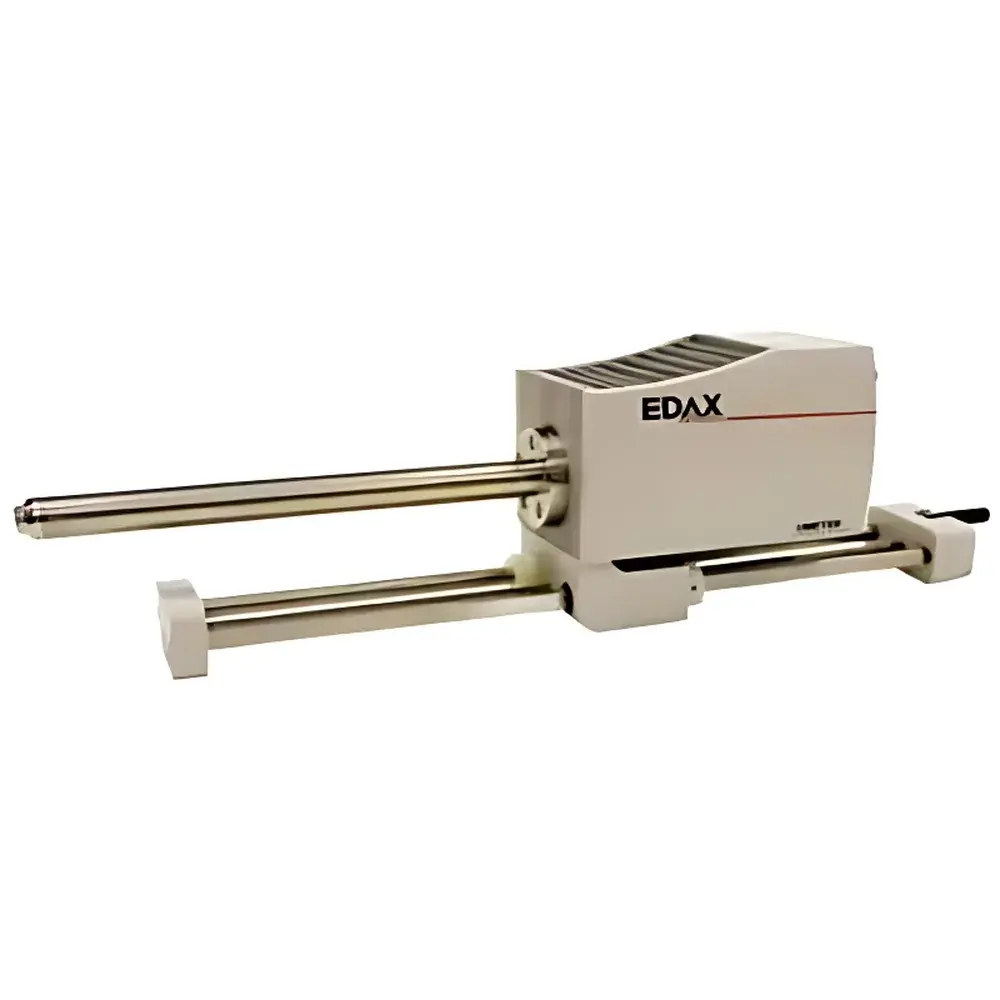
EDAX Genesis Apollo X/XL Energy Dispersive Spectrometer (EDS) for SEM
| Origin | USA |
|---|---|
| Manufacturer Type | Authorized Distributor |
| Origin Category | Imported |
| Model | Genesis Apollo X/XL |
| Price Range | USD 68,000 – 136,000 (based on FOB USD conversion) |
| Electron Source Compatibility | Tungsten Filament SEMs |
Overview
The EDAX Genesis Apollo X/XL Energy Dispersive Spectrometer (EDS) is a high-performance, silicon drift detector (SDD)-based microanalysis system engineered for precise elemental identification and quantification at the micro- to nanoscale. Designed for seamless integration with scanning electron microscopes (SEM), including tungsten-filament and field-emission instruments from JEOL, Thermo Fisher Scientific (formerly FEI), Hitachi, and SII NanoTechnology, the Apollo X/XL operates on the fundamental principle of energy-dispersive X-ray spectroscopy: incident electron beam excitation induces characteristic X-ray emission from sample atoms; these photons are collected and energy-resolved by the SDD detector to generate quantitative compositional maps and point spectra. As a core component of SEM-based materials characterization workflows, this EDS system delivers robust performance in routine QA/QC, failure analysis, geological petrography, metallurgical phase identification, and semiconductor process control—fully compliant with ASTM E1508, ISO 16574, and IEC 62239 standards for microanalysis.
Key Features
- Silicon Drift Detector (SDD) with selectable active areas: 10 mm² or 30 mm² — optimized for count-rate sensitivity and light-element detection (B–F)
- Energy resolution ≤127 eV at Mn Kα (100,000 cps input), maintained across wide dynamic range via integrated on-chip FET architecture
- DPP III Digital Pulse Processor: supports >1,000,000 cps maximum input count rate and 350,000 cps sustained output — enabling rapid mapping without spectral distortion
- Advanced lightweight-element optimization: enhanced low-energy response (<1 keV) through proprietary window design and detector geometry
- Intelligent Auto Time Constant selection: dynamically adjusts amplifier shaping time based on beam current, working distance, and detector load to preserve resolution at high throughput
Sample Compatibility & Compliance
The Genesis Apollo X/XL is compatible with all major SEM platforms operating under high vacuum, low vacuum (LV), and variable pressure (VP) modes. It supports standard bulk solids, polished cross-sections, thin films, powders, and coated/non-conductive specimens when paired with appropriate charge compensation (e.g., carbon sputtering or low-kV imaging). All hardware and firmware comply with CE, FCC Part 15, and RoHS directives. Software operation adheres to GLP/GMP data integrity requirements, including full audit trail logging, user access controls, and electronic signature support per FDA 21 CFR Part 11 when configured with TEAM™ EDS v6.5+.
Software & Data Management
Powered by TEAM™ EDS v6.5 software suite, the system provides an expert-guided analytical interface built upon decades of empirical spectral interpretation knowledge. Key modules include:
- EXpert ID™: A physics-informed peak identification engine that correlates spectral line intensities, relative energies, and transition probabilities — significantly improving accuracy for overlapping peaks (e.g., S Kα/Pb Mα, Ti Kβ/V Kα) and trace-level elements
- HPD (High-Precision Deconvolution): Enables accurate background subtraction and peak separation using iterative least-squares fitting
- SEC (Standardless Elemental Correction): Applies matrix correction algorithms (ZAF or φ(ρz)) for improved light-element quantification (C, N, O, F)
- ViP (Variable Pressure Correction): Compensates for X-ray absorption effects in low-vacuum SEM environments
- SnapShot Mode: Captures sequential spectra at user-defined time intervals to monitor beam-specimen interaction dynamics (e.g., contamination buildup, elemental migration)
All spectral data, maps, and reports are stored in vendor-neutral .eds and .map formats, exportable to CSV, TIFF, and HDF5 for third-party analysis or LIMS integration.
Applications
The Genesis Apollo X/XL serves as a primary tool in diverse industrial and academic domains:
- Materials Science: Phase constitution analysis in alloys, intermetallics, and composites; inclusion identification in steels and superalloys
- Electronics: Contamination screening on wafers, solder joint composition verification, and failure root-cause analysis of delamination or electromigration
- Geosciences: Mineral identification and stoichiometric modeling in polished thin sections and grain mounts
- Life Sciences: Elemental mapping of calcified tissues, metalloprotein localization, and nanoparticle uptake studies in biological TEM/SEM samples
- Forensics & Archaeology: Provenance determination of pigments, glass fragments, and corrosion products via trace-element fingerprinting
FAQ
Is the Genesis Apollo X/XL compatible with older tungsten-filament SEMs?
Yes — it is fully compatible with legacy SEM platforms using thermionic tungsten sources, including JEOL JSM series, Hitachi SU series, and Zeiss EVO models. Detector geometry and pulse processing are optimized for lower beam currents typical of filament-based systems.
What is the minimum detectable limit (MDL) for light elements such as oxygen or carbon?
Under optimal conditions (high beam current, short working distance, clean detector window), MDLs are approximately 0.1–0.2 wt% for C, N, and O using standard ZAF quantification; SEC-enhanced protocols can improve detection to ~0.05 wt% in homogeneous matrices.
Does the system support automated phase identification?
While the Apollo X/XL itself does not perform crystallographic phase ID, it integrates directly with EDAX’s OIM Analysis™ software for combined EDS + EBSD workflows, enabling correlative chemical and crystallographic phase mapping.
Can spectral data be exported for external multivariate analysis (e.g., PCA, clustering)?
Yes — raw spectrum files (.eds) contain full channel-by-channel intensity data with calibrated energy axis and live-time metadata, supporting import into Python (SciPy, PyMCA), MATLAB, or commercial chemometrics packages.
Is remote diagnostics and software update support available?
EDAX provides secure remote maintenance via TeamViewer-assisted sessions and quarterly firmware/software updates through the EDAX Customer Portal, requiring valid maintenance contract enrollment.





