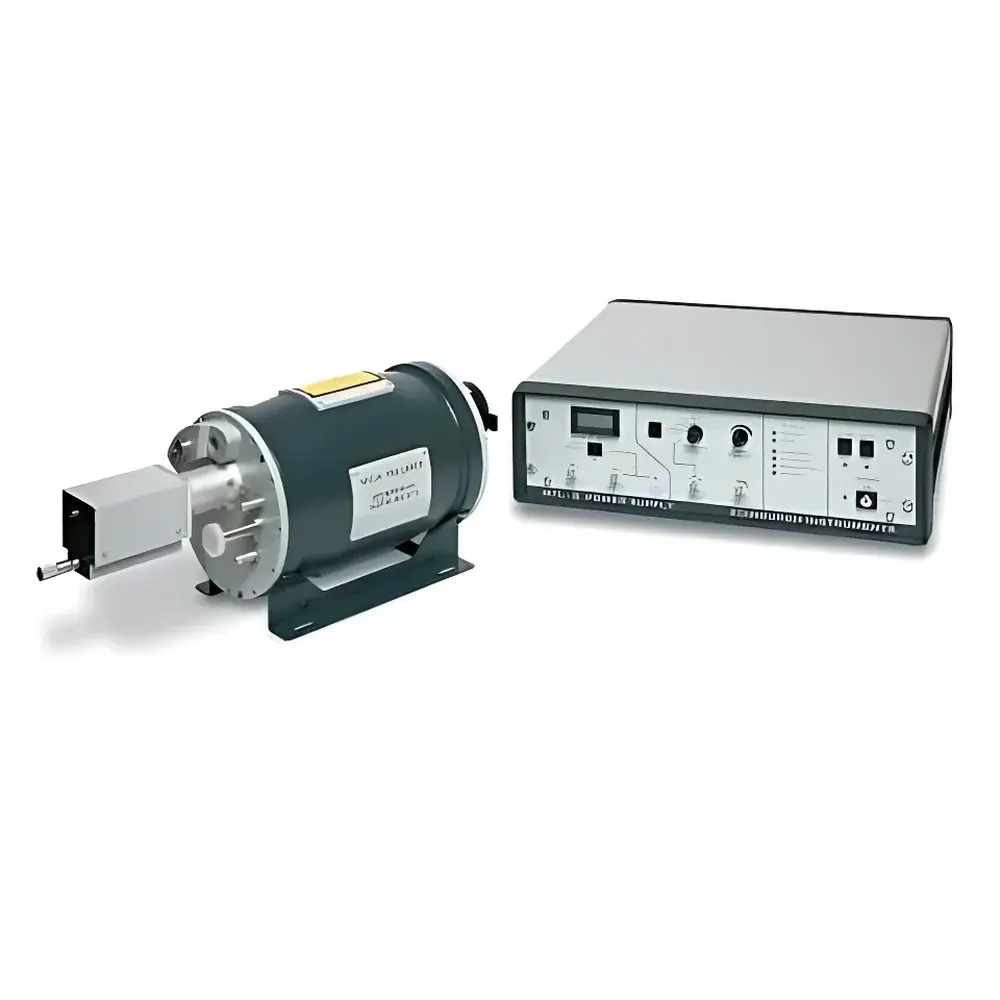
Edinburgh Instruments MTL-3 Compact Nanosecond TEA-CO₂ Laser
| Brand | Edinburgh Instruments |
|---|---|
| Origin | United Kingdom |
| Manufacturer Type | Authorized Distributor |
| Origin Category | Imported |
| Model | MTL-3 |
| Configuration | Sealed-off Gas Laser System |
| Pulse Width | Nanosecond-scale |
| Wavelength Range | 9.2–10.8 µm (60 discrete lines) |
| Repetition Rate | 1–100 Hz (standard), up to 2000 Hz (custom high-rep-rate variants) |
| Output Energy | Up to 150 mJ (multi-mode), TEM₀₀ option available |
| Max Custom Energy | 3.5 J (large-aperture TEA configuration) |
| Tuning Mechanism | Intracavity grating |
Overview
The Edinburgh Instruments MTL-3 is a compact, sealed-off transversely excited atmospheric-pressure (TEA) carbon dioxide laser engineered for high-stability nanosecond pulse generation in the mid-infrared spectral region. Operating on the fundamental vibrational–rotational transitions of CO₂, the MTL-3 delivers discrete-line output across 60 resolvable wavelengths from 9.2 to 10.8 µm—enabling precise spectroscopic targeting without external wavelength conversion. Its TEA architecture ensures efficient population inversion at near-atmospheric gas pressure, yielding short-duration pulses (typically 50–150 ns FWHM) with excellent temporal reproducibility and low jitter (< ±2 ns). Designed for integration into demanding laboratory and industrial platforms, the MTL-3 maintains consistent beam pointing stability (< 25 µrad) and spatial mode control, supporting both multi-mode operation for maximum energy extraction and optional TEM₀₀ Gaussian output for applications requiring diffraction-limited focusability.
Key Features
- Compact, air-cooled design with integrated high-voltage pulser and gas handling system—no external water chiller or vacuum pump required
- Sealed-tube configuration enabling >150 million shots lifetime with minimal gas replenishment; compatible with long-term unattended operation
- Grating-based intracavity wavelength selection with motorized drive and encoder feedback for repeatable line selection and automated spectral scanning
- Adjustable repetition rate from single-shot to 100 Hz (standard); custom high-repetition-rate versions support up to 2000 Hz with optimized thermal management
- Dual-output configuration available: primary beam path for high-energy delivery and auxiliary sampling port for real-time pulse energy monitoring
- Robust mechanical housing rated IP54, compliant with CE/UKCA electromagnetic compatibility and low-voltage directives
Sample Compatibility & Compliance
The MTL-3 is designed for use with standard CO₂:N₂:He gas mixtures and requires no consumable optics under normal operating conditions. Its 9–11 µm output is strongly absorbed by atmospheric H₂O and CO₂, making it suitable for controlled-environment applications including purged beamlines or vacuum chambers. The laser complies with IEC 60825-1:2014 Class 4 laser safety requirements, and includes interlocked shutter, emission indicator, and key-controlled enable circuitry. For regulated environments, firmware supports audit-trail logging (timestamped operation records) and configurable user access levels—facilitating alignment with GLP, ISO/IEC 17025, and FDA 21 CFR Part 11 data integrity expectations when integrated with validated control software.
Software & Data Management
Control is executed via Edinburgh Instruments’ LaserCommander™ GUI (Windows-based), offering full remote configuration of repetition rate, wavelength selection, pulse delay, and internal diagnostics. The application programming interface (API) provides native support for MATLAB, Python (PySerial/PyVISA), and LabVIEW, enabling synchronized triggering with oscilloscopes, spectrometers, or time-resolved detectors. All operational parameters—including shot count, cumulative energy, gas pressure trend, and HV supply status—are logged in HDF5 format with embedded metadata (ISO 8601 timestamps, instrument ID, calibration version). Export options include CSV, ASCII, and direct database push to SQL-compatible repositories for LIMS integration.
Applications
- Laser-induced breakdown spectroscopy (LIBS) of metallic and ceramic materials using mid-IR excitation for reduced plasma shielding effects
- Differential absorption lidar (DIAL) for atmospheric trace-gas monitoring (e.g., CH₄, N₂O, O₃) with line-tunable probing in the 9–11 µm fingerprint region
- Isotope-selective photodissociation studies, particularly for ¹³C/¹²C and ¹⁸O/¹⁶O separation via resonant vibrational excitation
- Pump-probe experiments in ultrafast molecular dynamics, where nanosecond IR pulses initiate vibrational relaxation cascades detectable by fs-visible probes
- Calibration source for Fourier-transform infrared (FTIR) spectrometers and quantum cascade detector characterization
- Mid-IR photoacoustic spectroscopy systems requiring high peak power and narrow linewidth stability
FAQ
What is the typical pulse-to-pulse energy stability over 1 hour of continuous operation?
Energy stability is ≤ ±1.5% RMS (measured with calibrated pyroelectric sensor, 100-shot averages, 10 Hz, 100 mJ output).
Can the MTL-3 be operated in Q-switched mode?
No—the MTL-3 uses passive TEA discharge switching; Q-switching is not supported. Pulse duration and timing are governed by discharge physics and cavity geometry.
Is factory recalibration required, and how often?
Wavelength calibration is traceable to NPL standards and remains stable for ≥24 months under normal use; energy calibration is recommended annually or after 50,000 shots.
Does the system support external TTL triggering?
Yes—fully compatible with negative- or positive-edge TTL sync input (5 V CMOS), with adjustable delay (0–100 ms, 10 ns resolution) relative to trigger edge.
What safety certifications does the MTL-3 hold?
CE-marked per 2014/35/EU (LVD) and 2014/30/EU (EMC); classified as IEC 60825-1:2014 Class 4 laser product with integrated safety interlock loop and emergency stop interface.