
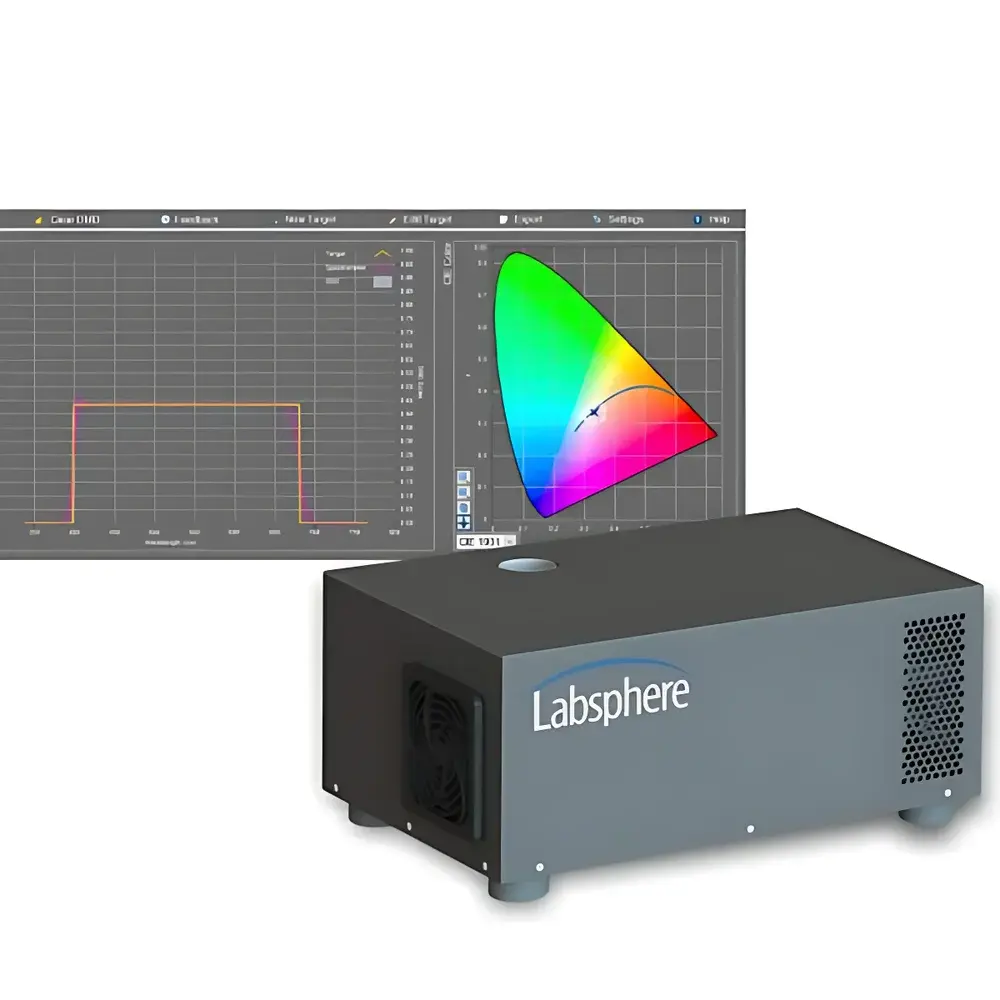
Labsphere Spectra-UT Hyperspectral Calibration Source
| Brand | Labsphere |
|---|---|
| Model | Spectra-UT |
| Origin | USA |
| Light Source Type | Tunable Hyperspectral Source with Integrated Tungsten-Halogen (QTH) Reference Lamp and Onboard Spectrometer |
| Spectral Range | 380–780 nm (Visible) |
| Spectral Resolution | Adjustable down to ~10 nm FWHM |
| Output Uniformity | >98% over 50 mm Ø field (flat-field compliant) |
| Control Interface | USB 2.0 + Ethernet |
| Software | SpectraSoft v4.x (Windows-based, supports scripting via Python API) |
| Calibration Traceability | NIST-traceable via integrated QTH lamp and factory-characterized spectrometer |
| Compliance | ISO/IEC 17025–accredited calibration documentation available |
| Power Supply | 100–240 VAC, 50/60 Hz |
| Cooling | Forced-air thermal management system |
| Dimensions | 320 × 240 × 180 mm (W × D × H) |
| Weight | 8.2 kg |
Overview
The Labsphere Spectra-UT Hyperspectral Calibration Source is an engineered reference instrument designed for high-fidelity spectral radiance simulation and traceable photometric calibration in metrology-grade optical laboratories. Based on a hybrid architecture combining a stabilized quartz-tungsten-halogen (QTH) broadband source, a precision monochromator-driven scanning engine, and real-time feedback from an integrated NIST-traceable miniature spectrometer, the Spectra-UT delivers programmable, time-stable spectral irradiance across the visible spectrum (380–780 nm). Unlike fixed-standard lamps or LED-based approximations, it employs continuous-spectrum synthesis via sequential narrowband wavelength selection and intensity-weighted recombination—enabling physically accurate replication of complex emission profiles including OLED, MicroLED, and multi-peak phosphor-converted LED spectra. Its core function is to serve as a primary transfer standard for spectral responsivity characterization, enabling correction of tristimulus mismatch errors in colorimeters and spectroradiometers per CIE Publication 15 and ISO/CIE 13655.
Key Features
- Programmable spectral output with adjustable resolution down to 10 nm full width at half maximum (FWHM), supporting both discrete-line and continuous-shape target spectra
- Onboard traceable calibration chain: integrated QTH reference lamp + calibrated miniature spectrometer enables in-situ validation and drift compensation without external instrumentation
- Uniform spatial output (>98% flatness over 50 mm diameter) compatible with fiber-optic light guides, collimators, and integrating sphere input ports
- Digital closed-loop intensity control with real-time photodiode feedback ensures stability better than ±0.3% over 2 hours (at constant ambient temperature)
- Sub-second spectral switching capability (<800 ms between arbitrary spectra), enabling dynamic calibration sequences for high-throughput sensor testing
- Full software control via SpectraSoft v4.x—including spectral library import (CIE S026, IEC 62471, ANSI C78.377), custom waveform definition, and automated compliance reporting
Sample Compatibility & Compliance
The Spectra-UT is optimized for use with photometric and colorimetric instruments requiring spectral validation under controlled laboratory conditions. It interfaces seamlessly with goniophotometers, imaging colorimeters (e.g., Radiant Vision Systems, Konica Minolta CS-2000), and benchtop spectroradiometers (e.g., Ocean Insight HDX, Instrument Systems CAS 140D). All factory calibrations are performed in accordance with ISO/IEC 17025 requirements and documented with uncertainty budgets referenced to NIST SRM 2020 and 2021. The system supports audit-ready data logging aligned with FDA 21 CFR Part 11 (electronic signatures, user access controls, and immutable audit trails) when operated with validated SpectraSoft configurations. It meets the spectral fidelity requirements defined in CIE Technical Report CIE 224:2017 for display measurement and ISO 13406-2 Annex E for backlight spectral characterization.
Software & Data Management
SpectraSoft v4.x provides a deterministic, scriptable environment for spectral definition, execution, and traceability management. Users can load industry-standard spectral power distributions (SPDs) from CSV, XML, or CIE S026-compliant files—or construct custom waveforms using spline interpolation, Gaussian peak superposition, or blackbody curve modulation. The software enforces metadata tagging (operator ID, timestamp, environmental conditions, calibration certificate ID) and exports measurement-ready datasets in HDF5 format for integration into MATLAB, Python (NumPy/Pandas), or LabVIEW workflows. Raw spectrometer readings, lamp aging compensation logs, and thermal drift records are stored in encrypted local databases with optional network backup. Version-controlled firmware updates and calibration coefficient tables are delivered through Labsphere’s secure customer portal, ensuring long-term reproducibility across instrument lifecycles.
Applications
- Primary calibration of spectral radiometers and colorimeters against user-defined or standards-based SPDs (e.g., CIE Illuminant D65, A, F2, or proprietary display white points)
- Tristimulus error mapping and correction matrix derivation for chromatic adaptation transforms in display manufacturing QC
- Characterization of spectral crosstalk and channel isolation in multispectral and hyperspectral imagers (e.g., agricultural, biomedical, or remote sensing sensors)
- Validation of optical filter transmission curves and detector quantum efficiency models
- Development and verification of perceptual color rendering metrics (TM-30 Rf/Rg, CQS, GAI) under tunable illumination conditions
- GLP-compliant spectral validation of lighting products per IES LM-79 and ENERGY STAR Lamps V2.1 test protocols
FAQ
Is the Spectra-UT suitable for UV or NIR spectral extension beyond 380–780 nm?
No—the Spectra-UT is optimized exclusively for the visible band. UV (780 nm) extensions require separate hardware modules not included in the base configuration.
Can the system be integrated into automated production line calibration stations?
Yes—Ethernet and USB 2.0 interfaces support industrial PLC integration; Python API and SCPI command set enable synchronization with robotic handlers and conveyors.
How often does the integrated spectrometer require recalibration?
Factory recalibration is recommended every 12 months or after 2,000 operating hours, whichever occurs first. Field verification using the onboard QTH lamp is performed automatically at startup.
Does SpectraSoft support third-party spectral database formats such as ASTM E308 or CIE 15:2018?
Yes—SpectraSoft includes native parsers for ASTM E308-22, CIE 15:2018, and ISO/CIE 13655:2012 SPD definitions, with automatic wavelength interpolation and normalization.
What environmental conditions are required for optimal performance?
Operation is specified at 20–25°C ambient temperature, <60% RH non-condensing, and minimal air turbulence. Active thermal stabilization maintains internal optics at ±0.2°C during extended spectral scans.




