
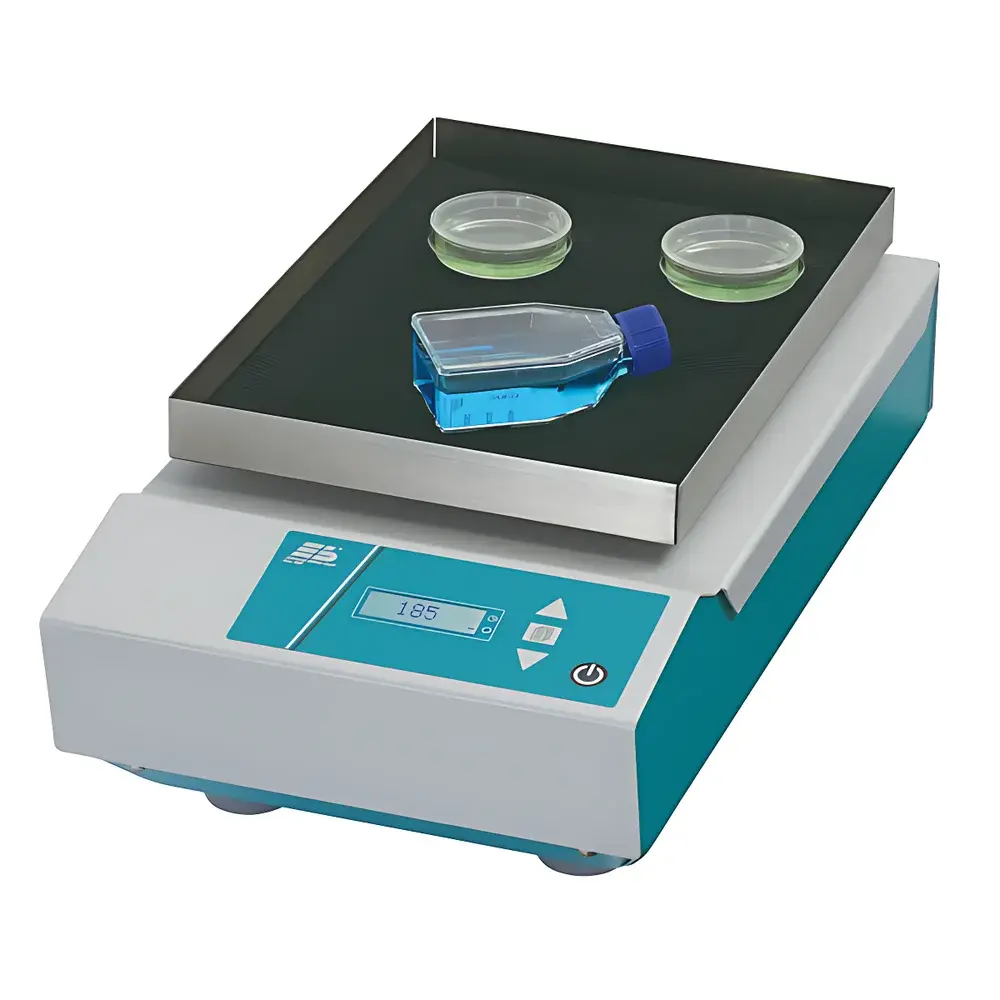
Edmund Büehler KM2 Microplate Shaker
| Brand | Edmund Büehler |
|---|---|
| Origin | Germany |
| Model | KM2 |
| Instrument Type | Microplate Oscillator/Shaker |
| Timer Range | 1 s to 99 h 59 min |
| Oscillation Frequency | 100–1,500 rpm (adjustable in 1 rpm increments) |
| Orbital Diameter | 2 mm |
| Operating Temperature Range | Ambient +5 °C to 45 °C |
| Platform Capacity | Single 96-well or 384-well microplate (standard footprint), compatible with PCR plates, deep-well plates, and assay tubes (via optional adapters) |
| Power Supply | 100–240 V AC, 50/60 Hz |
| Dimensions (W × D × H) | 170 × 220 × 125 mm |
| Weight | 2.8 kg |
Overview
The Edmund Büehler KM2 Microplate Shaker is a compact, high-precision orbital shaker engineered for consistent mixing of small-volume samples in life science laboratories. Designed around a brushless DC motor and precision-machined eccentric drive mechanism, the KM2 delivers stable, low-vibration orbital motion with a fixed 2 mm diameter—optimized for uniform suspension of cells, reagents, and immunoassay components without splashing or cross-contamination. Its solid aluminum housing and thermally stable base ensure mechanical rigidity and long-term calibration integrity, making it suitable for integration into automated workflows, incubator environments, and regulated QC/QA settings where reproducibility and minimal footprint are critical.
Key Features
- Compact footprint (170 × 220 × 125 mm) enables placement inside biosafety cabinets, cold rooms, or stacked benchtop configurations.
- Wide speed range (100–1,500 rpm) with 1-rpm resolution allows fine-tuning for sensitive applications such as ELISA plate washing, cell dissociation, or enzymatic reaction homogenization.
- Programmable timer supports single-step or multi-segment protocols—from 1 second to 99 hours 59 minutes—with automatic shutdown and audible end-of-cycle alert.
- Orbital motion geometry minimizes shear stress on fragile biological samples compared to reciprocating or vortex agitation methods.
- Integrated thermal management maintains platform temperature stability within ±0.5 °C across ambient +5 °C to 45 °C operating conditions—no external cooling required.
- Universal microplate compatibility includes ANSI/SLAS-standard 96-well and 384-well formats; optional holders support PCR strips, 1.5 mL tubes, and deep-well plates (e.g., 2 mL V-bottom).
Sample Compatibility & Compliance
The KM2 accommodates standard microplates used in molecular biology, clinical diagnostics, and pharmaceutical screening—including flat-bottom, U-bottom, and V-bottom configurations. Its non-slip silicone mat and adjustable clamping system prevent lateral displacement during high-speed operation. The device complies with IEC 61010-1:2010 for laboratory electrical safety and meets EMC requirements per EN 61326-1:2013. While not a Class II medical device, its design supports GLP and GMP-aligned workflows when deployed with documented SOPs and periodic performance verification (e.g., speed calibration using traceable tachometry). It is routinely validated in accordance with ASTM E2500-13 (Standard Guide for Specification, Design, and Verification of Pharmaceutical and Biopharmaceutical Manufacturing Systems) for ancillary equipment qualification.
Software & Data Management
The KM2 operates via an intuitive front-panel interface with LED display and rotary encoder control—requiring no PC connection for routine use. For integration into LIMS or electronic lab notebook (ELN) systems, optional RS-232 or USB-to-serial interfaces enable remote command execution (e.g., “START”, “STOP”, “SET SPEED=850”) and real-time status polling. All parameter changes and operational events (start time, duration, speed, error codes) are logged internally with timestamping. Audit trail functionality satisfies FDA 21 CFR Part 11 requirements when paired with validated third-party data capture software that enforces user authentication, electronic signatures, and immutable log archiving.
Applications
- Homogenization of immunoassays (ELISA, CLIA) prior to optical density measurement.
- Cell suspension maintenance during staining, fixation, or wash steps in flow cytometry preparation.
- Reagent resuspension in high-throughput screening (HTS) assays involving compound libraries or siRNA transfection mixes.
- Temperature-controlled agitation of enzyme-linked reactions in kinetic studies (e.g., protease activity assays).
- Pre-incubation mixing of qPCR master mixes to ensure primer-dye uniformity before thermal cycling.
- Supporting ISO 15189-accredited clinical labs for standardized sample preparation prior to automated analyzers.
FAQ
Is the KM2 compatible with 384-well plates?
Yes—the standard platform supports ANSI/SLAS-compliant 384-well microplates without adapter. Plate retention is secured via vacuum-assisted edge grip and anti-slip surface texture.
Can the KM2 be operated inside a CO₂ incubator?
It is rated for ambient +5 °C to 45 °C, but operation inside humidified CO₂ incubators is not recommended due to condensation risk on internal electronics. A dedicated incubator-rated variant (KM2-I) is available upon request.
Does the KM2 support programmable multi-step protocols?
No—the onboard controller executes only single-segment timing. Multi-step sequences require external triggering via serial command or integration with a programmable logic controller (PLC).
What calibration documentation is provided?
Each unit ships with a factory calibration certificate traceable to PTB (Physikalisch-Technische Bundesanstalt), covering speed accuracy (±1 rpm at setpoint) and timer deviation (< ±0.1% over 24 h).
How often should preventive maintenance be performed?
Annual inspection of motor coupling integrity and encoder alignment is recommended. No consumables or lubrication are required under normal usage conditions.





