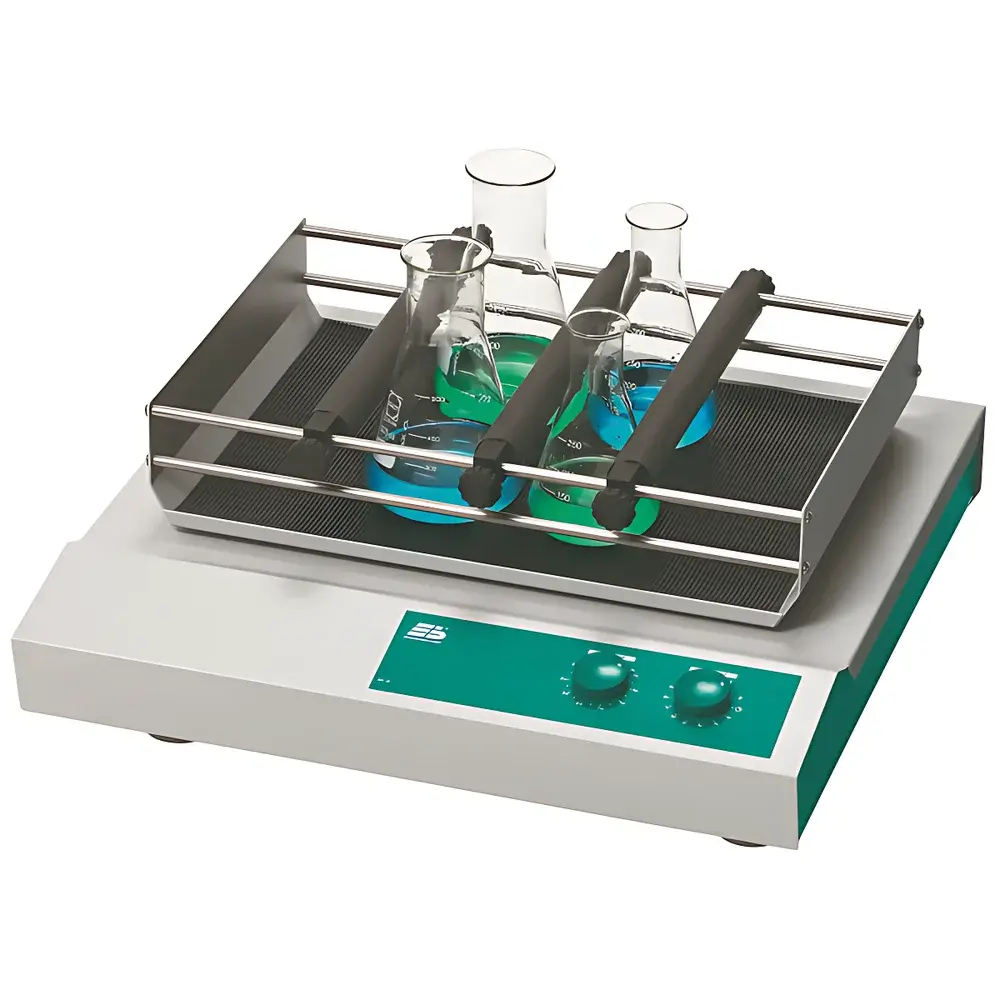
Edmund Büehler KS15A Compact Orbital Shaker
| Brand | Edmund Büehler |
|---|---|
| Origin | Germany |
| Model | KS15A |
| Instrument Type | Orbital Shaker |
| Shaking Mode | Orbital |
| Control Type | Analog or Digital (model-dependent) |
| Platform Size | ~200 × 200 mm |
| Max Load Capacity | 3 kg |
| Power Supply | 100–240 V AC, 50/60 Hz |
| Safety Class | IP20 |
| Compliance | CE, RoHS, IEC 61010-1 |
Overview
The Edmund Büehler KS15A Compact Orbital Shaker is a precision-engineered benchtop instrument designed for consistent, low-profile orbital agitation of samples in microbiology, molecular biology, and cell culture laboratories. Operating on the principle of eccentric drive-induced orbital motion (typically 12–25 mm diameter), the KS15A generates uniform mixing without vortexing—ideal for suspension cultures, solubilization, staining, and gentle reagent homogenization. Its compact footprint (approx. 250 × 280 × 140 mm) enables seamless integration into biosafety cabinets, cold rooms, and crowded incubator stacks. Engineered in Germany to DIN-certified manufacturing standards, the shaker features a robust aluminum alloy chassis, brushless DC motor for long-term stability, and passive thermal management—ensuring continuous operation without fan-induced contamination or vibration coupling to adjacent equipment.
Key Features
- Compact orbital design optimized for space-constrained lab environments—including glove boxes and laminar flow hoods.
- Brushless DC motor delivering high torque at low speeds (typically 30–300 rpm range, model-specific), with minimal electromagnetic interference and zero carbon dust generation.
- Stainless steel or epoxy-coated platform compatible with standard microtiter plates (96-/384-well), test tubes (up to 50 mL), flasks (up to 250 mL Erlenmeyer), and custom clamping accessories.
- Analog or digital control interface (depending on configuration), supporting manual speed adjustment and optional timer function (0–999 min) with auto-shutdown.
- Integrated leveling feet and non-slip silicone mat ensure stable operation on uneven surfaces and prevent sample displacement during extended runs.
- No external cooling or heating unit—designed for ambient-temperature use only; suitable for placement inside refrigerated or CO₂ incubators (subject to environmental rating verification).
Sample Compatibility & Compliance
The KS15A accommodates a broad range of vessel formats through interchangeable platform inserts and universal clamps, including PCR tube racks, deep-well plates, glass vials, and conical centrifuge tubes. It meets essential laboratory safety and electromagnetic compatibility requirements per EN 61326-1 (measurement/control lab equipment) and EN 61000-6-3 (emission limits). As a Class I electrical device conforming to IEC 61010-1, it supports GLP-compliant workflows when paired with documented operational procedures and periodic performance verification (e.g., speed calibration using traceable tachometer). While not intrinsically rated for hazardous locations, its IP20 enclosure provides protection against solid objects >12.5 mm—sufficient for standard ISO Class 5–7 cleanroom environments when used with appropriate containment practices.
Software & Data Management
The base KS15A operates as a standalone analog/digital hardware unit without embedded firmware or network connectivity. For laboratories requiring audit-ready documentation, Edmund Büehler recommends integration with third-party environmental monitoring systems (e.g., DeltaTrak, SensiLog) via analog 0–10 V output (optional accessory). When configured with digital control, the unit supports manual logging of setpoints and runtime—fully compatible with paper-based or electronic lab notebook (ELN) entries under 21 CFR Part 11 if accompanied by user-defined SOPs and access controls. No proprietary software is required; calibration certificates and mechanical maintenance logs are provided per ISO/IEC 17025-aligned service protocols.
Applications
- Maintenance of bacterial and yeast cultures in liquid media (e.g., LB, YPD) at sub-incipient growth conditions.
- Antibody labeling and antigen-antibody binding steps in ELISA and Western blot workflows.
- Cell dissociation support during passaging—particularly for adherent lines requiring gentle agitation post-trypsinization.
- Buffer equilibration, dialysis bag mixing, and gel staining/destaining protocols where uniform motion prevents localized concentration gradients.
- Pre-analytical sample homogenization prior to HPLC, GC-MS, or NGS library preparation—reducing pipetting-induced variability.
FAQ
Is the KS15A suitable for use inside a CO₂ incubator?
Yes—provided the incubator’s internal temperature and humidity remain within the shaker’s specified ambient operating range (10–40 °C, <80% RH non-condensing) and airflow does not impede motor cooling. Verify compatibility with your incubator manufacturer prior to installation.
Does the KS15A support programmable ramping or multi-step protocols?
No—the standard KS15A lacks programmable profiles. For gradient shaking applications, consider Edmund Büehler’s digitally controlled KS series (e.g., KS4000i) with USB/RS232 interfaces and PC-based scheduling.
What is the recommended calibration frequency?
Annual speed verification using an NIST-traceable optical tachometer is advised for GLP/GMP environments; more frequent checks may be required based on usage intensity and risk assessment per ISO/IEC 17025 Clause 6.5.
Can the platform be replaced with a custom fixture?
Yes—Edmund Büehler offers OEM-compatible mounting kits and threaded platform adapters for integration with specialized carriers, including magnetic stirrer hybrids and multi-vessel bioreactor sleeves.