
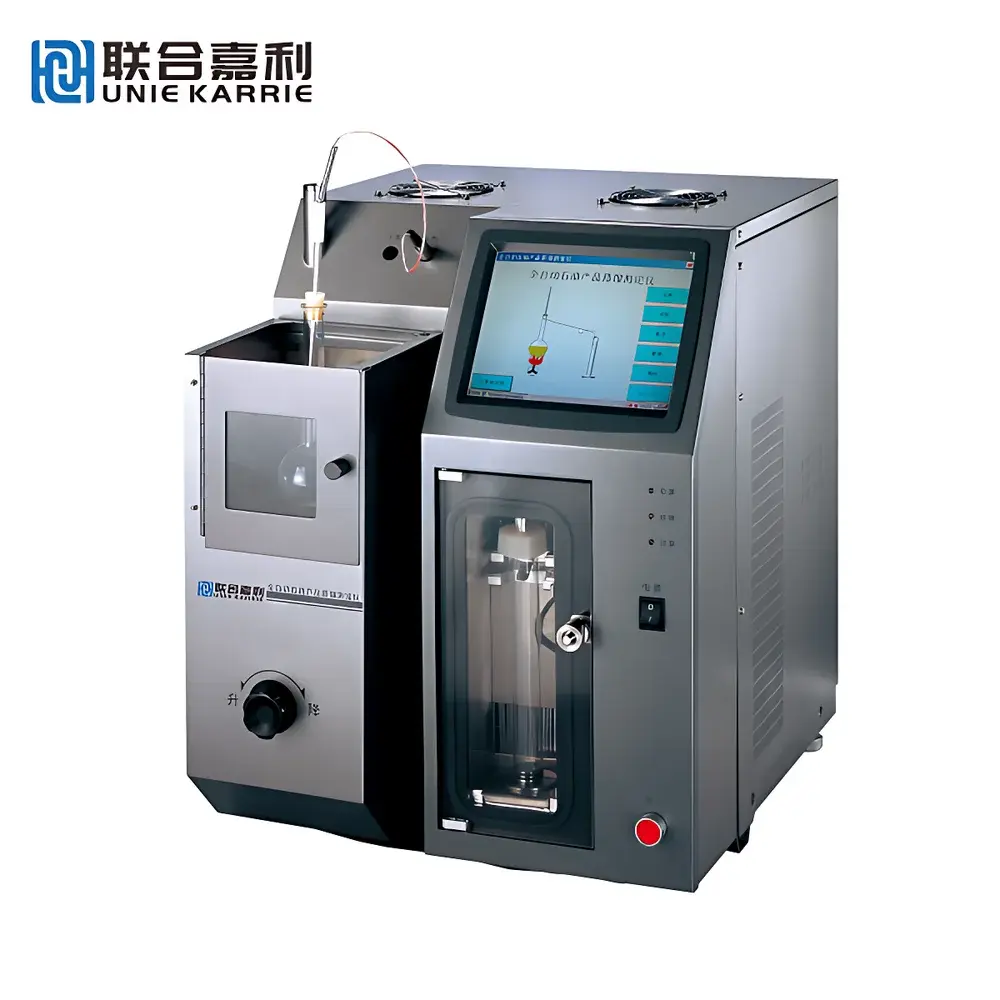
EDS110 Automated Petroleum Distillation Apparatus by KARRIE
| [Brand | KARRIE |
|---|---|
| Model | EDS110 |
| Origin | Guangdong, China |
| Temperature Range | Ambient to 400 °C |
| Temperature Accuracy | ±0.1 °C |
| Cold Bath Range | 0–60 °C |
| Distillation Rate | 12 mL/min |
| Volume Detection Range | 0–100 mL |
| Volume Resolution | 0.1 mL |
| Compliance | ASTM D86, ASTM D850, GB/T 6536, GB/T 7534, ISO 3405] |
Overview
The KARRIE EDS110 Automated Petroleum Distillation Apparatus is an engineering-grade distillation system designed for precise, repeatable determination of boiling point distributions in petroleum fractions and related hydrocarbon-based fluids. It operates on the principle of atmospheric distillation under controlled heating and condensation conditions, adhering strictly to standardized test methods including ASTM D86 (Standard Test Method for Distillation of Petroleum Products at Atmospheric Pressure), ASTM D850 (for volatile solvents), GB/T 6536 (Chinese national standard equivalent to ASTM D86), GB/T 7534 (for organic solvents), and ISO 3405. The instrument delivers fully automated, unattended operation—from sample loading to final report generation—while maintaining traceable thermal control, volumetric tracking, and real-time data acquisition across the entire distillation curve.
Key Features
- Dual-architecture control system: Combines a dedicated microcontroller for real-time sensor acquisition and distillation logic with an industrial-grade embedded PC (256 MB RAM, 4 GB flash storage) running Windows CE 5.0. This architecture ensures deterministic timing, high data integrity, and immunity to common OS-level vulnerabilities associated with general-purpose desktop platforms.
- Peltier-based thermal management: Cold bath and receiver chamber utilize solid-state thermoelectric modules (TECs) operating on the Peltier effect. Enables bidirectional temperature control (cooling/heating) within 0–60 °C range without refrigerants, offering lower maintenance burden, reduced acoustic noise, and improved energy efficiency compared to compressor-based systems.
- High-fidelity volumetric detection: Japanese-sourced mechanical liquid-level tracking mechanism coupled with industrial infrared photoelectric sensors provides robust, drift-free volume measurement up to 100 mL with 0.1 mL resolution. System supports both volume-triggered and temperature-triggered data capture points.
- Multi-point calibration suite: Software-integrated correction algorithms for vapor temperature, ambient pressure, graduated cylinder volume, cold bath temperature, and receiver chamber temperature—ensuring metrological traceability per ISO/IEC 17025 requirements.
- True-color human interface: 10.4-inch TFT LCD display (640 × 480 pixels) with capacitive touch panel, complemented by optional keyboard and optical mouse support. Interface available in English or Chinese; firmware supports field-upgradable language packs via USB.
- Comprehensive self-diagnostic protocol: Automatic sensor validation at power-on (vapor, heater, cold bath, receiver chamber PT100s), actuator checks (fan status, level detector response), and runtime fault monitoring—including door-open detection, stagnation alerts (>2 min no volume change), and thermal over-limit protection capped at 400 °C absolute safety threshold.
Sample Compatibility & Compliance
The EDS110 is validated for use with a broad spectrum of petroleum-derived samples, including but not limited to: gasoline (motor, aviation, and aviation turbine fuel), naphthas, kerosene, diesel fuels (including ultra-low sulfur variants), light cycle oils, solvent naphthas, and specialty hydrocarbon solvents. All operational parameters—including heating rate profiles, condenser cooling setpoints, and volume sampling intervals—are programmable to match method-specific requirements across ASTM, ISO, and GB standards. Instrument design conforms to IEC 61010-1 (Safety Requirements for Electrical Equipment for Measurement, Control, and Laboratory Use) and electromagnetic compatibility (EMC) directives applicable to Class B laboratory equipment.
Software & Data Management
Embedded software provides full method editing capability, supporting both standardized endpoints (e.g., IBP, FBP, 10–90% recovery points) and user-defined custom detection logic (up to 15 additional points). Data output includes tabular results (temperature vs. recovered volume), graphical distillation curves, and summary statistics (loss correction, atmospheric pressure normalization). All measurements are time-stamped and logged with operator ID, sample ID, and method name. Export formats include CSV and PDF reports compatible with LIMS integration via RS-232, USB host, or Ethernet (RJ-45). Audit trail functionality meets GLP/GMP documentation expectations, recording all parameter changes, calibration events, and system errors with immutable timestamps. Local storage capacity exceeds 10,000 test records with multi-field search (date range, operator, sample batch).
Applications
Primarily deployed in refinery QC laboratories, petrochemical R&D centers, third-party testing facilities, and regulatory compliance units, the EDS110 serves critical functions in product specification verification (e.g., ASTM D439 for gasoline volatility), process optimization (fractionation column performance assessment), formulation development (blending stock characterization), and regulatory submission (EPA Tier 3, EN 228, GB 17930). Its ability to execute partial-range distillations—via configurable stop conditions (target volume or temperature)—makes it suitable for rapid screening of narrow-cut fractions without full-range analysis overhead.
FAQ
Which international standards does the EDS110 comply with?
The instrument is fully compliant with ASTM D86, ASTM D850, ISO 3405, GB/T 6536, and GB/T 7534 for atmospheric distillation testing of petroleum products.
Can the EDS110 operate without continuous operator supervision?
Yes. Once sample and receiver are loaded and a method is selected, the system executes the entire distillation sequence autonomously—including heating ramp control, condensate collection, real-time volume/temperature logging, and automatic termination.
What type of temperature sensors are used, and how are they calibrated?
German-sourced PT100 platinum resistance thermometers in four-wire configuration are employed for vapor, heater, cold bath, and receiver chamber measurements. Each sensor is supplied with individual calibration certificates traceable to national standards.
Is the system compatible with FDA 21 CFR Part 11 requirements?
While the base configuration supports audit trails and electronic signatures, full Part 11 compliance requires optional validation packages and site-specific IQ/OQ documentation—available upon request for regulated environments.
What maintenance is required for the Peltier cooling system?
No refrigerant recharge or compressor servicing is needed. Routine maintenance consists of periodic cleaning of heat sink surfaces and verification of thermal interface compound integrity—typically every 12 months under normal lab use.






