
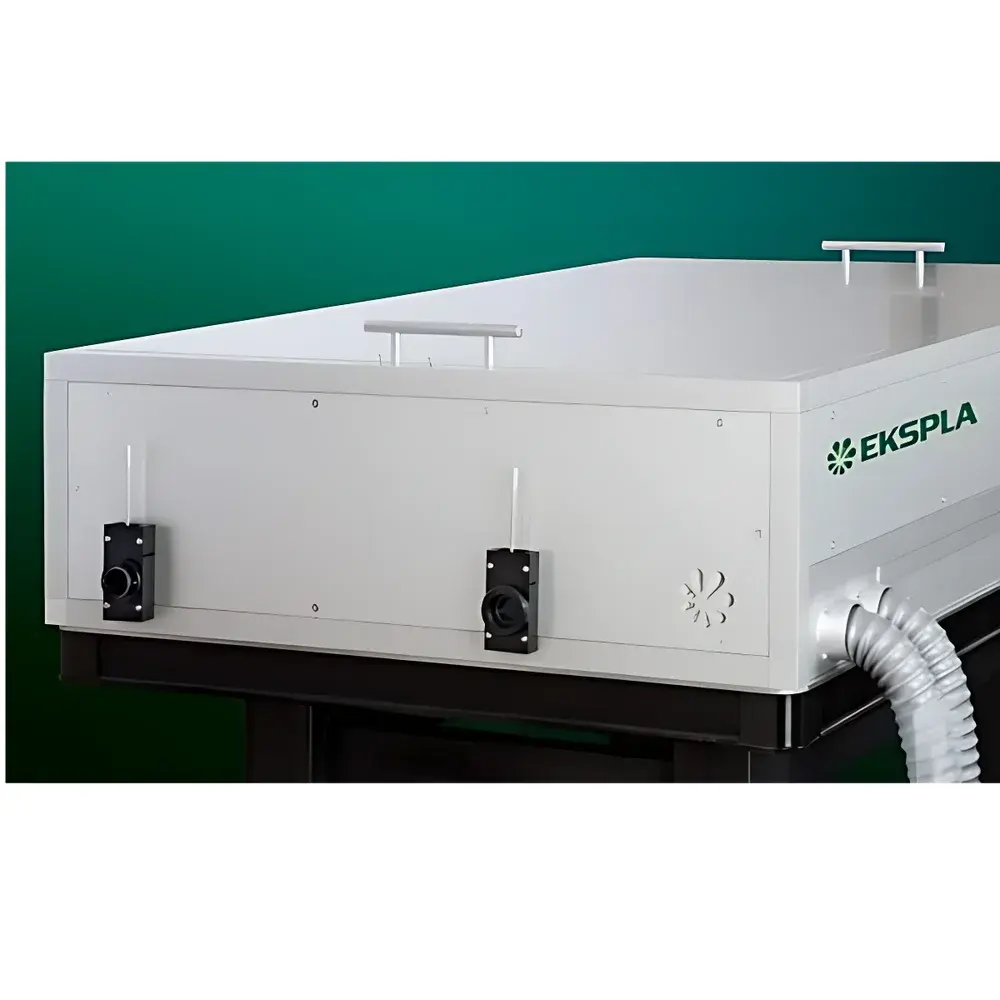
Ekspla ANL AWG High-Energy Nd:YAG Laser with Arbitrary Waveform Generation
| Brand | Ekspla |
|---|---|
| Model | ANL AWG |
| Output Pulse Energy | Up to 1 J @ 1064 nm |
| Repetition Rate | Up to 1 kHz |
| Pulse Duration | 2–4 ns or 5 ns (selectable) |
| Beam Profile | Spatial flat-top |
| Pumping | High-efficiency diode-pumped |
| Footprint | 1 × 2 m |
| Harmonics Options | Optional 532 nm (2nd) and 355 nm (3rd) generation |
| Housing | Optional industrial-grade portable enclosure with integrated power supply and closed-loop cooling |
| Diagnostics | Internal real-time system diagnostics |
| Compliance | Designed for ISO 11146-compliant beam characterization and EN 60825-1 laser safety class IV operation |
Overview
The Ekspla ANL AWG is a high-energy, diode-pumped solid-state Nd:YAG laser engineered for precision time-domain pulse shaping in demanding scientific and industrial applications. Unlike conventional Q-switched lasers with fixed temporal profiles, the ANL AWG integrates an arbitrary waveform generator (AWG) architecture that enables user-defined temporal intensity envelopes—facilitating advanced pump-probe spectroscopy, laser-induced breakdown spectroscopy (LIBS), nonlinear frequency conversion optimization, and plasma diagnostics. Operating at the fundamental wavelength of 1064 nm, the system delivers up to 1 joule per pulse with pulse durations configurable between 2–4 ns or 5 ns, depending on operational mode and harmonic selection. Its spatially uniform flat-top beam profile ensures consistent energy distribution across the target area—critical for uniform ablation, precise material processing, and reproducible optical parametric amplification (OPA) seeding. The laser’s monolithic Nd:YAG rod design, combined with high-efficiency diode pumping chambers, provides exceptional thermal stability and long-term amplitude stability (<±1.5% RMS over 8 hours), making it suitable for GLP-compliant laboratories and 24/7 industrial integration.
Key Features
- Arbitrary waveform generation capability for programmable pulse trains and shaped temporal profiles
- Up to 1 J pulse energy at 1064 nm with selectable pulse width (2–4 ns or 5 ns)
- Repetition rate adjustable from single-shot to 1 kHz, with jitter <500 ps RMS
- Flat-top spatial beam profile (M² <1.3) enabling uniform irradiance distribution and minimized edge effects
- Integrated real-time diagnostics including cavity alignment status, pump diode current/voltage monitoring, and thermal sensor feedback
- Optional harmonic generation modules: frequency-doubled (532 nm) and tripled (355 nm) outputs with >65% conversion efficiency (at full energy)
- Compact 1 × 2 m laser head footprint optimized for cleanroom and vacuum chamber integration
- Industrial-grade portable housing variant available—fully self-contained with air-cooled or chiller-integrated thermal management and CE/UL-certified power supplies
Sample Compatibility & Compliance
The ANL AWG is compatible with a broad range of optically transparent, reflective, and absorptive materials—including fused silica, sapphire, metals (Al, Cu, Ti), polymers (PMMA, PI), and biological tissues—provided appropriate pulse energy density thresholds are observed. Beam delivery is compatible with standard Ø25 mm or Ø50 mm optical mounts and supports integration with motorized attenuators, Pockels cells, and delay stages for ultrafast synchronization. The system conforms to IEC/EN 60825-1:2014 for Class IV laser safety requirements and includes interlock-ready connectors for integration into ISO 13857-compliant enclosures. All firmware and control logic comply with IEC 61508 SIL-2 functional safety guidelines where applicable. Beam parameter measurements adhere to ISO 11146-1/2 standards for M², divergence, and beam width determination.
Software & Data Management
Control and configuration are managed via Ekspla’s proprietary LaserStudio software suite (Windows 10/11, 64-bit), which provides GUI-based waveform editing, pulse sequence scripting (Python API supported), and synchronized data logging. The software supports timestamped acquisition of internal diagnostics (e.g., pump diode temperature, cavity thermistor readings, Q-switch voltage), enabling traceable performance validation per FDA 21 CFR Part 11 requirements when deployed in regulated environments. Audit trails, user role-based access control, and encrypted configuration backups are included. Remote operation via Ethernet (TCP/IP) or USB 3.0 allows integration into LabVIEW, MATLAB, or custom SCADA systems without proprietary drivers.
Applications
- Laser-induced breakdown spectroscopy (LIBS) requiring high peak power and stable pulse-to-pulse energy for quantitative elemental analysis
- Pump-probe experiments in ultrafast physics, where temporal pulse shaping improves signal-to-noise ratio in transient absorption measurements
- Optical parametric amplifier (OPA) and optical parametric chirped-pulse amplifier (OPCPA) seeding with controlled temporal contrast
- High-precision laser shock peening (LSP) and surface texturing of aerospace alloys
- Time-resolved fluorescence lifetime imaging (FLIM) and multi-photon microscopy using harmonics
- Calibration of high-speed photodetectors and streak cameras requiring known pulse duration and energy stability
FAQ
What is the maximum average power output at 1064 nm?
At 1 kHz repetition rate and 1 J pulse energy, the maximum average power is 1 kW. Derating applies above 500 Hz under continuous operation to maintain thermal equilibrium.
Can the ANL AWG be synchronized with external equipment such as delay generators or oscilloscopes?
Yes—dedicated TTL/PECL sync outputs provide <100 ps jitter trigger signals for both Q-switch and flashlamp (if installed), with programmable delay resolution down to 10 ps.
Is remote firmware update supported?
Firmware updates are performed via secure USB or Ethernet connection using signed binaries; rollback capability and version verification are built into the bootloader.
Does the system support third-party harmonic generation modules?
While Ekspla-supplied harmonic generators are fully characterized and warranted, the 1064 nm output beam meets ISO 10110-3 specifications for wavefront error (<λ/8 PV), enabling compatibility with select OEM nonlinear crystals (e.g., BBO, LBO) under user responsibility.
What cooling options are available?
Standard configuration uses forced-air convection; optional integrated recirculating chillers (±0.1 °C stability) or dry cooler packages are available for ambient temperatures up to 40 °C.



