
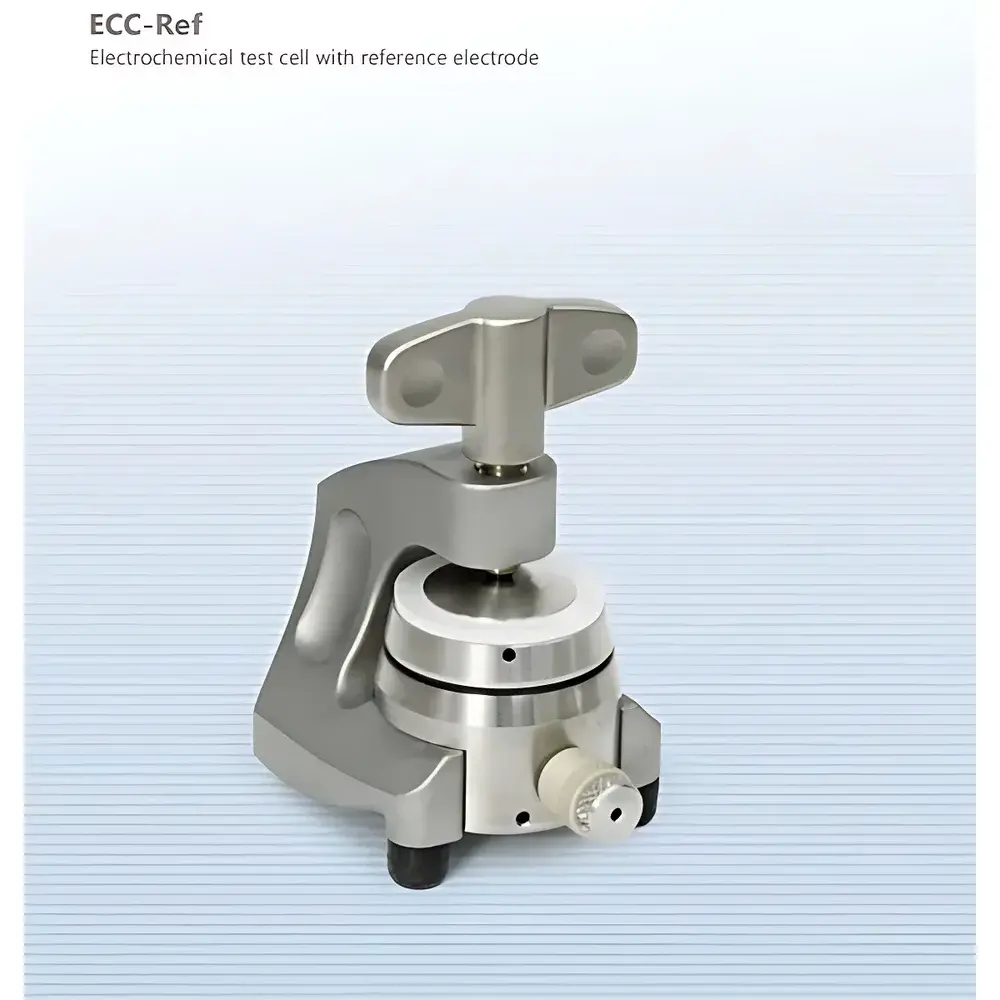
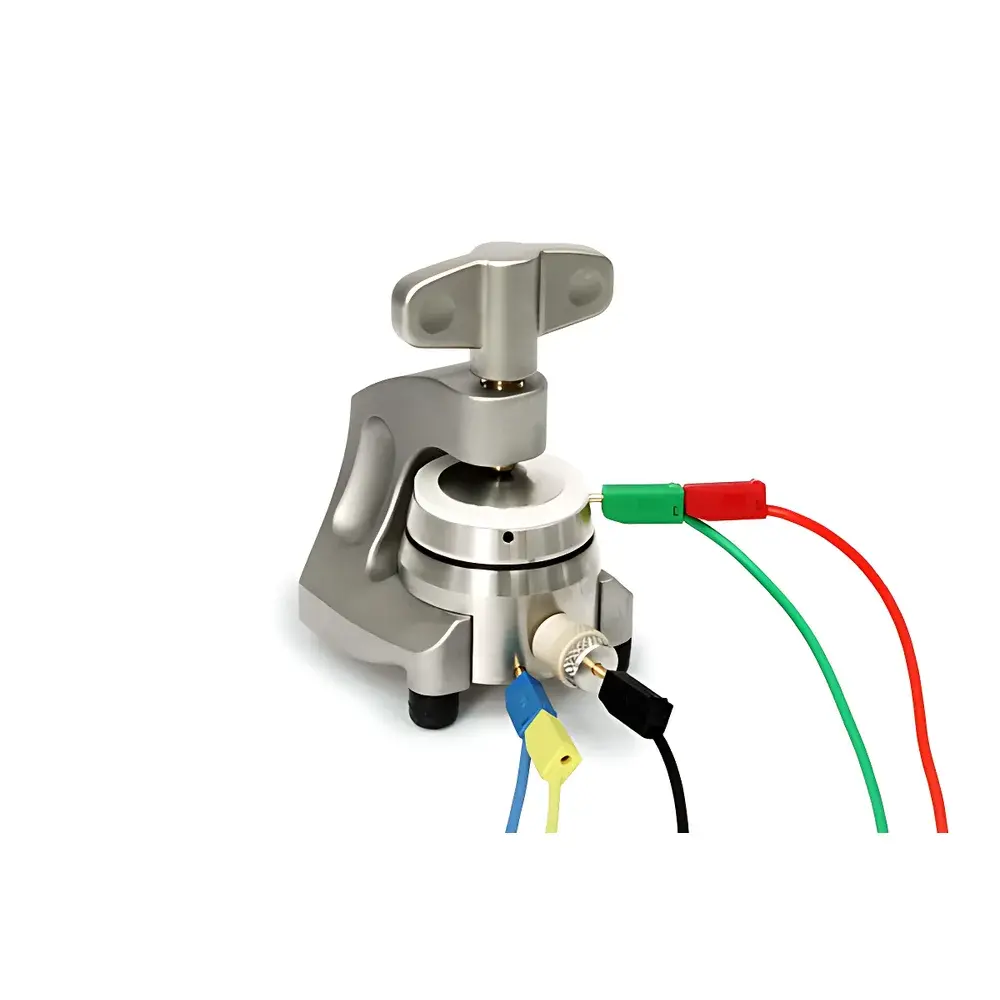
EL-Cell ECC-Ref Electrochemical Test Cell with Integrated Reference Electrode
| Brand | EL-Cell |
|---|---|
| Origin | Germany |
| Model | ECC-Ref |
| Dimensions | 90 × 54 × 70 mm (H × W × D) |
| Electrode Diameter | 18 mm |
| Electrolyte Volume | 0.1 mL (min.) |
| Weight | 640 g |
| Construction Materials | Stainless Steel (316L), PEEK, Aluminum (lower plunger), Copper (upper plunger), Polypropylene (PP), PTFE/PE sealing elements |
Overview
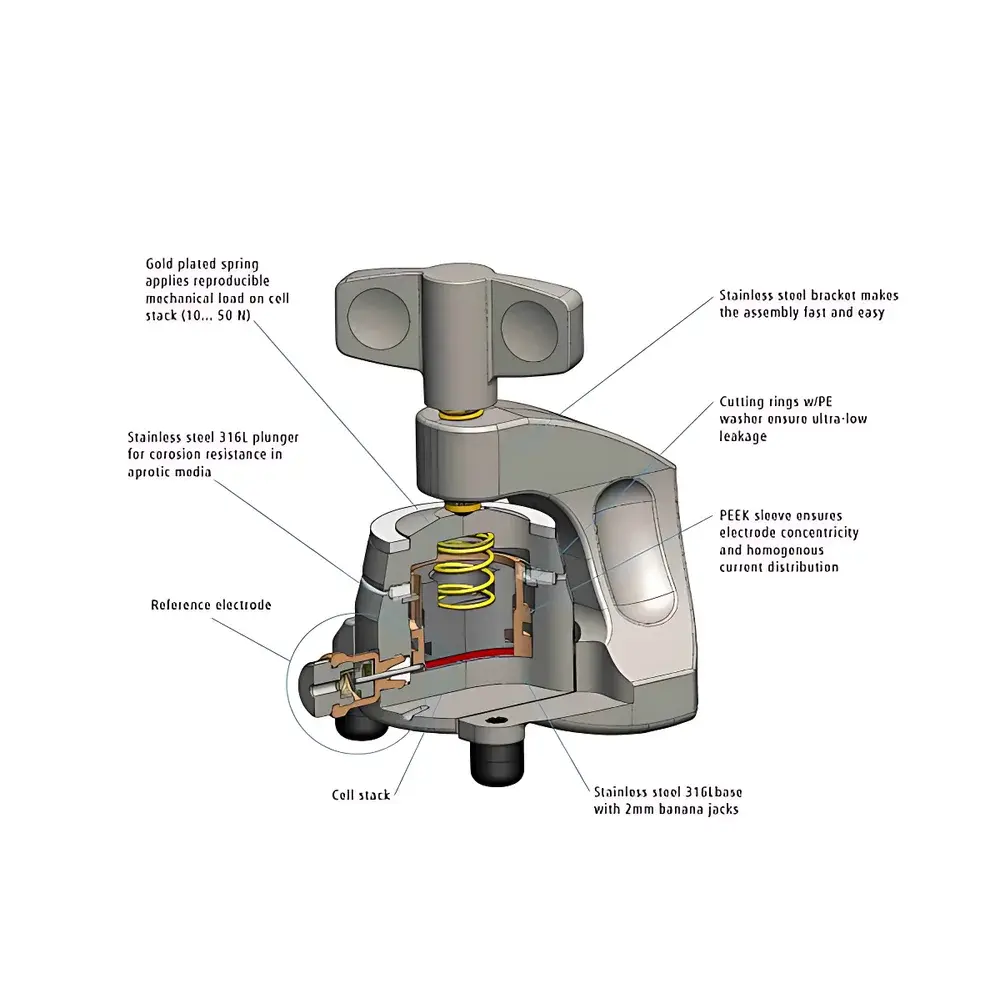
The EL-Cell ECC-Ref Electrochemical Test Cell with Integrated Reference Electrode is a precision-engineered, modular cell platform designed for controlled three-electrode electrochemical characterization of advanced energy storage systems—including proton-conducting batteries, lithium-ion battery electrodes (e.g., graphite anodes vs. LiMO₂ cathodes), and non-aqueous supercapacitors. Built upon the standardized PAT-Core mechanical architecture, the ECC-Ref implements a coaxial, stack-type geometry (18 mm electrode diameter) with sub-0.1 mm concentricity tolerance—ensuring uniform current distribution and minimized edge effects during galvanostatic or potentiostatic measurements. Its core functional distinction lies in the pre-integrated annular reference electrode cavity within the insulated sleeve, enabling stable, reproducible potential referencing without external salt bridges or Luggin capillaries. The cell operates under mechanically adjustable, repeatable compression (via calibrated torque application), critical for maintaining interfacial contact integrity between porous electrodes and current collectors—particularly in solid-state or viscous electrolyte systems.
Key Features
- Modular PAT-Core foundation: Comprises lower Al plunger (counter electrode), upper Cu plunger (working electrode collector), and a precision-machined insulating sleeve housing the reference electrode contact point.
- Configurable electrode architecture: Supports both 2-electrode (via optional ECC-Std conversion kit) and 3-electrode operation—enabling half-cell vs. full-cell analysis flexibility.
- Battery-grade material compatibility: All wetted components are constructed from chemically inert, high-purity materials—316L stainless steel, PEEK, aluminum, copper, and polypropylene—validated for prolonged exposure to carbonate-based, ether-based, and sulfonamide electrolytes.
- Low dead-volume design: Minimum electrolyte requirement of 0.1 mL reduces parasitic side reactions and improves mass transport control in kinetic studies.
- Reproducible mechanical loading: Adjustable axial pressure ensures consistent electrode–current collector interface resistance across repeated assemblies—critical for impedance stability and cycle-life correlation.
- Tool-assisted rapid assembly/disassembly: Dedicated PAT assembly tools enable sub-minute cell construction with leak-tight sealing via PTFE/PE O-rings; all metallic and polymer components (except seals) are fully reusable after solvent cleaning.
Sample Compatibility & Compliance
The ECC-Ref accommodates standard 18 mm coin-type electrodes, slurry-coated disk electrodes, and thin-film working electrodes mounted on current collectors. It is routinely deployed in R&D labs validating anode/cathode materials per ASTM D7282 (electrochemical impedance spectroscopy of battery electrodes) and ISO 18563-2 (non-destructive testing of electrochemical interfaces). All materials comply with REACH Annex XIV restrictions and exhibit no detectable leaching in ICP-MS analysis following 72 h immersion in 1 M LiPF₆ in EC:DMC (1:1 v/v). The cell’s stainless steel and PEEK construction meets USP Class VI biocompatibility requirements, supporting electrolyte stability assessments under GMP-aligned QC protocols.
Software & Data Management
While the ECC-Ref is hardware-only and protocol-agnostic, it integrates seamlessly with commercial potentiostats (BioLogic VSP-300, Gamry Interface 5000E, Metrohm Autolab PGSTAT302N) supporting multi-channel EIS, GITT, PITT, and galvanostatic intermittent titration techniques. When used with instruments compliant with FDA 21 CFR Part 11, the cell enables ALCOA+ data integrity—particularly when paired with audit-trail-enabled software (e.g., EC-Lab v12+, NOVA 2.1.4) for timestamped parameter logging, user authentication, and electronic signature capture during method execution.
Applications
- Half-cell evaluation of Li-metal, Si-alloy, or hard carbon anodes vs. Li/Li⁺ reference.
- Three-electrode impedance mapping of solid-electrolyte interphases (SEI) on NMC811 cathodes in lean-electrolyte configurations.
- Proton-conducting membrane electrode assembly (MEA) testing in PEM supercapacitors using H⁺/H₂ reference systems.
- Post-mortem electrode inspection: Transparent top-cap variants (optional) allow visual assessment of delamination, gas evolution, or dendrite formation without disassembly.
- Accelerated aging studies under controlled stack pressure—correlating mechanical stress with capacity fade mechanisms per IEEE 1625 standards.
FAQ
Can the ECC-Ref be used with aqueous electrolytes?
Yes—provided the reference electrode configuration and current collector materials (e.g., Pt or Au instead of Al/Cu) are selected to avoid corrosion; stainless steel 316L and PEEK remain compatible.
Is the reference electrode included with the cell?
No—the ECC-Ref provides a dedicated cavity and electrical contact point for user-installed reference electrodes (e.g., Li metal wire, Ag/AgCl micro-wire, or custom quasi-reference probes); no internal reference element is supplied.
What torque range is recommended for plunger tightening?
EL-Cell specifies 0.5–1.2 N·m for the upper plunger, depending on electrode thickness and compressibility; torque-controlled assembly tools are available as accessories.
Does the cell support elevated temperature testing?
Yes—standard configuration is rated to 80°C; high-temp variants with Kalrez® seals and modified thermal expansion compensation are available upon request.
How is calibration traceability maintained?
The cell itself requires no calibration; however, its geometric consistency (18 mm ±0.02 mm electrode diameter, 0.1 mm concentricity) is certified per EN ISO/IEC 17025 by EL-Cell’s accredited metrology lab, with certificate provided upon shipment.






