
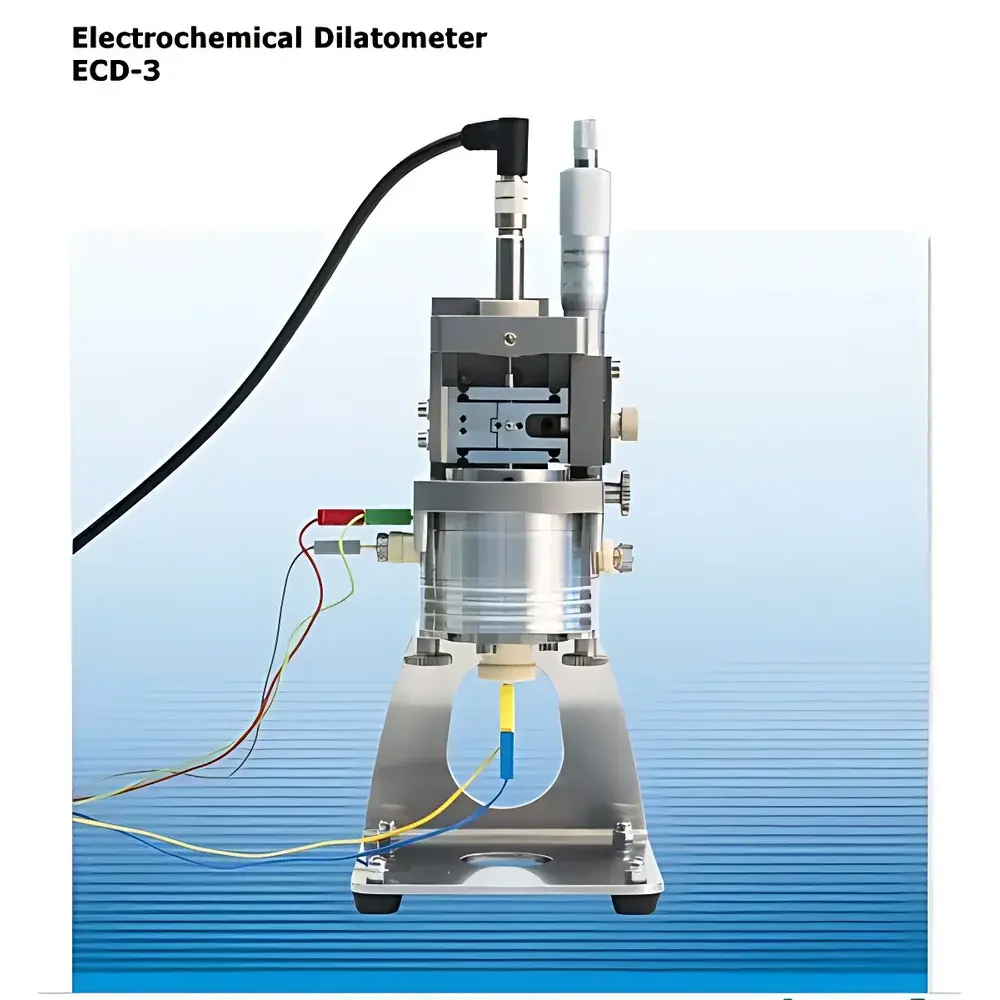
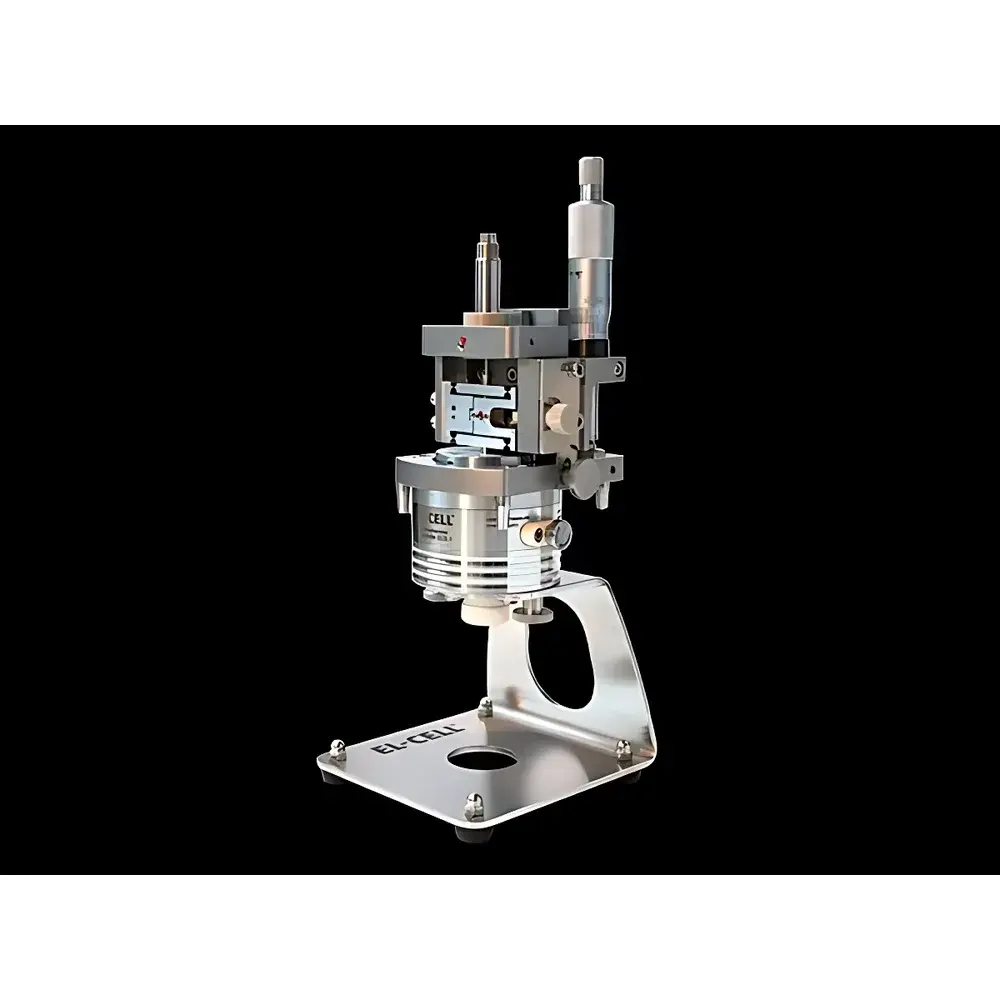
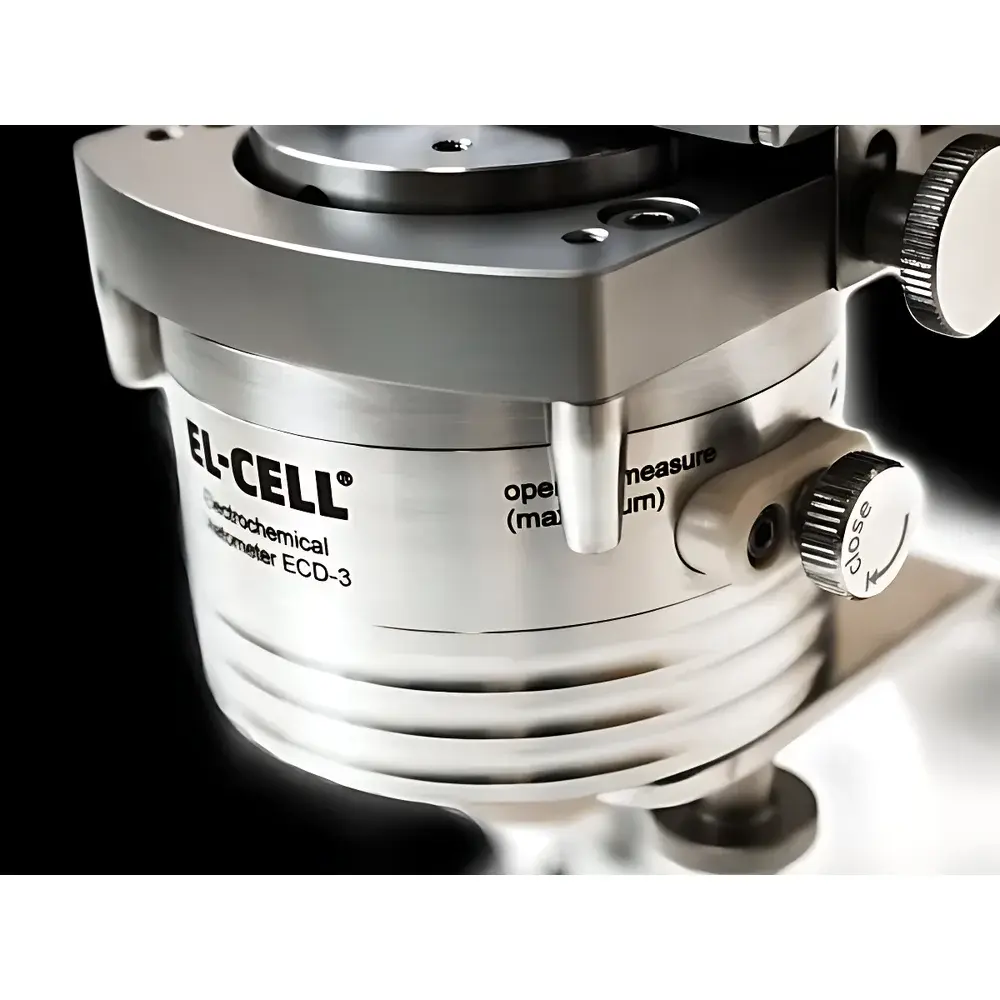
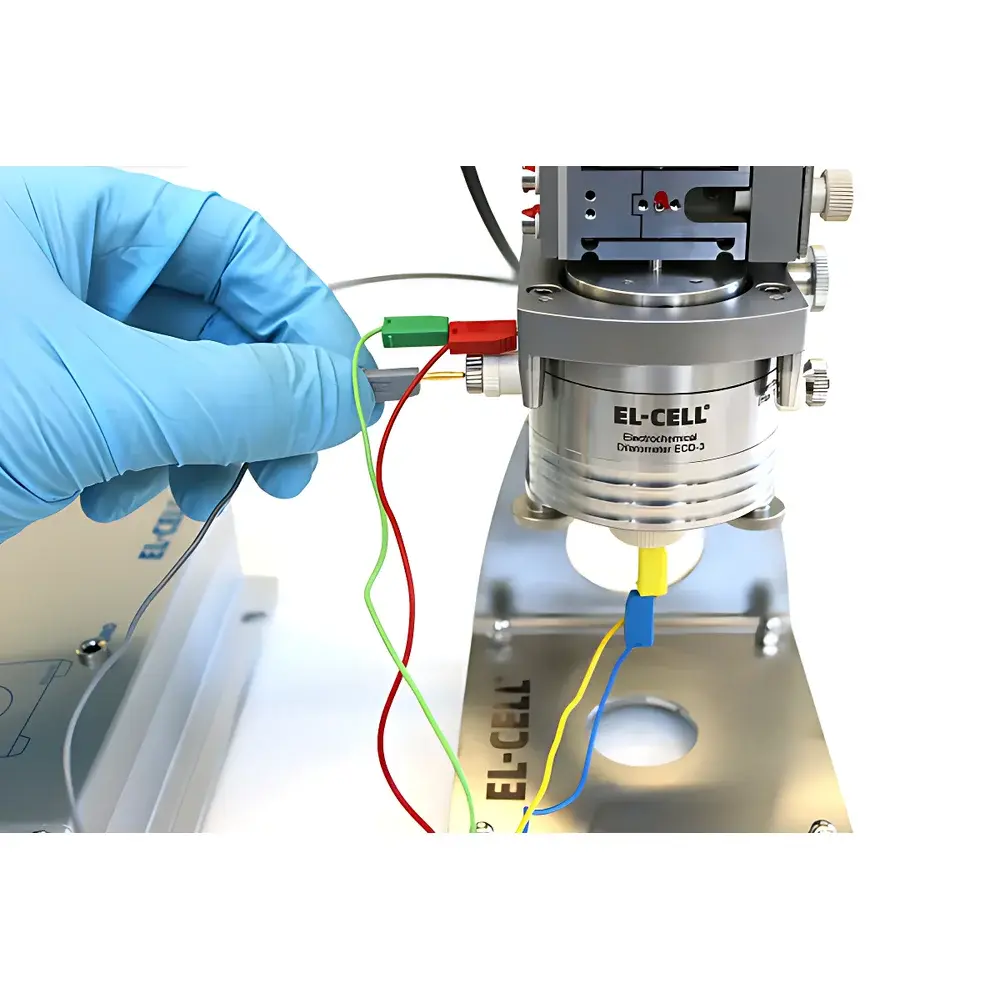
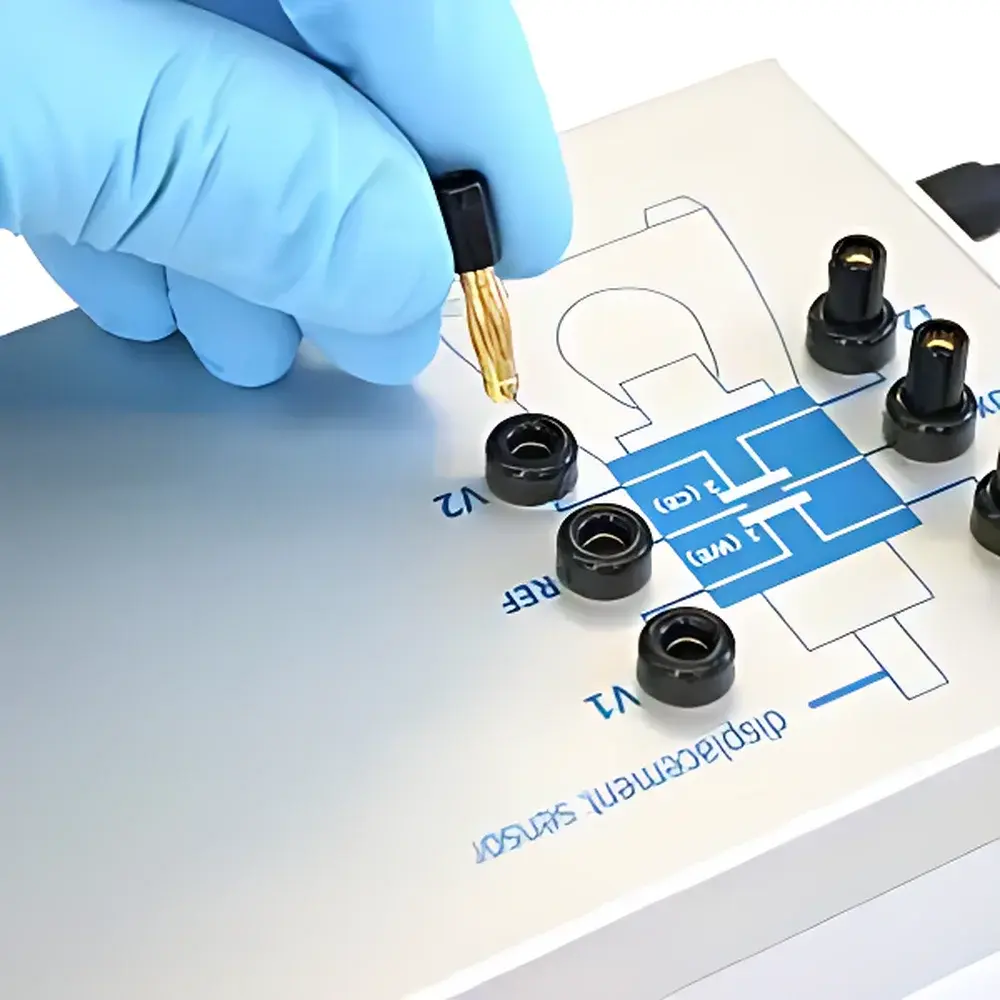
EL-Cell ECD-3 Electrochemical Dilatometer
| Brand | EL-Cell |
|---|---|
| Origin | Germany |
| Model | ECD-3 |
| Displacement Resolution | ≤50 nm |
| Measurement Range | 0–500 µm |
| Linear Sensor Output | ±10 V DC |
| Linearity | <0.15% of full scale |
| Drift | ≤100 nm/h |
| Electrolyte Volume Requirement | ~1 mL |
| Electrode Diameter | 10 mm (max thickness: 1.0 mm) |
| Operating Temperature Range | −20 °C to +70 °C |
| Dimensions (H×W×D) | 230 × 100 × 110 mm |
| Weight | 1.5 kg |
| Compatible Electrolytes | Organic (e.g., LiPF₆ in EC/DMC), Aqueous (with Au upgrade kit) |
| Load on Working Electrode | Fixed 130 g |
| Housing Material | PEEK |
| Seals | EPDM |
| Electrode Separation | Fused quartz frit |
Overview
The EL-Cell ECD-3 Electrochemical Dilatometer is a precision nanomechanical measurement system engineered for in situ, real-time quantification of dimensional changes—expansion and contraction—of battery electrodes during electrochemical cycling. It operates on the principle of high-resolution capacitive or inductive displacement sensing coupled with a rigid, hermetically sealed electrochemical cell architecture. Unlike conventional dilatometers used in thermal analysis, the ECD-3 is purpose-built for electrochemical environments, enabling direct correlation between charge/discharge states (e.g., Li⁺ intercalation/deintercalation) and volumetric strain in electrode materials. Its design addresses critical challenges in next-generation battery research: quantifying mechanical degradation mechanisms (e.g., particle cracking, SEI growth, binder fatigue), validating mechanical-electrochemical coupling models, and benchmarking electrode architectures—including binder-free films, single-crystal cathodes, and alloy anodes—under realistic operating conditions.
Key Features
- Nanometer-scale resolution (≤50 nm) with 500 µm total displacement range, enabling detection of both rapid transient swelling (e.g., initial lithiation bursts) and slow, cumulative expansion over multi-day aging tests.
- Hermetically sealed electrochemical cell with fused quartz frit separator, ensuring strict isolation from ambient atmosphere—critical for air-sensitive chemistries (e.g., Li-metal, sulfur, solid-state interfaces).
- Modular, glovebox-compatible mechanical design: compact footprint (230 × 100 × 110 mm), low mass (1.5 kg), and tool-free assembly/disassembly for rapid configuration changes between experiments.
- Dual-electrolyte compatibility: standard stainless steel (1.4404) construction for organic carbonate-based electrolytes; optional gold-plated components upgrade for stable operation in aqueous electrochemical systems (e.g., proton-conducting or neutral pH media).
- Fixed 130 g compressive load applied directly to the working electrode via a calibrated mass, replicating realistic stack pressure conditions encountered in pouch or cylindrical cells.
- Thermal operability from −20 °C to +70 °C when integrated with external temperature control units—supporting low-temperature Li plating studies and high-temperature SEI evolution kinetics.
- Low-drift performance (≤100 nm/h) over extended durations, validated under GLP-aligned long-term stability protocols, ensuring data integrity for week-long cycling experiments.
Sample Compatibility & Compliance
The ECD-3 accommodates diverse electrode geometries: free-standing thin films (up to 1 mm thick, Ø10 mm), slurry-cast composites, binder-free powder layers, and single-crystal or polycrystalline specimens. Its minimal electrolyte requirement (~1 mL) reduces material consumption and enables testing of scarce or synthetically challenging active materials. Cell housing is constructed from chemically inert PEEK, with EPDM elastomer seals rated for compatibility with common Li-ion electrolytes (e.g., 1 M LiPF₆ in EC:DMC) and mild aqueous systems. All wetted metallic parts comply with ASTM F899-22 (standard specification for stainless steel alloys in medical devices) and ISO 10993-1 biocompatibility screening prerequisites—relevant for biomedical battery development. The system supports audit-ready experimental documentation when paired with compliant data acquisition software adhering to FDA 21 CFR Part 11 requirements for electronic records and signatures.
Software & Data Management
The ECD-3 integrates a USB-connected data logger delivering analog ±10 V DC output proportional to displacement, compatible with industry-standard potentiostats (e.g., BioLogic SP-300, Gamry Interface 5000E) and DAQ systems (NI PXI, Keysight 34972A). Raw sensor signals are digitized at ≥1 kHz sampling rate, supporting time-resolved strain analysis synchronized with voltage/current profiles. EL-Cell provides open-format ASCII export (CSV/TXT) and MATLAB-compatible binary outputs. When deployed in regulated environments, users may implement third-party validated software platforms (e.g., DeltaTau PMAC, LabVIEW with GAMP 5-compliant modules) to enforce ALCOA+ data integrity principles—ensuring Attributable, Legible, Contemporaneous, Original, Accurate, Complete, Consistent, Enduring, and Available records per ICH-GCP and ISO/IEC 17025 guidelines.
Applications
- Quantitative strain mapping of layered oxide cathodes (NMC, NCA) during deep delithiation to assess structural instability thresholds.
- Real-time monitoring of silicon anode pulverization kinetics under varying C-rates and upper cutoff voltages.
- SEI growth-induced volumetric expansion in lithium metal anodes, correlated with Coulombic inefficiency and dendrite onset.
- Mechanical response of solid-state electrolyte/electrode interfaces under galvanostatic polarization.
- Proton exchange membrane (PEM) electrode swelling in fuel cell catalyst layers under hydration/dehydration cycles.
- Validation of multiscale continuum mechanics models (e.g., phase-field, finite strain plasticity) against empirical dilatometric datasets.
FAQ
What electrochemical techniques can be performed simultaneously with dilatometry?
Galvanostatic intermittent titration (GITT), cyclic voltammetry (CV), and constant-current cycling are fully supported. Potentiostatic holds and impedance spectroscopy (EIS) may be conducted with appropriate synchronization protocols.
Is the ECD-3 compatible with solid-state battery testing?
Yes—when used with compression fixtures and compatible solid electrolytes (e.g., LLZO, sulfides), provided interfacial contact is maintained. Custom cell adapters are available upon request.
How is calibration traceability established?
Each unit ships with a NIST-traceable calibration certificate referencing ISO/IEC 17025-accredited displacement standards. Users may perform in-house verification using certified gauge blocks or piezoelectric step calibrators.
Can multiple ECD-3 units be operated in parallel?
Yes—via independent USB channels and synchronized external triggers. EL-Cell offers multi-channel acquisition firmware upgrades for coordinated multi-cell studies.
What maintenance is required for long-term reliability?
Annual verification of seal integrity and sensor linearity is recommended. Quartz frits are replaceable; PEEK housings require only IPA cleaning between experiments.





