
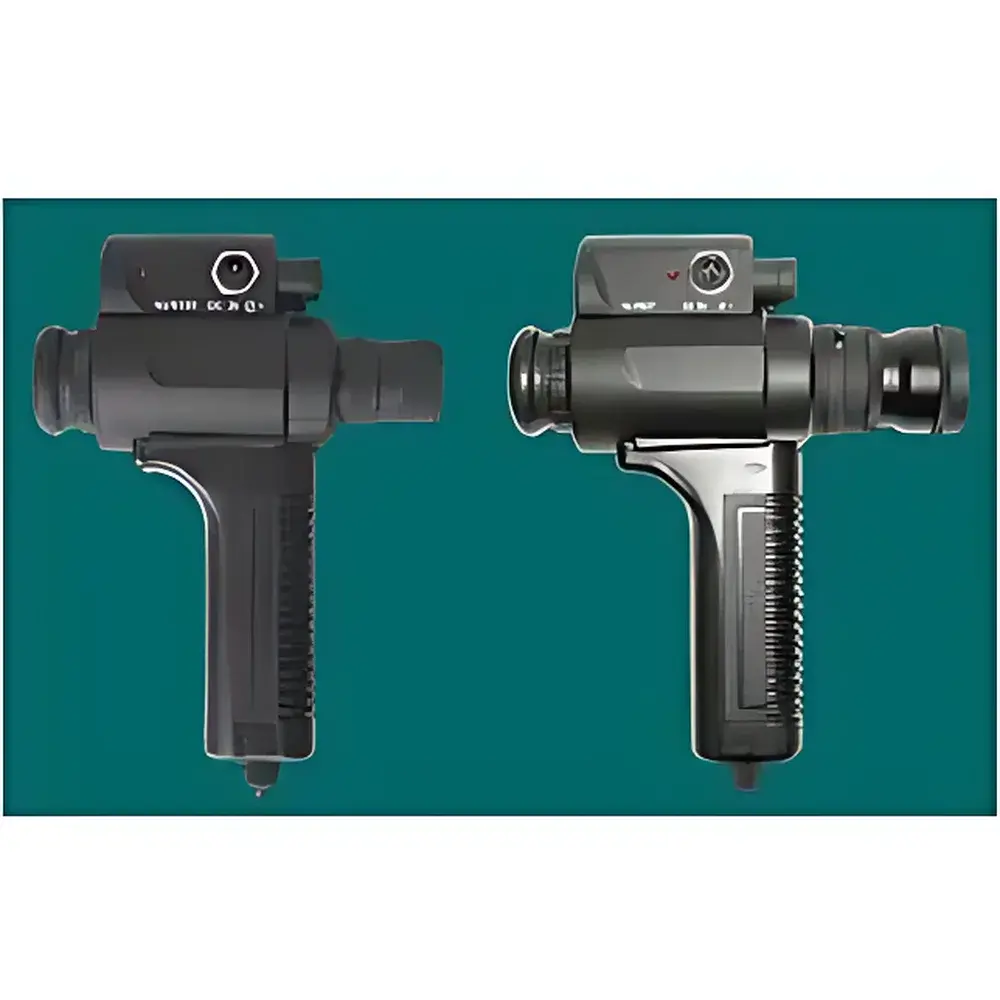
ElectroOptic ABRIS-M Series Infrared Laser Viewing Camera
| [Brand | ElectroOptic |
|---|---|
| Origin | Belarus |
| Model | ABRIS-M Series |
| Spectral Range | 350–2000 nm |
| Detector Type | Linear Infrared Photodetector Array |
| Cooling | Uncooled Operation |
| Operating Temperature | −10 °C to +40 °C |
| Angular Resolution (Center) | 20° field of view, 60 lp/mm |
| Output Wavelength | 550 nm (green phosphor) |
| Magnification | 2× |
| Objective Lens | F1.8/50 mm with iris |
| Focus Range | 0.25 m to infinity |
| Power Supply | 1.5 V AAA battery (35 h runtime) or external DC 3 V, ≤20 mA |
| Weight | 0.42 kg |
| Dimensions | 158 × 78 × 50 mm |
| Minimum Detectable Irradiance | 20 µW/cm² @ 1064 nm, 10 mW/cm² @ 1550 nm, up to 3 W/cm² @ 2000 nm] |
Overview
The ElectroOptic ABRIS-M Series Infrared Laser Viewing Camera is a compact, handheld image-converter device engineered for real-time visualization of near-infrared (NIR) and short-wave infrared (SWIR) radiation in the 350–2000 nm spectral band. Unlike thermal imaging systems that rely on blackbody emission, the ABRIS-M operates on the principle of photoelectron conversion: incident photons strike a photocathode (S-1 type), generating electrons accelerated by an internal 16–18 kV high-voltage supply toward a phosphor screen emitting green light at 550 nm. This electron-optical amplification enables direct visual observation—without digital processing—of low-power laser beams, fiber outputs, and optically excited fluorescence. Its uncooled architecture, minimal power requirement (1.5 V AAA), and mechanical simplicity make it suitable for field deployment, alignment tasks, and educational labs where robustness and immediate feedback are critical.
Key Features
- Compact ergonomic design (158 × 78 × 50 mm; 0.42 kg) with 1/4″-20 tripod thread for mounting on optical benches or camera rigs
- 2× magnified optical path with F1.8/50 mm objective lens and adjustable iris for optimized signal-to-noise ratio across varying irradiance levels
- High angular resolution of 60 line pairs per millimeter (lp/mm) at center field of view (20° FOV), supporting precise beam profiling and alignment verification
- Uncooled operation ensures stable performance without thermoelectric stabilization or warm-up delays—ideal for intermittent use in ambient environments (−10 °C to +40 °C)
- Dual power options: internal AAA alkaline cell (35 h continuous operation) or regulated external DC 3 V input (≤20 mA)
- Integrated high-voltage generator (16–18 kV) activated only when the momentary button is pressed—enhancing safety and battery longevity
- Modular compatibility: supports C-mount adapters for CCD/CMOS cameras and microscope couplers for NIR microscopy applications
Sample Compatibility & Compliance
The ABRIS-M series is compatible with pulsed and CW lasers operating from UV (350 nm) through SWIR (2000 nm), including common industrial and telecom wavelengths such as 980 nm, 1064 nm, 1310 nm, 1550 nm, 1650 nm, and 1800 nm. Minimum detectable irradiance thresholds are wavelength-dependent and calibrated per ISO 11551 (Laser and laser-related equipment — Test methods for laser beam parameters), ranging from 20 µW/cm² at 1064 nm to 3 W/cm² at 2000 nm. While not a radiometric measurement instrument, its response profile aligns with typical S-1 photocathode sensitivity curves and has been validated in accordance with GLP-aligned lab practices for qualitative beam diagnostics. It does not meet FDA 21 CFR Part 11 requirements for electronic records, as it produces no digital data output.
Software & Data Management
The ABRIS-M is an analog optical viewing instrument with no embedded firmware, memory, or software interface. It generates no digital files, timestamps, or metadata—making it inherently compliant with air-gapped environments and legacy optical workflows. When coupled with external imaging hardware (e.g., scientific CMOS cameras via C-mount adapter), users retain full control over acquisition parameters (exposure, gain, frame rate) using standard machine vision SDKs (e.g., GenICam, Spinnaker). No proprietary drivers or vendor lock-in is required. For documentation purposes, video capture may be archived under institutional SOPs for laser safety audits or alignment traceability.
Applications
- Laser Alignment & Beam Diagnostics: Real-time visualization of collimation, divergence, mode structure, and spatial overlap in free-space and fiber-coupled NIR/SWIR systems (e.g., Ti:sapphire, OPOs, quantum cascade lasers)
- Forensic & Cultural Heritage Analysis: Non-destructive inspection of ink composition, pigment layering, and substrate aging in documents, manuscripts, paintings, and engravings under 780–1000 nm illumination with appropriate IR-pass filters
- Semiconductor Inspection: Visualization of subsurface features in silicon and GaAs wafers using 1150–1350 nm illumination—complementing visible-light microscopy protocols
- Fiber Optics & Telecom: Monitoring output modes from single-mode and multimode fibers (SMF-28, PM fibers), arrayed waveguide gratings (AWGs), and PLC splitters without coupling loss
- Biomedical & Plant Physiology: Observing chlorophyll fluorescence, vascular patterns, and tissue transparency in leaf sections or excised biological samples under NIR excitation
- UV-Induced NIR Emission: Detection of upconversion phosphors (e.g., Yb³⁺/Er³⁺ doped crystals) and NIR-emitting fluorophores stimulated by UV sources (254–365 nm)
FAQ
What laser wavelengths can the ABRIS-M visualize?
It responds across 350–2000 nm, with detection thresholds varying by wavelength: 20 µW/cm² at 1064 nm, 10 mW/cm² at 1550 nm, and up to 3 W/cm² at 2000 nm. Performance depends on beam diameter, divergence, and ambient lighting conditions.
Is the ABRIS-M suitable for quantitative power measurement?
No. It is a qualitative imaging tool—not calibrated for radiometry. Use NIST-traceable thermopile or photodiode sensors for power/energy quantification.
Can it be mounted on a microscope?
Yes—via optional microscope coupler adapters (1× or 2× magnification variants), enabling NIR fluorescence mapping and wafer-level defect inspection.
Why is no battery included?
International air transport regulations (IATA PI 965 Section II) prohibit shipping devices with installed alkaline batteries. A standard AAA cell must be inserted prior to first use.
What is the expected service life under laboratory conditions?
Units deployed in academic and industrial labs since the early 2000s remain operational beyond 12 years with proper storage (dry, dark, room temperature) and periodic cathode activation.
Does it require recalibration?
No. The image-converter tube has no user-serviceable components and retains stable gain characteristics over its operational lifetime. No factory recalibration interval is specified.




