
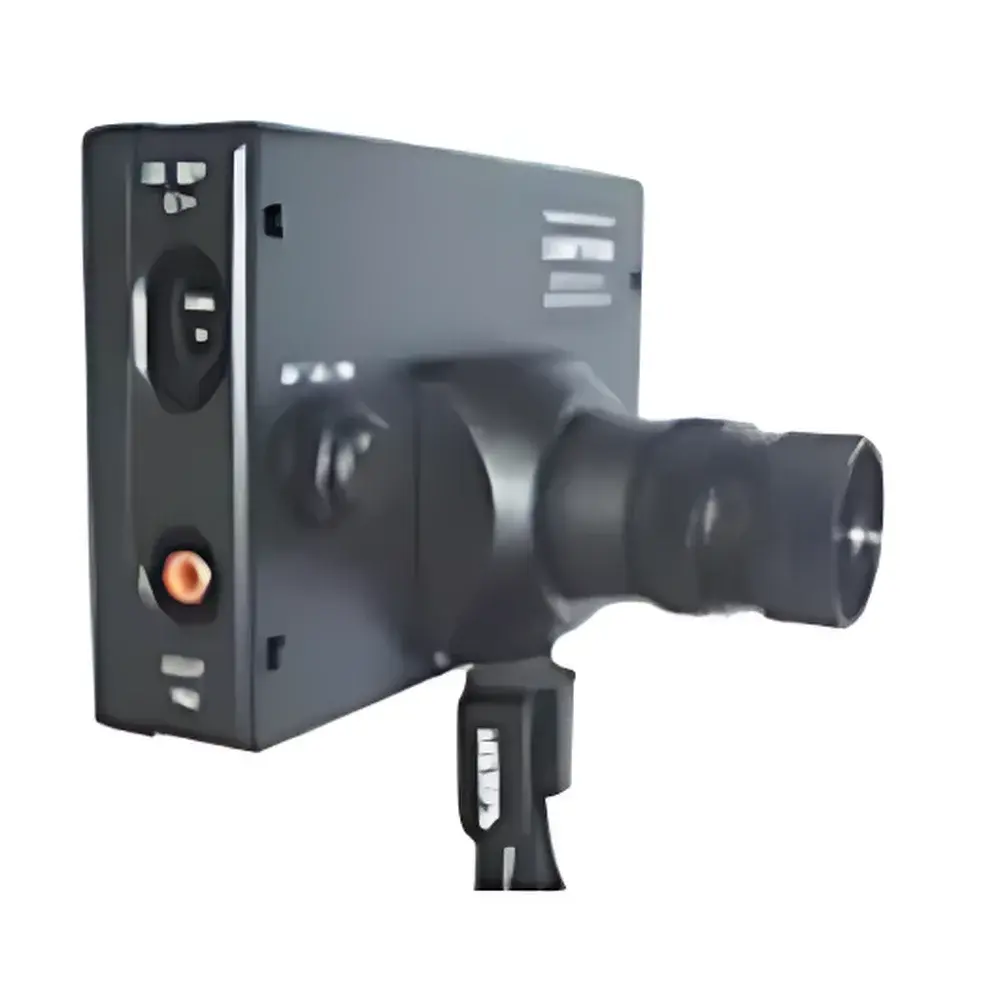
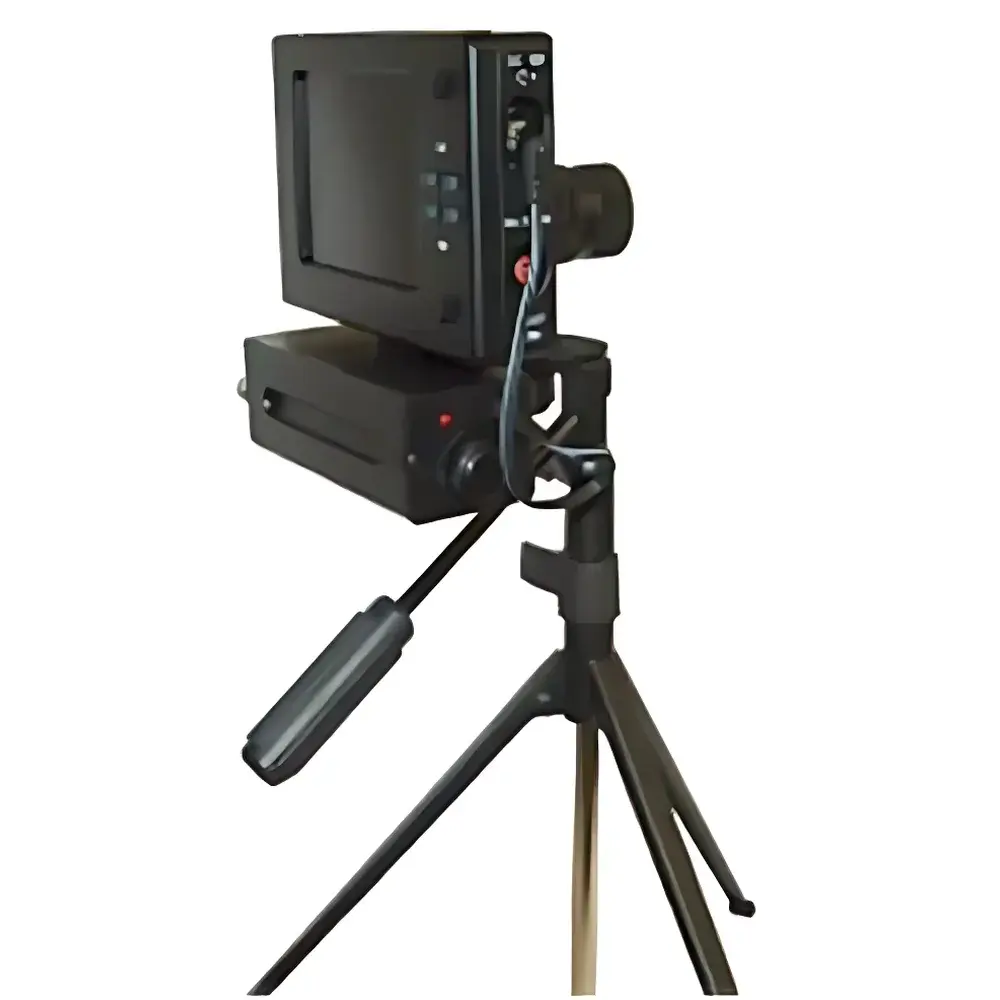
ElectroOptic CONTOUR-M Near-Infrared TV Imaging Camera
| Brand | ElectroOptic |
|---|---|
| Origin | Russia |
| Model | CONTOUR-M |
| Spectral Range | 400–1700 nm |
| Sensor Type | High-Sensitivity Silicon CCD |
| Display | 4-inch TFT LCD |
| Mounting Thread | 1/4"-20 internal thread |
| Form Factor | Handheld, Compact Design |
| Intended Use | IR beam alignment, NIR system characterization, IR microscopy support, luminescence visualization, and cultural heritage diagnostics |
Overview
The ElectroOptic CONTOUR-M Near-Infrared TV Imaging Camera is a dedicated real-time visualization instrument engineered for qualitative and semi-quantitative observation of near-infrared (NIR) radiation in the 400–1700 nm spectral band. Unlike broadband visible-light cameras, the CONTOUR-M leverages a specially selected silicon-based CCD sensor with extended red/NIR quantum efficiency—optimized to detect emissions from GaAs LEDs, diode lasers (e.g., 808 nm, 980 nm, 1550 nm), solid-state NIR lasers, and thermally excited NIR sources. Its operational principle relies on photon-to-electron conversion within the depleted region of the CCD, followed by analog signal amplification and digitization for live display on an integrated 4-inch TFT LCD. The camera does not provide calibrated radiometric output or spectral decomposition; rather, it serves as a high-contrast, low-latency alignment and diagnostic tool for optical path verification, component positioning, and spatial pattern recognition in NIR systems. It is commonly deployed during laser cavity alignment, fiber coupling optimization, thermal emission mapping, and non-invasive inspection of layered materials.
Key Features
- Extended spectral response from 400 nm (visible violet) to 1700 nm (short-wave infrared), enabling visualization across multiple NIR laser bands without filter switching
- High-sensitivity silicon CCD sensor with thermoelectric stabilization to suppress dark current and improve signal-to-noise ratio during prolonged exposure
- Integrated 4-inch high-resolution TFT LCD display with adjustable brightness and contrast—enabling immediate visual feedback without external monitors or frame grabbers
- Compact, ergonomic housing with 1/4″-20 UNC internal mounting thread compliant with standard optical breadboard and post accessories (e.g., Thorlabs, Newport)
- No external power supply required: powered via USB 2.0 interface (5 V DC, <500 mA), supporting plug-and-play operation in lab and field environments
- Minimal optical distortion and uniform pixel response across the active area—critical for accurate beam centroid estimation and relative intensity profiling
Sample Compatibility & Compliance
The CONTOUR-M is compatible with any NIR-emitting source operating within its spectral window, including but not limited to edge-emitting laser diodes, VCSEL arrays, superluminescent diodes (SLDs), and incandescent filaments filtered for NIR transmission. It supports passive imaging of NIR fluorescence (e.g., from rare-earth-doped phosphors or biological fluorophores with NIR emission), though excitation must be provided externally. While not certified for medical or industrial safety-critical applications, the device conforms to IEC 61000-6-3 (EMC emission limits) and IEC 61000-6-1 (immunity requirements) for laboratory equipment. Its mechanical design follows ISO 10110-7 standards for optical mounting interface geometry. No intrinsic laser safety classification (e.g., Class 1/1M/2) is assigned to the camera itself; users must comply with applicable local laser safety regulations (ANSI Z136.1, IEC 60825-1) when integrating with Class 3B or Class 4 sources.
Software & Data Management
The CONTOUR-M operates in standalone mode via its built-in display, requiring no host software for basic functionality. For documentation and archival purposes, optional USB video class (UVC) compatibility enables direct capture using industry-standard tools such as VLC Media Player, OBS Studio, or MATLAB’s Image Acquisition Toolbox (with appropriate UVC driver support). Frame rate is fixed at 25–30 fps depending on illumination level and gain setting. No proprietary SDK or API is provided; however, the device generates uncompressed YUV422 video streams compatible with third-party machine vision libraries (e.g., OpenCV). Audit-trail metadata (timestamp, gain, exposure index) is not embedded in the video stream—users implementing GLP/GMP workflows must log acquisition parameters manually or via external synchronization.
Applications
- Laser beam alignment and collimation verification in free-space NIR optical setups
- Characterization of NIR optical components—including lenses, filters, waveplates, and fiber couplers—via transmitted/reflected intensity distribution analysis
- Support for NIR microscopy: real-time monitoring of sample illumination uniformity and focus position in transmitted-light NIR modalities
- Cultural heritage science: visualization of underdrawings, pigment layer stratigraphy, and varnish degradation beneath visible-opacity surfaces (e.g., oil paintings, parchment manuscripts)
- Industrial process monitoring: detection of hot spots in electronic assemblies, weld seam integrity assessment, and moisture content mapping in agricultural products
- Education and training: hands-on demonstration of NIR transparency, scattering behavior, and detector spectral response limitations
FAQ
Does the CONTOUR-M provide radiometric calibration or absolute irradiance measurements?
No. It is a qualitative imaging tool optimized for spatial pattern recognition and alignment—not quantitative photometry.
Can it image through silicon wafers or germanium optics?
Yes, within its spectral range: silicon is transparent up to ~1100 nm; germanium transmits strongly from ~1800 nm onward, so partial transmission may occur at 1550 nm depending on thickness and surface finish.
Is the CCD cooled? What is the typical dark current at room temperature?
The sensor incorporates passive thermal management and low-noise readout architecture. Dark current remains below 0.5 e⁻/pixel/s at 25°C ambient, sufficient for exposures ≤1 s without significant accumulation.
What is the effective pixel resolution and field of view with standard C-mount lenses?
The native sensor resolution is 752 × 582 pixels (interlaced). With a standard 25 mm focal length C-mount lens, diagonal FOV approximates 18°; exact values depend on lens magnification and working distance.
Is FDA 21 CFR Part 11 compliance supported?
No. The device lacks electronic signature capability, audit trail logging, or user access control—features required for regulated environments.






