
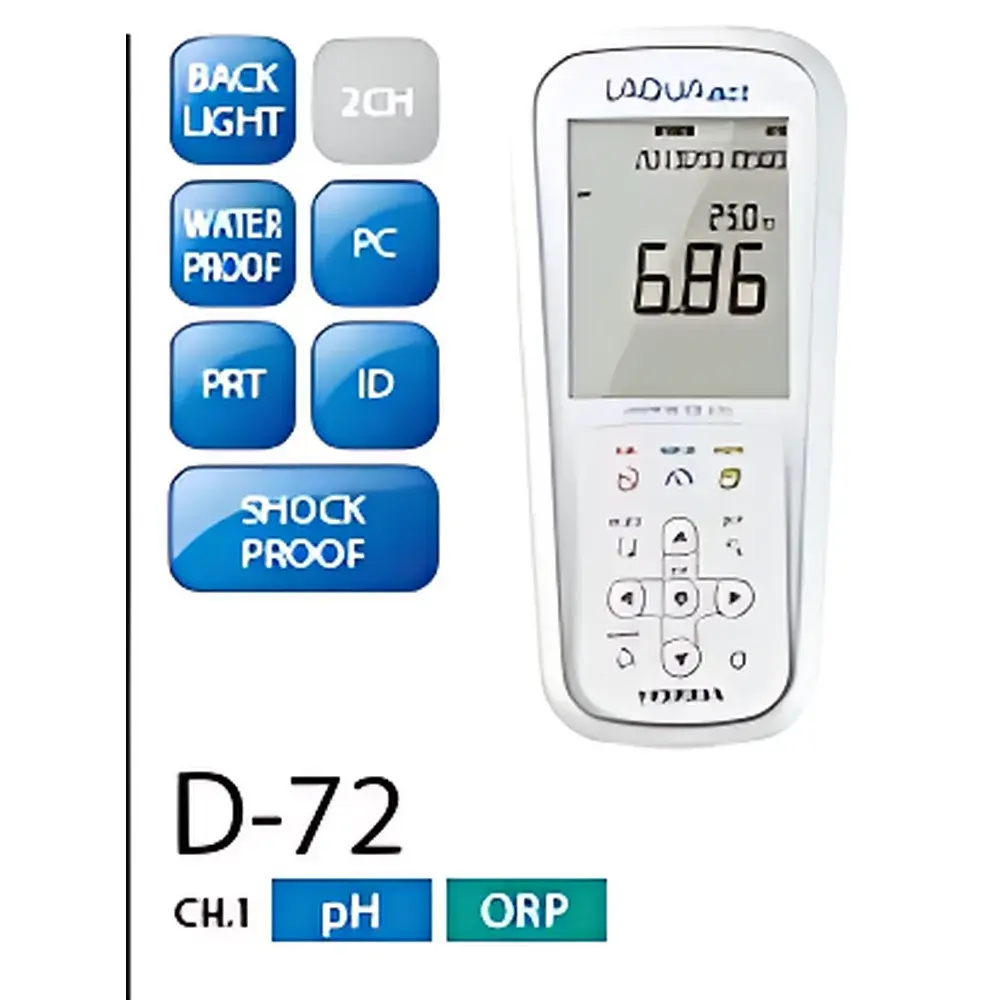
HORIBA LAQUAact D-72 Portable pH/ORP Meter
| Brand | HORIBA |
|---|---|
| Origin | Japan |
| Model | D-72 |
| Instrument Type | Portable/Handheld Water Quality Analyzer |
| Measurable Parameters | pH, ORP (Redox), Conductivity |
| Display | Dual-parameter LCD with backlight |
| Enclosure Rating | IP67 |
| Data Storage | 1,000 measurements |
| Power | ~1000 hours battery life (alkaline) |
| Electrode Mount | Rotatable, single-hand adjustable stand |
| Housing Material | Impact-resistant polycarbonate |
| Compliance | GLP/GMP-compliant data output (with optional printer and software) |
| Connectivity | PC interface via optional USB cable (software available via registered user download) |
| Cleaning Compatibility | Wipeable with ethanol, weak acids/bases, and oils |
Overview
The HORIBA LAQUAact D-72 is a rugged, field-deployable handheld meter engineered for reliable, on-site measurement of pH, oxidation-reduction potential (ORP), and electrical conductivity in diverse aqueous environments. Designed using Couette-type electrode geometry and temperature-compensated potentiometric principles, the D-72 delivers high reproducibility across variable ambient conditions—from municipal wastewater treatment plants to remote freshwater sampling sites and industrial process streams. Its core architecture reflects HORIBA’s decades-long expertise in electrochemical sensor design, emphasizing stability under mechanical stress, chemical exposure, and thermal fluctuation. Unlike benchtop analyzers requiring controlled lab environments, the D-72 operates without external power sources or calibration stations—enabling immediate deployment during emergency response, regulatory inspections, or routine QA/QC field audits.
Key Features
- Rugged IP67-rated enclosure: Fully sealed against dust ingress and submersible up to 1 m for 30 minutes—ideal for wet, muddy, or splash-prone operational zones.
- Polycarbonate housing: Offers ~2× higher impact resistance than conventional ABS resin; chemically inert toward ethanol, dilute acids/bases, and hydrocarbon-based contaminants—enabling rapid decontamination without degradation.
- Dual-parameter LCD display: Backlit, high-contrast screen with 1.4× larger viewing area vs. prior-generation models; supports simultaneous real-time readouts of pH and ORP, or pH and conductivity—eliminating manual mode switching during multi-parameter surveys.
- Ergonomic single-hand operation: Three dedicated tactile buttons (ON/OFF, HOLD, MODE) positioned for intuitive thumb access; compact form factor (158 × 80 × 40 mm) ensures secure grip and fatigue-free extended use.
- Rotatable electrode stand: Integrated swivel mount allows vertical/horizontal positioning adjustment without tools—facilitating stable tabletop measurements while retaining portability.
- Extended battery endurance: Optimized circuitry reduces power draw by ~90% versus legacy units; achieves ~1000 hours of continuous operation on standard AA alkaline batteries—critical for unattended monitoring or multi-day field campaigns.
Sample Compatibility & Compliance
The D-72 is validated for use with standard gel-filled combination pH electrodes (e.g., HORIBA 9615S-10D) and platinum ORP sensors, supporting measurements in natural waters (rivers, lakes, groundwater), treated effluents, cooling tower fluids, and food/beverage process streams. Conductivity measurements comply with ASTM D1125–22 (Standard Test Methods for Electrical Conductivity of Water) and ISO 7888:2019 (Water quality — Determination of electrical conductivity). All stored datasets include timestamp, temperature, electrode ID (if auto-recognized), and calibration history—structured to satisfy GLP and GMP audit requirements per FDA 21 CFR Part 11 when paired with HORIBA’s certified data transfer software and optional thermal printer.
Software & Data Management
Internal memory retains up to 1,000 measurement records with full metadata (date/time, parameter values, temperature, operator ID if entered). Data export is enabled via optional USB interface cable (model LAQUA-USB-01); HORIBA’s LAQUA Connect software—freely downloadable after registration on the official HORIBA global portal—supports CSV export, trend visualization, statistical summary (mean, SD, min/max), and automated report generation compliant with ISO/IEC 17025 documentation standards. The software enforces electronic signature capture and audit-trail logging for all calibration, configuration, and data export events.
Applications
- Environmental field monitoring: Rapid assessment of acid mine drainage (pH/ORP correlation), eutrophication indicators (conductivity trends), and sediment pore-water redox status.
- Municipal water utilities: On-the-spot verification of disinfection residual efficacy (via ORP), distribution system corrosion potential, and source water variability.
- Industrial process control: Real-time tracking of rinse bath neutrality, plating bath stability, and bioreactor redox setpoints in pharmaceutical manufacturing.
- Educational laboratories: Robust platform for undergraduate electrochemistry experiments—resistant to accidental drops, solvent spills, and repeated student handling.
- Regulatory compliance: Supports EPA Method 150.1 (pH), Method 150.2 (conductivity), and ASTM D3223–21 (ORP) for field-collected samples prior to lab confirmation.
FAQ
Does the D-72 support automatic temperature compensation (ATC) for all parameters?
Yes—integrated NTC thermistor enables ATC for pH, ORP, and conductivity measurements across 0–50 °C.
Can the D-72 be calibrated in the field without a computer?
Yes—full 1–3 point pH calibration and 1-point ORP offset adjustment are performed directly on-device using standard buffer solutions (e.g., pH 4.01/7.00/10.01, Zobell’s solution).
Is electrode calibration data stored with each measurement?
Yes—each saved record includes the date/time of last calibration, slope (%), and offset (mV) for traceability.
What is the operating temperature range for the instrument itself (not sample)?
–10 °C to +50 °C, with relative humidity ≤85% non-condensing.
Does the D-72 meet international electromagnetic compatibility (EMC) standards?
Yes—certified to IEC 61326-1:2013 (industrial environment) and EN 61000-6-2:2019 (immunity) / EN 61000-6-3:2019 (emissions).
Related Products







