
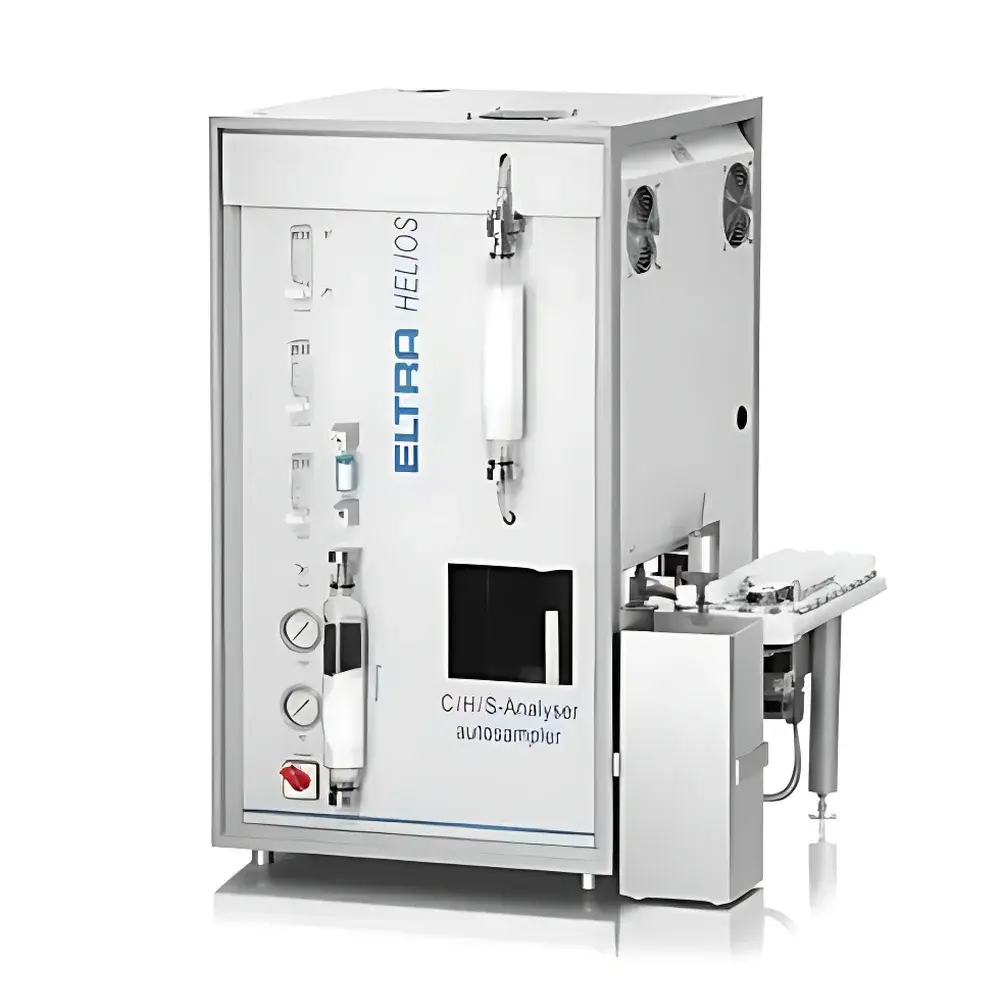
ELTRA CHS-580A Automated Carbon-Hydrogen-Sulfur Analyzer with High-Temperature Vertical Resistance Furnace and Gold-Coated IR Cells
| Brand | ELTRA |
|---|---|
| Origin | Germany |
| Model | CHS-580A |
| Measurement Principle | Infrared Absorption Spectroscopy |
| Heating System | Vertical Resistance Furnace (Ceramic Tube, Max. 1550 °C, Adjustable in 1 °C Increments) |
| Sample Capacity | Up to 500 mg (Including Heterogeneous Materials) |
| Analysis Time | 60–180 s per Sample |
| Combustion Power | Up to 2000 W |
| C Range | 0.005–100 wt% |
| H Range | 0.01–15 wt% |
| S Range | 0.005–20 wt% (Customizable Ranges Available) |
| Autosampler Options | 36-position or 130-position Crucible Carousels |
| IR Cell Enhancement | Gold-Coated Optical Path for Extended Lifetime and Compatibility with Halogen- or Acid-Containing Samples |
Overview
The ELTRA CHS-580A is a high-precision, fully automated elemental analyzer engineered for the simultaneous quantitative determination of carbon (C), hydrogen (H), and sulfur (S) in organic and organometallic materials. It operates on the principle of high-temperature combustion coupled with non-dispersive infrared (NDIR) absorption spectroscopy. Solid or liquid samples are combusted quantitatively in a vertical resistance furnace under controlled oxygen flow, converting all C, H, and S into CO₂, H₂O, and SO₂, respectively. These gaseous products are then swept through thermally stabilized, gold-coated infrared gas cells where their concentrations are measured via characteristic absorption bands at specific wavelengths. The vertical furnace design—featuring a ceramic tube and precise temperature control from ambient to 1550 °C in 1 °C increments—ensures complete oxidation even for refractory or heterogeneous matrices, including polymers, pharmaceutical intermediates, catalysts, coal, and biomass derivatives.
Key Features
- Vertical high-temperature resistance furnace with ceramic tube construction and programmable ramp/soak profiles up to 1550 °C
- Gold-coated infrared detection cells for enhanced chemical resistance, extended service life, and reliable analysis of halogenated or acidic samples
- Integrated 36-position or 130-position autosampler for unattended operation and high-throughput laboratory workflows
- Robust mechanical architecture designed for continuous use in both R&D laboratories and production quality control environments
- No consumable catalysts required; maintenance-free combustion system with optimized gas flow dynamics and integrated moisture removal
- Modular configuration supporting customizable calibration ranges, optional gas purification modules, and integration with LIMS via Ethernet or RS232
Sample Compatibility & Compliance
The CHS-580A accommodates a broad spectrum of organic and low-inorganic-content materials—including pharmaceutical actives, synthetic polymers, rubber compounds, food additives, agrochemicals, and environmental reference standards. Sample masses range from 1 mg to 500 mg, enabling accurate analysis of trace-level analytes as well as major constituents. The instrument complies with core regulatory expectations for elemental analysis instrumentation: measurement traceability to NIST-traceable standards, documented system suitability testing, and full audit trail capability. Its software architecture supports 21 CFR Part 11-compliant user access control, electronic signatures, and immutable data logging—making it suitable for GLP and GMP-regulated environments. Method validation protocols align with ASTM D5373 (for coal and coke), ISO 29541 (carbon in polymers), and USP <231> / <232> (elemental impurities in pharmaceuticals).
Software & Data Management
The proprietary ELTRA Analytical Software provides intuitive method setup, real-time signal monitoring, and comprehensive post-run evaluation tools. It supports multilingual interfaces (English, German, French, Spanish, Chinese, Japanese), customizable report templates (PDF, CSV, XML), and configurable result displays with statistical summaries (mean, SD, RSD, confidence intervals). Calibration routines include single-point verification, multi-point linear/non-linear regression, and drift correction using internal reference standards. All analytical sequences are timestamped and stored with full metadata—including operator ID, furnace parameters, gas flow rates, and raw IR absorbance spectra—ensuring full data integrity and retrospective review capability. Export functions enable seamless integration with enterprise LIMS and ERP platforms.
Applications
- Pharmaceutical QC: Quantification of residual solvents, excipient composition, and elemental impurity profiling per ICH Q3D guidelines
- Materials Science: Carbon/hydrogen stoichiometry verification in MOFs, conductive polymers, and carbon black formulations
- Fuel & Energy: Total sulfur content in biofuels, jet fuels, and lubricants per ASTM D2622 and ISO 8754
- Environmental Testing: Organic carbon and total sulfur in soils, sediments, and fly ash according to EPA Method 9060A
- Academic Research: Reaction monitoring in catalytic hydrogenation/dehydrogenation studies and thermal decomposition kinetics
FAQ
What sample types are compatible with the CHS-580A?
Solid powders, granules, pellets, films, liquids (via sealed crucibles), and viscous pastes—provided they contain ≤10 wt% inorganic ash and no free metals or strong oxidizers.
Is external calibration gas required for routine operation?
No. The system uses solid certified reference materials (CRMs) for calibration; optional span gas verification is available for critical audits.
How does the gold-coated IR cell improve performance over standard aluminum cells?
Gold provides superior corrosion resistance against SO₂, HCl, HF, and acidic condensates, extending cell lifetime by ≥3× and reducing baseline drift during long-term sequence runs.
Can the CHS-580A be validated for regulated pharmaceutical use?
Yes—full IQ/OQ/PQ documentation packages are available, and the software supports ALCOA+ data integrity principles including attributable, legible, contemporaneous, original, and accurate records.
What maintenance is required beyond routine cleaning?
Annual verification of furnace temperature uniformity, IR cell alignment, and gas flow calibration; no routine replacement of optical components or catalysts is necessary.






