
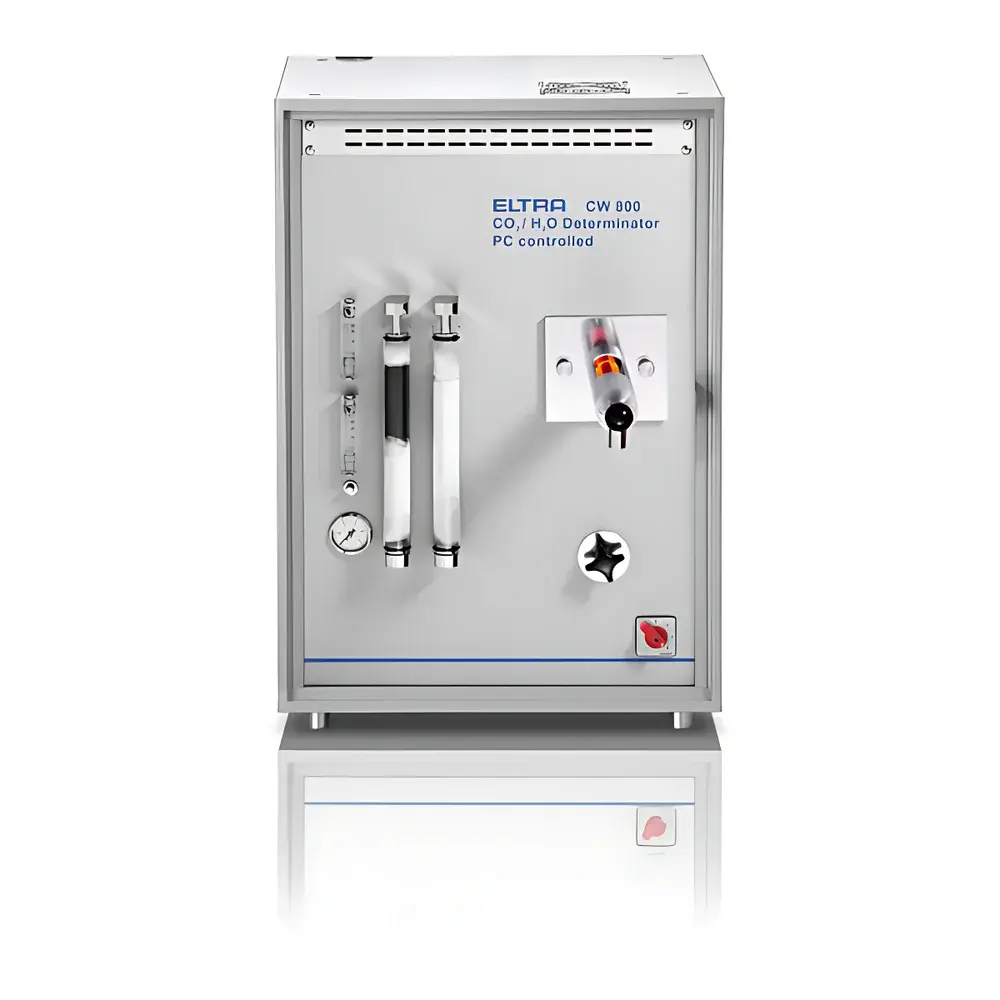
ELTRA CW-800 Carbon and Water Determinator
| Brand | ELTRA |
|---|---|
| Origin | Germany |
| Model | CW-800 |
| Measurement Principle | Infrared Absorption |
| Heating System | Resistance Furnace (up to 1000 °C, adjustable in 1 °C increments) |
| Sample Introduction | Quartz Boat |
| Carrier Gas | Nitrogen (standard) |
| Detection | Dual Independent IR Cells (CO₂ and H₂O) |
| Cell Material | Gold-Plated IR Cells |
| Calibration | Single-Point and Multi-Point |
| Gas Flow Control | Electronic Mass Flow Controller |
| Compliance | Designed for GLP/GMP environments |
| Software | Multilingual, customizable reporting, real-time process monitoring |
| Analysis Time | ~2–3 min per sample |
| Sample Form | Solids (powders, granules, pellets) |
| Maintenance | Maintenance-free gas path |
Overview
The ELTRA CW-800 Carbon and Water Determinator is a high-precision, dual-channel infrared combustion analyzer engineered for the quantitative determination of total carbon dioxide (CO₂) and moisture (H₂O) content in inorganic solids. Unlike conventional elemental analyzers focused on C/S or CHNS, the CW-800 operates on a dedicated thermal decomposition–infrared detection principle: samples are combusted quantitatively in a controlled oxidative atmosphere within a high-stability resistance furnace, and evolved CO₂ and H₂O vapors are separately measured using two independent, gold-plated infrared absorption cells. This architecture ensures stoichiometric release and selective detection without cross-interference—critical for materials where carbonate decomposition (e.g., CaCO₃ → CaO + CO₂) and bound water (e.g., gypsum dihydrate, CaSO₄·2H₂O) must be resolved independently. The instrument is purpose-built for quality assurance in cement, lime, plaster, and mineral processing industries, where regulatory compliance (e.g., ASTM C114, EN 196-2, ISO 29581-2) mandates trace-level accuracy in loss-on-ignition (LOI)-equivalent speciation.
Key Features
- Resistance furnace with precise 1 °C temperature resolution, programmable up to 1000 °C—optimized for complete carbonate decomposition and dehydration of refractory hydrates.
- Dual gold-plated infrared detection cells: one for CO₂ (4.26 µm band), one for H₂O (2.7 µm band), enabling simultaneous, non-dispersive quantification with no spectral overlap or chemical interference.
- Quartz tube combustion system with integrated oxidation catalysts; compatible with nitrogen carrier gas and optional oxygen-enriched purge for challenging matrices.
- Electronic mass flow controller ensures repeatable, drift-free gas delivery—eliminating mechanical rotameters and associated calibration drift.
- Maintenance-free optical path: gold-coated cells resist corrosion from halogenated, acidic, or sulfur-rich samples (e.g., fly ash, flue gas desulfurization residues), extending service life beyond 10,000 analyses.
- Full software integration with configurable workflows: method templates, user-defined calculation formulas (e.g., %CaCO₃ = %CO₂ × 2.291), automatic blank subtraction, and statistical reporting per ISO/IEC 17025.
Sample Compatibility & Compliance
The CW-800 accepts solid samples in powder, pellet, or crushed form—typically 0.1–1.0 g—without acid digestion or solvent extraction. Validated matrices include Portland cement clinker, limestone, dolomite, gypsum, anhydrite, kaolin, bauxite, phosphate rock, and contaminated soils. Each analysis conforms to thermogravimetric equivalence principles defined in ASTM C114 (Standard Test Methods for Chemical Analysis of Hydraulic Cement) and EN 196-2 (Methods of Testing Cement — Chemical Analysis). Instrument firmware and software support full 21 CFR Part 11 compliance: electronic signatures, role-based access control, immutable audit trails, and data integrity verification. Routine operation meets GLP and GMP documentation requirements for QC laboratories in construction materials certification and raw material supplier qualification.
Software & Data Management
ELTRA’s WinELTRA software provides a validated, multilingual platform (English, German, French, Spanish, Chinese) with intuitive method setup, real-time combustion profile visualization, and automated report generation in PDF, CSV, or LIMS-compatible XML. All measurement parameters—including furnace ramp rate, hold time, gas flow setpoints, and IR baseline correction—are stored with timestamps and operator ID. Calibration curves support both single-point verification and multi-point linear/nonlinear regression with R² validation. Raw IR absorbance spectra are archived alongside processed results, enabling retrospective reprocessing and uncertainty budgeting per GUM (Guide to the Expression of Uncertainty in Measurement). Data export includes ISO/IEC 17025-compliant metadata: instrument ID, calibration due date, environmental conditions (temperature/humidity logs), and analyst signature.
Applications
- Cement manufacturing: Quantification of free lime (CaO), calcined clay content, and residual carbonates affecting strength development and setting time.
- Lime industry: Verification of calcination efficiency in quicklime (CaO) and hydrated lime (Ca(OH)₂) production.
- Gypsum processing: Differentiation between dihydrate (CaSO₄·2H₂O), hemihydrate (CaSO₄·0.5H₂O), and anhydrite phases via controlled dehydration profiling.
- Mineral exploration: Rapid screening of carbonate gangue content in iron ore, bauxite, and phosphate deposits.
- Environmental testing: Determination of organic carbon interference in soil LOI protocols (ASTM D7551) and landfill leachate solid residue characterization.
- Research laboratories: Method development for novel binders (e.g., calcium sulfoaluminate cements), carbon capture material regeneration studies, and hydration kinetics modeling.
FAQ
What sample preparation is required prior to analysis?
No acid digestion or solvent treatment is needed. Samples are dried, homogenized, and weighed directly into quartz boats—typical mass range: 0.2–0.5 g.
Can the CW-800 distinguish between different forms of water (e.g., adsorbed vs. structural)?
Yes—via programmable temperature ramps, the instrument can isolate low-temperature physisorbed water (<200 °C) from higher-temperature crystalline or lattice-bound water (e.g., gypsum at 150–200 °C, brucite at 350 °C).
Is external calibration gas required for daily operation?
No—calibration uses certified reference materials (CRMs) traceable to NIST or BAM; zero gas is ambient-grade nitrogen, verified by built-in flow and pressure sensors.
How does the gold-plated IR cell improve long-term stability?
Gold coating prevents oxidation and halogen-induced etching of the detector window surface, maintaining optical transmission stability over >5 years under continuous industrial use.
Does the system support integration with laboratory information management systems (LIMS)?
Yes—via ODBC and ASTM E1384-compliant HL7/ADT interfaces; raw data and reports export in structured formats with embedded metadata for automated ingestion.





