
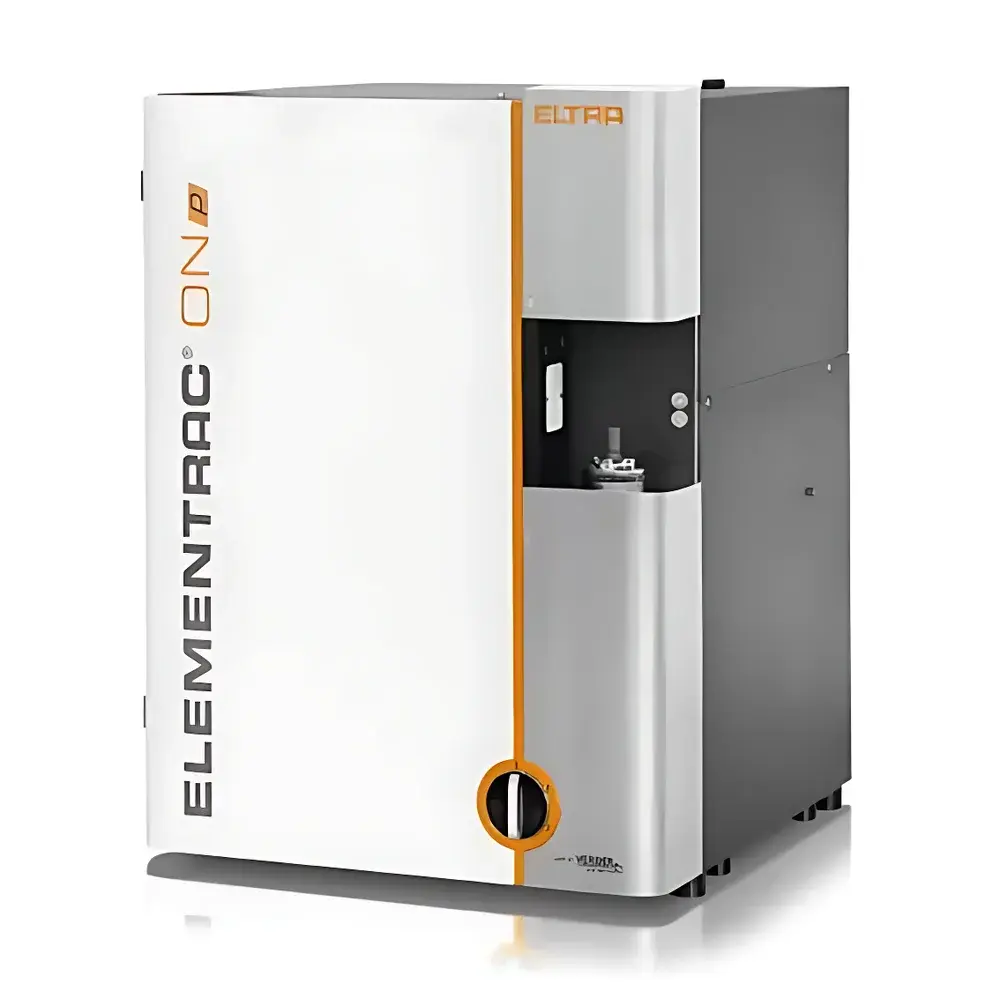
ELTRA ELEMENTRAC ON-p 2 Oxygen and Nitrogen Analyzer
| Brand | ELTRA |
|---|---|
| Origin | Germany |
| Model | ON-p 2 |
| Analysis Time | 120–180 s |
| Pulse Furnace Power | Up to 8.5 kW |
| Maximum Furnace Temperature | 3000 °C |
| Sample Weight Capacity | Up to 2000 mg |
| Detection Principle | Non-Dispersive Infrared (NDIR) for Oxygen, Thermal Conductivity Detection (TCD) for Nitrogen |
| Compliance | ASTM E1019, DIN EN 3976 |
Overview
The ELTRA ELEMENTRAC ON-p 2 is a high-performance, solid-state elemental analyzer engineered for precise and reproducible quantification of oxygen (O) and nitrogen (N) in inorganic materials. Operating on the principle of inert gas fusion—where samples are thermally decomposed in a graphite crucible under high-purity argon or helium atmosphere—the instrument liberates interstitial and bound O and N as gaseous oxides (CO, CO₂) and diatomic nitrogen (N₂). These species are then separated chromatographically and quantified using dual detection modules: a high-stability non-dispersive infrared (NDIR) cell for CO/CO₂ (proportional to oxygen content), and a precision thermal conductivity detector (TCD) for N₂. The system achieves trace-level sensitivity down to single-digit ppm while maintaining linearity across concentration ranges spanning from 10 wt%, making it suitable for both ultra-low-alloy steels and refractory ceramics.
Key Features
- High-power pulse furnace with programmable power delivery up to 8.5 kW and maximum operating temperature of 3000 °C, enabling complete decomposition of refractory matrices including Ti alloys, carbides, and nitrides.
- Vertical sample introduction mechanism with integrated pulse degassing, minimizing cross-contamination and ensuring consistent ignition conditions for rods, granules, powders, and chips—no pre-encapsulation in nickel capsules required.
- Closed-loop carrier gas circuit design reduces argon consumption by up to 40% versus conventional open-flow systems, enhancing operational economy without compromising baseline stability or detection limit performance.
- Dual-detector architecture: NDIR cell optimized for CO/CO₂ with temperature-stabilized optics and reference compensation; TCD module with low-drift electronics and flow-compensated signal processing.
- Robust graphite crucible system with optional automatic crucible cleaner accessory, extending service intervals and reducing manual maintenance downtime.
- Integrated pressure and flow monitoring with real-time diagnostics, supporting predictive maintenance and GLP-compliant audit trails.
Sample Compatibility & Compliance
The ON-p 2 accommodates a broad spectrum of inorganic solids without matrix-specific method reconfiguration: ferrous and non-ferrous metals (e.g., stainless steel, Ni-based superalloys, Cu alloys), refractory ceramics (Al₂O₃, SiC, ZrO₂), geological materials (slags, ores, fluxes), and advanced composites. Sample mass range is 10 mg to 2000 mg, with automated weighing integration available via optional balance interface. The analyzer conforms to international standard test methods including ASTM E1019 (Standard Test Methods for Determination of Carbon, Sulfur, Nitrogen, and Oxygen in Steel, Iron, Nickel, and Cobalt Alloys), DIN EN 3976 (Metallic materials — Determination of nitrogen content — Inert gas fusion-thermal conductivity method), and ISO 14284 (Steel and iron — Sampling and preparation of samples for the determination of chemical composition). Full compliance with FDA 21 CFR Part 11 requirements is supported through optional software modules with electronic signatures, audit trail logging, and user access control.
Software & Data Management
Control and data acquisition are managed via ELTRA’s proprietary WinElement software, built on a Microsoft .NET framework with SQL Server database backend. The interface supports method templates, multi-step temperature ramping profiles, real-time chromatogram visualization, peak integration with manual override, and automated calibration curve generation (linear, quadratic, or polynomial). All analytical results include metadata such as furnace power history, gas flow rates, detector baselines, and sample identification tags. Data export formats include CSV, XML, and PDF reports compliant with laboratory information management systems (LIMS). Audit trail functionality records all user actions—including method edits, result approvals, and instrument parameter changes—with timestamps and operator IDs, satisfying GLP and GMP documentation requirements.
Applications
- Quality assurance in primary metal production: monitoring O/N levels in molten steel ladle samples prior to casting.
- R&D of high-temperature alloys: quantifying interstitial gas content in additively manufactured Ti-6Al-4V parts to correlate with mechanical anisotropy.
- Failure analysis laboratories: detecting nitrogen embrittlement in austenitic stainless steels exposed to high-temperature ammonia environments.
- Raw material certification: verifying oxygen impurity limits in electronic-grade silicon carbide wafers for semiconductor substrate applications.
- Environmental geochemistry: determining nitrogen speciation in metallurgical slags for leaching behavior modeling under regulatory frameworks (e.g., EU Landfill Directive).
FAQ
What carrier gases are compatible with the ON-p 2?
Argon is the standard carrier gas; helium may be used for specific applications requiring faster elution or improved TCD response. Both gases must meet ISO 8573-1 Class 1 purity specifications.
Can the instrument analyze hydrogen in addition to oxygen and nitrogen?
No—the ON-p 2 is dedicated to O and N only. For simultaneous O/N/H analysis, ELTRA offers the ONH-p 2 variant, which incorporates a third TCD channel and modified furnace gas handling.
Is routine calibration required between sample batches?
Calibration is performed using certified reference materials (CRMs) at defined intervals per internal SOP or regulatory schedule (e.g., daily for regulated labs); drift correction is applied automatically using blank and reference measurements embedded in each sequence.
How does the vertical feed mechanism improve precision for irregular samples?
By eliminating horizontal sliding motion and ensuring consistent drop height and orientation, the vertical introduction minimizes mechanical variability in sample positioning relative to the heating zone—critical for heterogeneous granular or flake-like specimens.
What maintenance tasks require user intervention beyond crucible replacement?
Routine tasks include cleaning the dust filter upstream of the furnace, inspecting the quartz liner for cracking, verifying detector window cleanliness, and validating gas line integrity—typically performed during quarterly preventive maintenance.






