
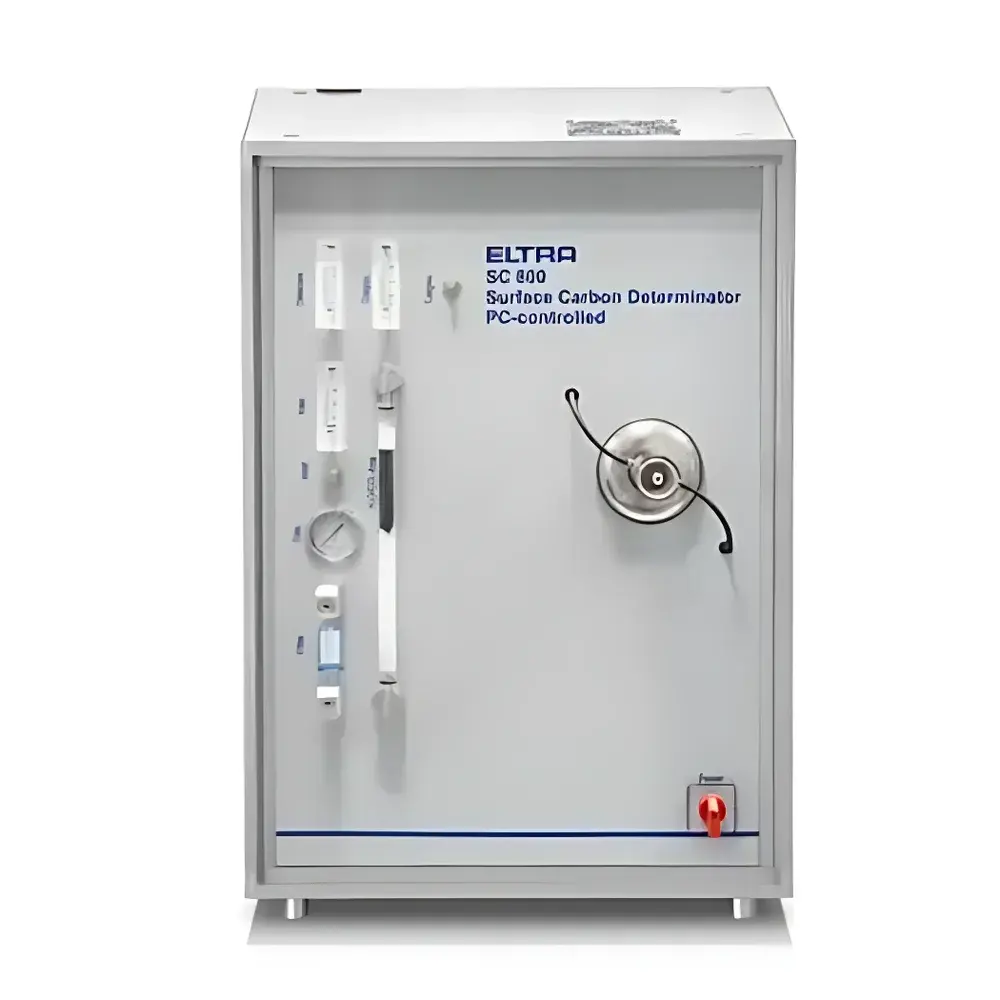
ELTRA SurfaceC-800 Surface Carbon Analyzer
| Brand | ELTRA |
|---|---|
| Origin | Germany |
| Model | SURFACEC-800 |
| Measurement Principle | Infrared Absorption |
| Heating System | Resistance Furnace |
| Measurement Range (Low) | 0.1–100 µg C/cm² |
| Measurement Range (High) | 1–1,000 µg C/cm² |
| Analysis Time | 60–90 s |
| Maximum Furnace Temperature | 1000 °C (1 °C adjustable) |
| Carrier Gas | Oxygen |
| Detection System | Dual Independent IR Cells |
| Calibration | Certified Reference Materials or Standard Gases |
| Flow Control | Electronic Mass Flow Controller |
| Compliance | Designed for GLP/GMP environments with audit-trail-capable software |
Overview
The ELTRA SurfaceC-800 Surface Carbon Analyzer is a dedicated instrumental system engineered for the quantitative determination of carbon contamination on solid material surfaces—primarily metals, alloys, and precision-engineered components used in aerospace, automotive, semiconductor, and medical device manufacturing. It operates on the principle of high-temperature oxidative combustion followed by non-dispersive infrared (NDIR) detection. Surface-bound carbon species—including hydrocarbons, lubricants, polishing residues, and organic films—are quantitatively liberated as CO₂ upon controlled thermal oxidation in a pure oxygen atmosphere within a quartz reaction tube. The evolved CO₂ is swept through two thermally stabilized, independent infrared absorption cells optimized for differential sensitivity across low- and high-concentration ranges (0.1–100 µg C/cm² and 1–1,000 µg C/cm², respectively). This dual-cell architecture ensures linear response, minimal cross-sensitivity, and high reproducibility without manual range switching.
Key Features
- Resistance-heated furnace with precise temperature control from ambient to 1000 °C in 1 °C increments, enabling optimization of oxidation efficiency for diverse surface contaminants.
- Dual-channel NDIR detection system with individually calibrated infrared cells—standard stainless-steel cells for general applications; optional gold-plated cells for corrosion-resistant analysis of halogenated or acidic samples.
- Electronic mass flow controller ensures stable, repeatable carrier gas (oxygen) delivery, eliminating mechanical drift and enhancing long-term measurement stability.
- Large sample chamber accommodates specimens up to 32 × 145 mm, supporting full-surface analysis of strips, foils, machined parts, and stamped components without sectioning.
- Modular calibration framework supporting both certified solid reference materials (e.g., carbon-coated silicon wafers) and traceable gas-phase standards, compliant with ISO/IEC 17025 method validation requirements.
- Rugged, benchtop-integrated design with minimal moving parts—no consumable traps, no catalyst replacement, and no routine optical alignment—reducing total cost of ownership and downtime.
Sample Compatibility & Compliance
The SurfaceC-800 is validated for direct analysis of conductive and non-conductive planar solids including stainless steel, titanium alloys, aluminum sheets, copper foils, silicon wafers, and ceramic substrates. Non-planar or irregular geometries may be analyzed using custom sample holders or localized surface ablation protocols. All hardware and firmware are designed in accordance with IEC 61000-6-3 (EMC) and IEC 61010-1 (safety). Software functionality supports 21 CFR Part 11 compliance via configurable user roles, electronic signatures, and immutable audit trails for raw data, calibration logs, and instrument parameter changes—enabling deployment in regulated quality control laboratories operating under ISO 9001, ISO 13485, or AS9100 frameworks.
Software & Data Management
The integrated SurfaceControl™ software provides multilingual interface support (English, German, French, Japanese, Chinese), customizable report templates (PDF/CSV/XLSX), and real-time visualization of CO₂ evolution profiles. It supports single-point and multi-point calibration routines with automatic linearity verification. Raw spectral data and time-resolved detector signals are stored with metadata (operator ID, timestamp, furnace profile, gas flow rate). Exported datasets include uncertainty estimates derived from calibration curve residuals and repeatability studies. Data integrity safeguards include password-protected configuration access, automatic backup to network drives, and optional integration with LIMS via ASTM E1384-compliant XML schema.
Applications
- Verification of cleaning efficacy after alkaline degreasing, plasma treatment, or ultrasonic solvent washing in metal fabrication lines.
- Quantification of residual cutting oils and coolants on machined engine components prior to coating or brazing.
- Monitoring carbon buildup on vacuum chamber walls or electron-beam weld zones in high-purity manufacturing.
- Validation of surface passivation on stainless steel medical implants per ASTM F86 and ISO 10993-15.
- Quality gate testing for incoming rolled metal coils in cold-rolling mills where surface carbon affects subsequent annealing behavior.
- Research into carbon diffusion kinetics at metal–oxide interfaces under controlled thermal ramp conditions.
FAQ
What sample types are compatible with the SurfaceC-800?
Planar metallic and non-metallic solids with maximum dimensions of 32 × 145 mm and thickness ≤10 mm. Coated, anodized, or oxidized surfaces may be analyzed directly if stable under 1000 °C oxygen flow.
Is calibration traceable to national standards?
Yes—calibration may be performed using NIST-traceable carbon-coated reference wafers or certified CO₂-in-N₂ standard gases, with documentation aligned to ISO/IEC 17025 requirements.
Can the instrument distinguish between elemental carbon and carbonate species?
No—the method reports total combustible carbon; speciation requires complementary techniques such as XPS or TPD-MS.
What maintenance is required beyond routine calibration?
None—quartz tube replacement is recommended every 12–18 months depending on sample load; IR cells require no periodic servicing due to sealed, inert construction.
Is remote diagnostics supported?
Yes—optional Ethernet-based remote access allows secure vendor-assisted troubleshooting and firmware updates while maintaining local network isolation per ITAR/EAR guidelines.






