
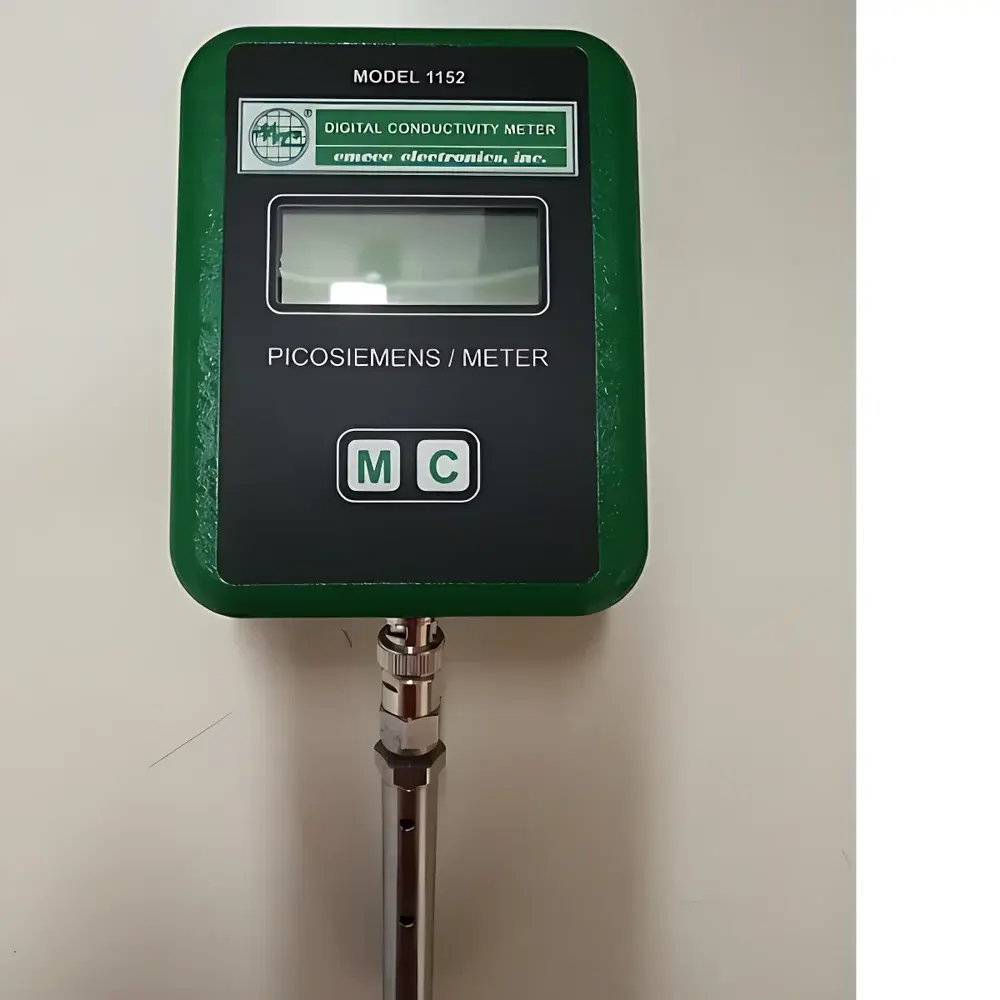
EMCEE 1152 Portable Digital Conductivity Meter
| Brand | EMCEE |
|---|---|
| Origin | USA |
| Model | 1152 |
| Measurement Range | 0–1999 pS/m |
| Resolution | 1 pS/m |
| Probe Type | Removable Stainless Steel Electrode |
| Display | LCD |
| Design | Portable, Field- and Lab-Compatible |
| Compliance | ASTM D2624, GB/T 6539 |
Overview
The EMCEE 1152 Portable Digital Conductivity Meter is a precision-engineered electrochemical instrument designed for reliable, field-deployable measurement of electrical conductivity in low-conductivity liquid media—particularly aviation turbine fuels (Jet A, Jet A-1, JP-8) and other hydrocarbon-based fluids. It operates on the principle of two-electrode AC conductometry, applying a low-frequency alternating current to minimize polarization effects and electrode fouling, thereby ensuring stable readings in non-aqueous or low-ionic-strength environments. Unlike standard aqueous conductivity meters optimized for μS/cm ranges, the 1152 is calibrated specifically for picosiemens-per-meter (pS/m) measurements—a critical requirement for fuel purity verification per ASTM D2624 and GB/T 6539. Its architecture integrates temperature compensation via integrated sensor feedback, referenced to 20 °C, supporting trace-level static charge assessment and contamination detection in fuel handling systems.
Key Features
- High-sensitivity dual-electrode stainless steel probe with corrosion-resistant 316 SS construction, fully detachable for cleaning, calibration verification, and replacement without system downtime
- True portable form factor (battery-powered, IP65-rated enclosure) enabling operation in hangar environments, fuel trucks, refueling points, and mobile laboratories
- Backlit LCD display with automatic unit scaling and real-time stability indicator—optimized for gloved operation and low-light conditions
- Factory-calibrated with NIST-traceable standards; supports user-initiated zero-point verification using dry air or certified reference fuel blanks
- No internal memory or data logging—designed for immediate readout integrity and compliance with audit-ready manual recording workflows
- Low-power consumption (<12 mA typical) extending battery life beyond 200 hours of intermittent use on standard AA alkaline cells
Sample Compatibility & Compliance
The EMCEE 1152 is validated for use with aviation gasoline (Avgas), jet fuels (Jet A, Jet A-1, JP-5, JP-8), diesel fuel (ASTM D975), and other non-polar hydrocarbons exhibiting conductivity below 2000 pS/m. It is not intended for aqueous solutions, acids, bases, or solvents with significant ionic content (e.g., methanol blends or contaminated fuel-water emulsions). Its measurement methodology aligns directly with the procedural requirements of ASTM D2624 (“Standard Test Method for Electrical Conductivity of Aviation Fuels”) and GB/T 6539 (“Test Method for Electrical Conductivity of Aviation Fuel”), both of which mandate electrode geometry control, cell constant verification, and environmental conditioning prior to measurement. The device satisfies pre-test conditioning protocols including static dissipation time (>30 s), sample homogenization, and ambient temperature stabilization (15–30 °C)—prerequisites for GLP-aligned fuel quality reporting.
Software & Data Management
The EMCEE 1152 operates as a standalone analog-to-digital measurement platform with no embedded firmware, wireless interface, or proprietary software dependency. All output is presented as direct numeric readout on the LCD panel; no data export, USB connectivity, or cloud synchronization is provided. This design intentionally eliminates digital validation overhead—supporting facilities operating under strict 21 CFR Part 11 Annex 11 or ISO/IEC 17025 environments where electronic record integrity must be demonstrably separable from instrumentation control logic. Users maintain full traceability through manual entry into LIMS or paper-based logbooks, with each reading accompanied by operator ID, sample ID, ambient temperature, and probe calibration status—consistent with GMP-compliant fuel release documentation.
Applications
- Pre-flight fuel quality assurance at commercial and military airfields
- In-transit verification during fuel transportation and storage (tanker trucks, railcars, API terminals)
- Root-cause analysis of electrostatic discharge (ESD) incidents linked to insufficient fuel conductivity
- Monitoring additive depletion (e.g., Stadis 450) in long-term fuel storage tanks
- Supporting ASTM D4865 “Guide for Determining Potential for Static Electricity Generation in Petroleum Products”
- Field validation of filtration efficiency where particulate or water ingress may alter bulk conductivity
FAQ
Does the EMCEE 1152 require annual recalibration?
Yes—per ASTM D2624 Section 7.2, the instrument must undergo functional verification with a traceable reference standard (e.g., 100 pS/m calibration fluid) before each day’s use; full recalibration is recommended every 12 months or after physical impact or probe replacement.
Can the stainless steel probe be used in biodiesel blends (e.g., B5, B20)?
No—the 1152 is not validated for fatty acid methyl ester (FAME)-containing fuels due to altered dielectric behavior and potential probe passivation; consult EMCEE Application Note AN-1152-BIO for alternative measurement guidance.
Is temperature compensation automatic or manual?
Automatic—using an integrated thermistor within the probe assembly, with compensation algorithm conforming to ASTM D2624 Annex A1 (linear correction between 15 °C and 30 °C).
What battery type does the unit use, and is it replaceable in the field?
Four standard AA alkaline batteries; battery compartment is tool-free accessible and sealed to IP65 when closed.
Does the device meet MIL-STD-810G for shock and vibration?
It meets MIL-STD-810G Method 516.6 Shock (transit drop test) and Method 514.6 Vibration (general purpose transport profile), as verified in EMCEE’s 2022 third-party test report TR-1152-810G-09.
Related Products




