
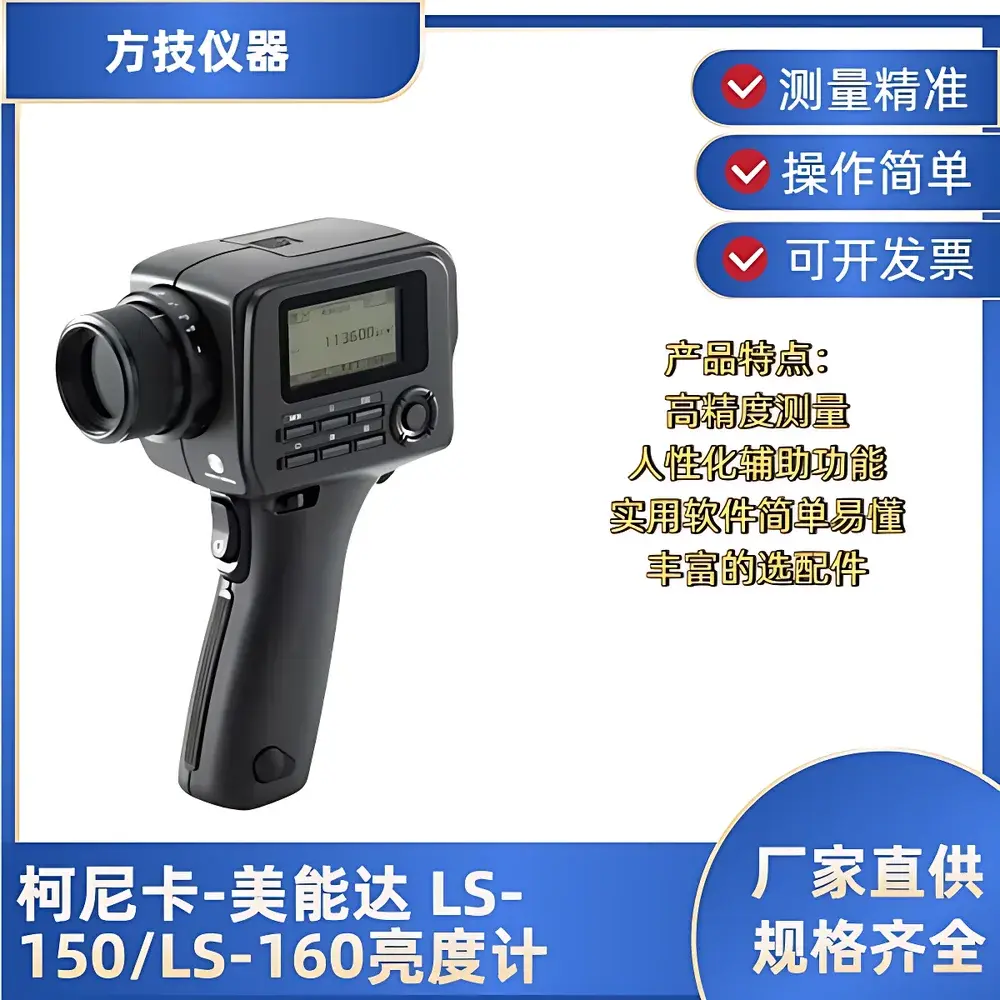
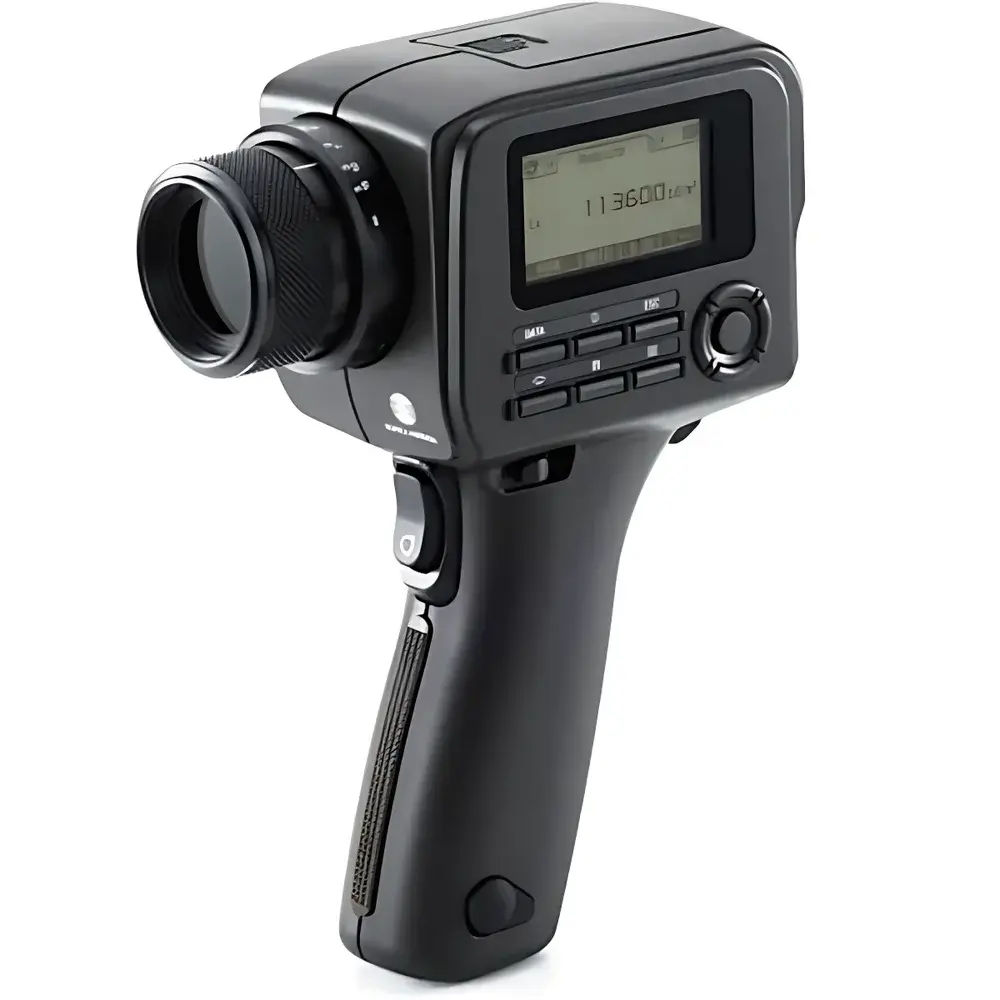
Konica Minolta LS-150 / LS-160 Series Luminance Meters
| Brand | Konica Minolta |
|---|---|
| Origin | Japan |
| Model | LS-150 / LS-160 Series Luminance Meter |
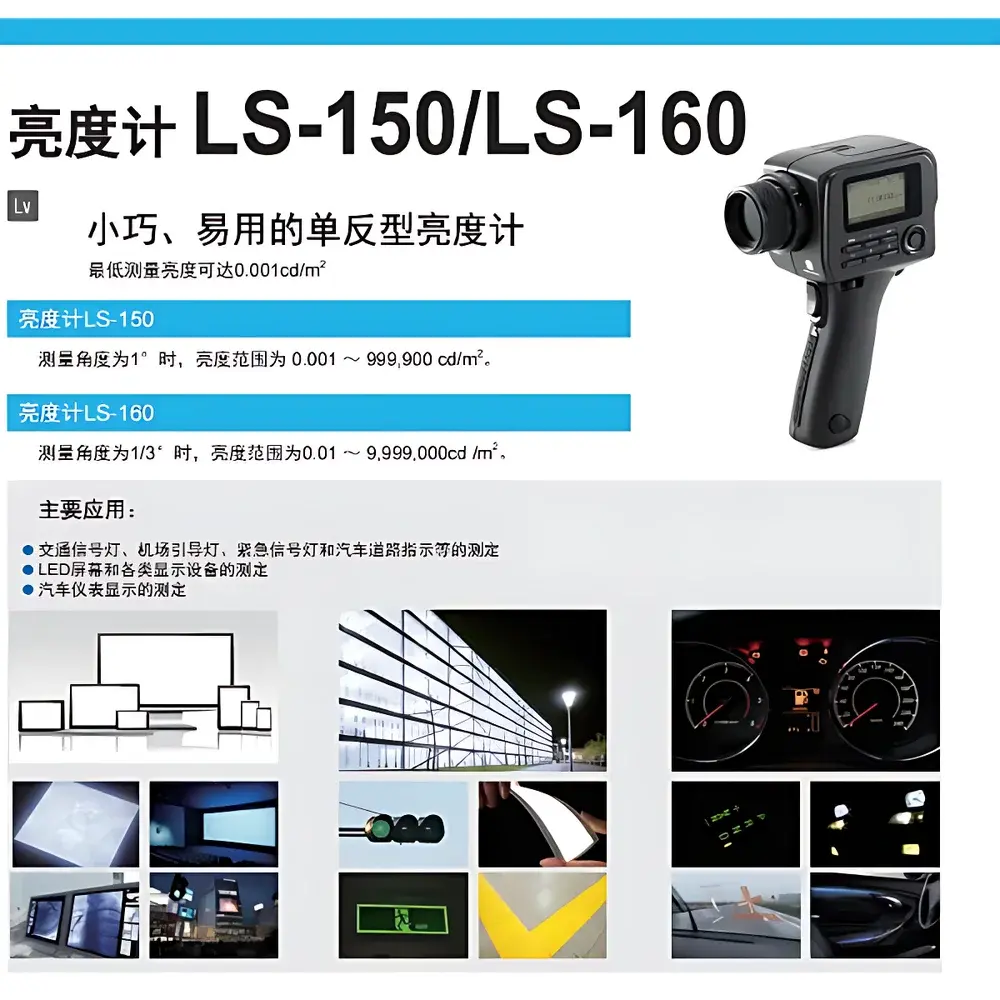
| Luminance Range (LS-150, 1° FOV) | 0.001–999,900 cd/m² |
| Luminance Range (LS-160, 1/3° FOV) | 0.01–9,999,000 cd/m² |
| Minimum Measurable Luminance | 0.001 cd/m² |
| Field of View Options | 1° (LS-150), 1/3° (LS-160) |
Overview
The Konica Minolta LS-150 and LS-160 Series are precision single-lens reflex (SLR) luminance meters engineered for high-accuracy photometric measurement of surface brightness in demanding industrial, regulatory, and R&D environments. Based on the CIE 1931 standard photopic luminosity function (V(λ)), these instruments employ a silicon photodiode detector coupled with precision optical filters and calibrated lens systems to deliver traceable, spectrally corrected luminance values in candela per square meter (cd/m²). The SLR optical path enables direct visual targeting—critical for spatially resolved measurements on non-uniform or small-area light sources—while maintaining strict geometric conditions defined by IEC 62471 and ISO/CIE 11664-1. Designed and manufactured in Japan, each unit undergoes individual factory calibration against NMI-traceable standards, with documented uncertainty budgets aligned to ISO/IEC 17025 requirements.
Key Features
- SLR optical design with real-time through-the-lens viewing for precise spot targeting and alignment verification
- Two interchangeable field-of-view configurations: LS-150 optimized for 1° measurement (ideal for medium-area sources and general-purpose luminance assessment); LS-160 featuring 1/3° narrow-angle optics for high-resolution evaluation of micro-LEDs, automotive instrument clusters, and pixel-level display uniformity
- Extended dynamic range: LS-150 measures from 0.001 cd/m² (e.g., OLED black level, night-vision-compatible displays) up to 999,900 cd/m²; LS-160 extends upper limit to 9,999,000 cd/m² for high-brightness signage and automotive headlamp testing
- Integrated auto-ranging and exposure control ensuring optimal signal-to-noise ratio across full scale without manual gain adjustment
- Rugged aluminum housing with thermal stabilization design to minimize drift during extended field operation (±0.1% stability over 8 h at 23 °C ±2 °C)
- Compliance-ready measurement modes supporting peak hold, min/max capture, continuous logging (up to 10,000 data points), and user-defined averaging intervals
Sample Compatibility & Compliance
The LS-150/LS-160 series is validated for use across diverse emissive and reflective surfaces including LED arrays, OLED and microLED panels, TFT-LCDs, automotive interior lighting, aviation obstruction lights, roadway signage, and emergency egress indicators. Its angular response meets the f1′ < 3% requirement specified in CIE Publication 69 for luminance meters, and its spectral mismatch correction factor (f1) is ≤1.5%—within the Class L tolerance defined in DIN 5032-7 and JIS Z 8722. The instruments support compliance workflows for EN 12830 (cold chain monitoring displays), SAE J1383 (automotive lighting), FAA AC 150/5340-30H (airport visual aids), and IEC 62368-1 (hazard-based safety engineering for AV equipment). Calibration certificates include full uncertainty statements compliant with ISO/IEC 17025:2017 and are accepted under GLP and GMP audit protocols.
Software & Data Management
Konica Minolta’s proprietary SpectraMagic NX software (Windows-based, USB 2.0 interface) provides full instrument control, real-time graphing, batch export (CSV, TXT, XML), and customizable report generation—including side-by-side comparison of multiple measurement positions, time-series trend analysis, and pass/fail threshold mapping. All data logs embed metadata such as timestamp, operator ID, instrument serial number, calibration due date, and environmental conditions (optional external temperature/humidity sensor input). Audit trail functionality records all parameter changes and measurement events, satisfying FDA 21 CFR Part 11 requirements for electronic records and signatures when deployed in regulated quality assurance environments.
Applications
- Verification of luminance uniformity and contrast ratio on large-format video walls and digital billboards
- Validation of automotive HUD (Head-Up Display) brightness and glare compliance per UNECE R121 and ISO 15008
- Photometric certification of airport runway edge lights, PAPI systems, and taxiway centerline illuminators
- Quality control of instrument panel backlighting, switch illumination, and warning indicator luminance in Tier 1 vehicle manufacturing
- Research-grade characterization of emissive material degradation (e.g., OLED burn-in studies) via longitudinal low-light tracking
- Calibration transfer and reference checks for integrating sphere-based photometry systems
FAQ
What is the difference between LS-150 and LS-160 in terms of optical configuration?
The LS-150 uses a 1° field-of-view lens optimized for general-purpose luminance measurement of areas ≥5 mm at 300 mm working distance; the LS-160 employs a 1/3° telephoto lens enabling resolution of features as small as 1.7 mm at the same distance—critical for high-density display pixel analysis.
Does the instrument support automatic calibration verification?
Yes—optional Konica Minolta CAL-150 portable calibration source (NIST-traceable, 100 cd/m² reference) enables on-site verification and drift monitoring without returning to an accredited lab.
Can measurement data be integrated into a LabVIEW or Python-based automated test system?
Yes—the device supports SCPI-compliant ASCII command protocol over USB-VCOM, with full documentation provided for third-party driver development and integration into custom QA/QC automation frameworks.
Is the LS-150/LS-160 suitable for measuring luminance of curved or textured surfaces?
When used with appropriate cosine-corrected diffusers (sold separately), the meters meet the angular response criteria for Lambertian surface evaluation per CIE 1931; however, specular reflections require careful positioning and may necessitate auxiliary baffling to avoid measurement artifacts.




