
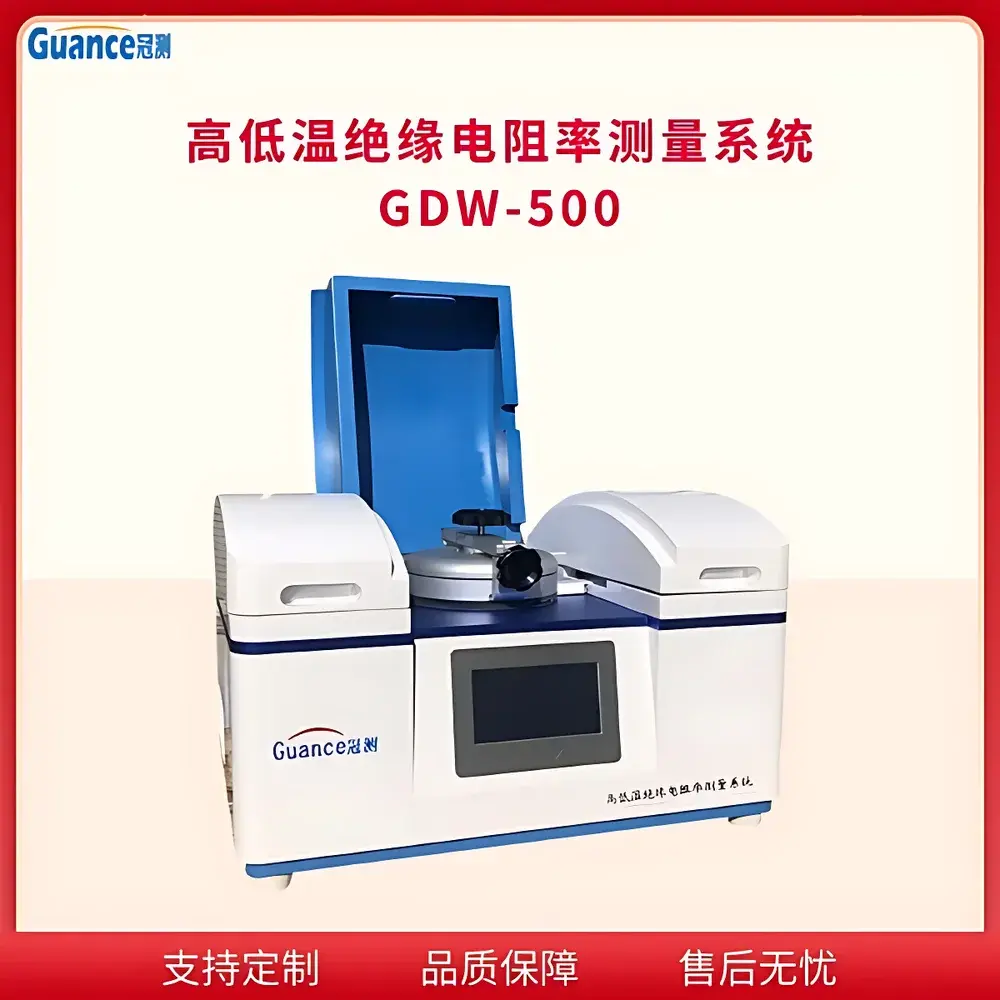
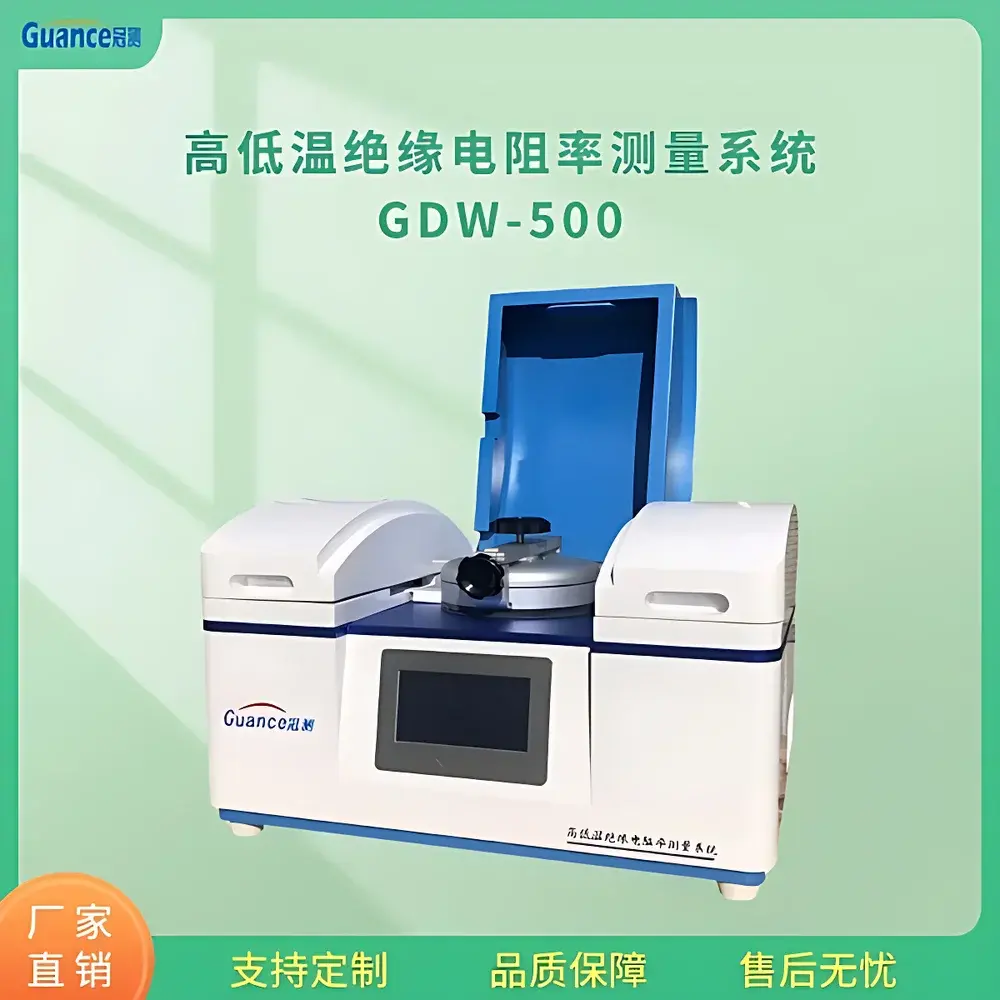
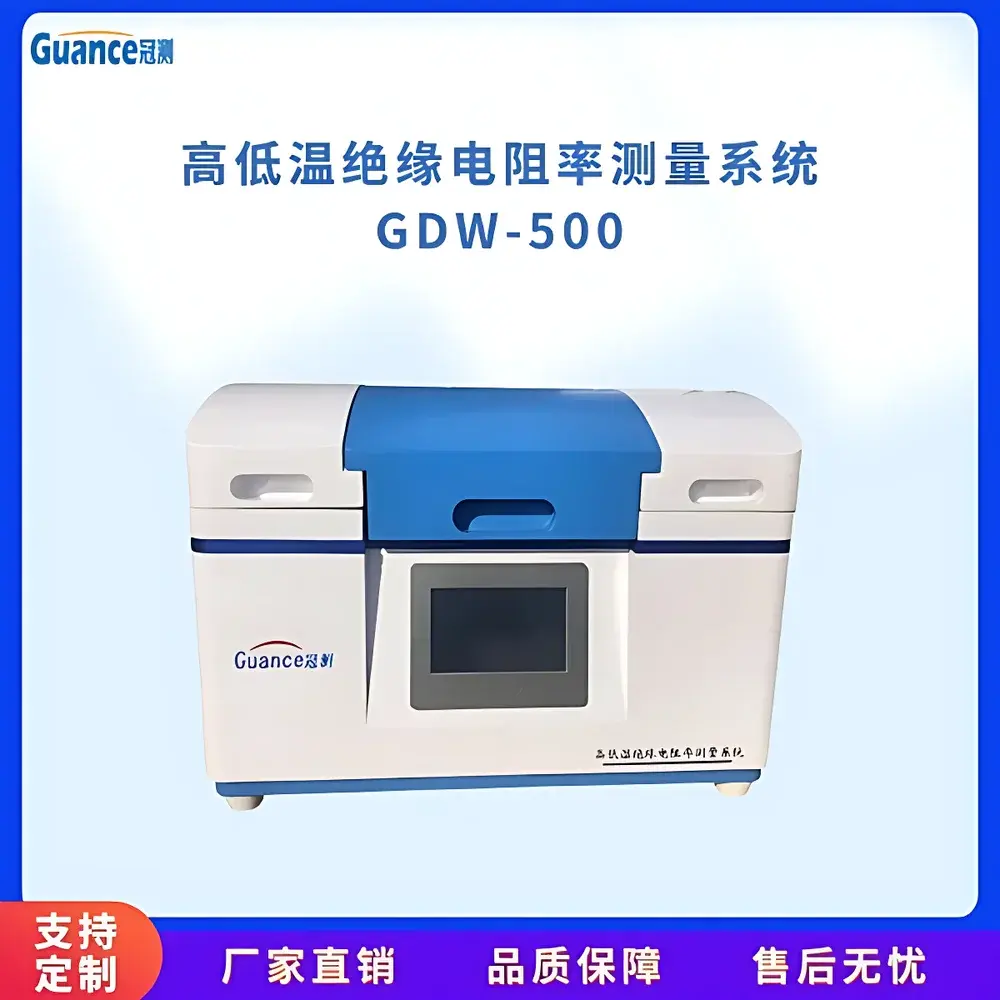
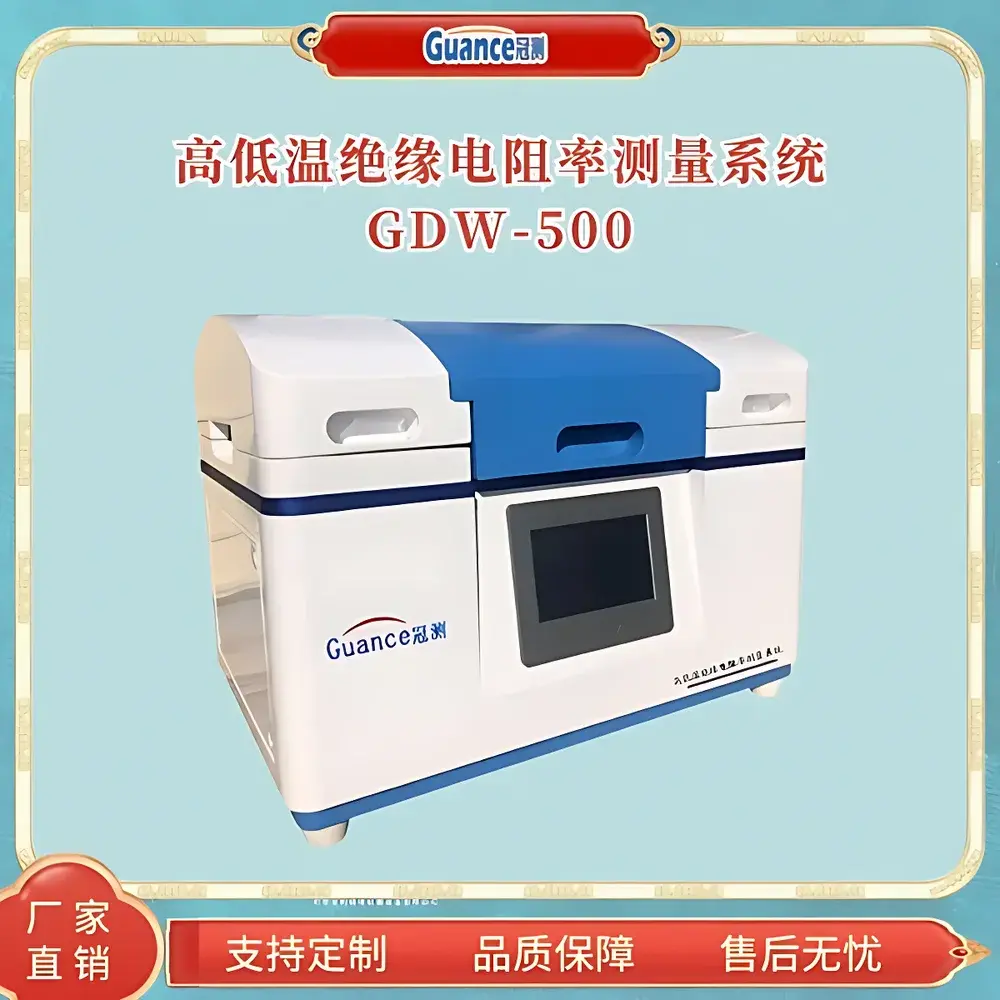
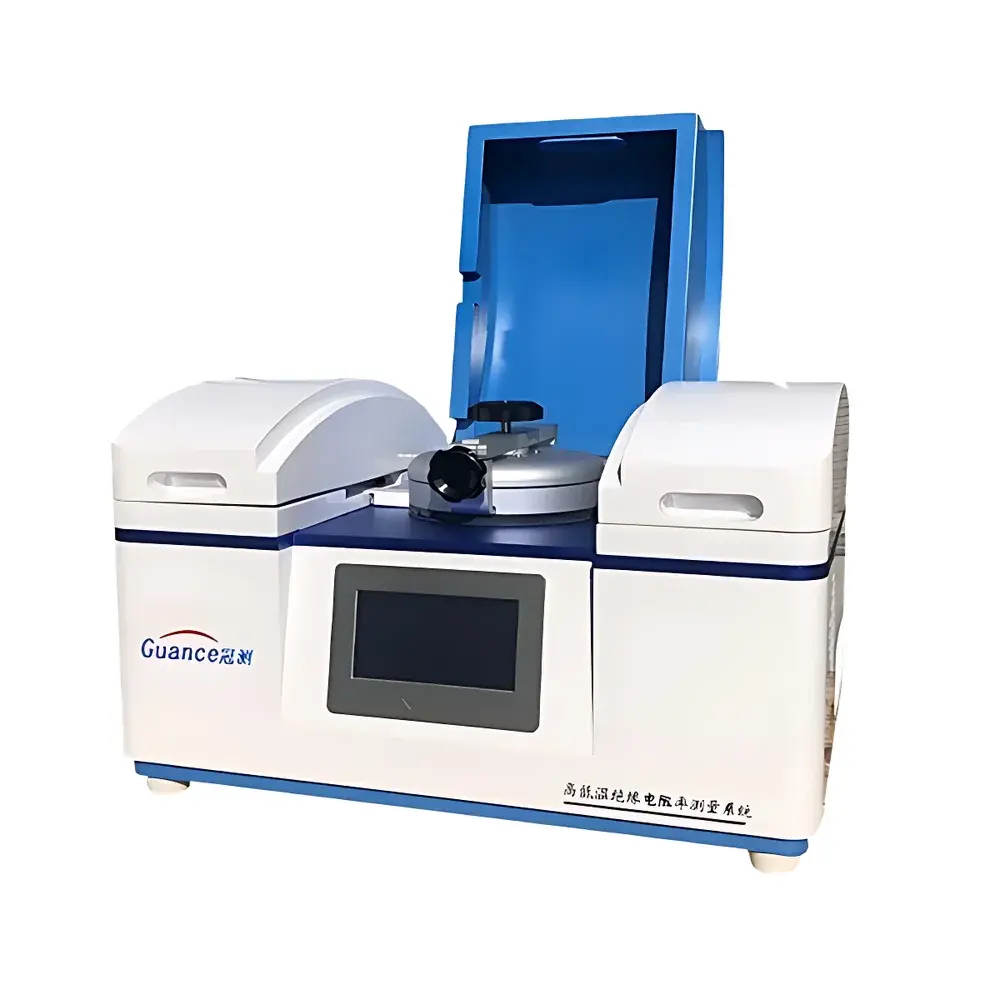
Guance Instruments GDW-500C Fully Automated High-Low Temperature Dielectric Constant Measurement System
| Brand | Guance Instruments |
|---|---|
| Origin | Beijing, China |
| Manufacturer Type | Authorized Distributor |
| Country of Origin | China |
| Model | GDW-500C |
| Price | USD 2,100 (FOB) |
| Temperature Range | −160 °C to +500 °C |
| Temperature Stability | ±0.5 °C |
| Cooling Method | Liquid Nitrogen |
| Heating Method | Resistive Cartridge Heating |
| Electrode Material | Brass |
| Electrode Diameter | 25 mm |
| Test Frequency Range | 20 Hz – 2 MHz |
Overview
The Guance Instruments GDW-500C Fully Automated High-Low Temperature Dielectric Constant Measurement System is an engineered solution for precise, temperature-resolved dielectric characterization of solid and liquid insulating materials under controlled thermal conditions. It operates on the principle of impedance spectroscopy—measuring complex capacitance (C*) and conductance (G*) across a defined electrode geometry to derive the complex permittivity ε* = ε′ − jε″, where ε′ is the real (storage) component and ε″ the imaginary (loss) component of relative permittivity. The system integrates a cryogenic–high-temperature environmental chamber with a high-precision LCR meter and automated data acquisition software, enabling continuous monitoring of dielectric response as a function of both frequency and temperature. Designed for fundamental materials research and industrial quality assurance, the GDW-500C supports investigations into polarization mechanisms—including dipolar, interfacial (Maxwell–Wagner), and ionic conduction effects—across extreme thermal regimes from cryogenic (−160 °C) to elevated temperatures (+500 °C).
Key Features
- Wide operational temperature range: −160 °C to +500 °C, achieved via dual-mode thermal control—liquid nitrogen cooling for sub-ambient operation and resistive cartridge heating for high-temperature stability.
- High-accuracy temperature regulation: ±0.5 °C uniformity over the electrode zone, verified by integrated Pt100 sensors and closed-loop PID feedback.
- Standard brass parallel-plate electrodes (25 mm diameter) with precision-machined surface finish (Ra < 0.8 µm) to minimize edge effects and ensure reproducible contact geometry.
- Frequency-swept and multi-point dielectric analysis from 20 Hz to 2 MHz, supporting both rapid screening and high-resolution spectral acquisition.
- Three selectable measurement speeds—Fast, Medium, Slow—to balance throughput and signal-to-noise ratio depending on sample loss tangent and thermal time constants.
- Automated thermal ramping with programmable soak dwell times, enabling standardized dielectric thermal profiling per ASTM D150 and IEC 60250 protocols.
Sample Compatibility & Compliance
The GDW-500C accommodates rigid solids (ceramics, polymers, thin films, sintered oxides), powdered compacts (with dielectrically inert pressing fixtures), and low-conductivity liquids (e.g., transformer oils, silicone fluids). Sample thickness is user-defined within mechanical constraints of the electrode gap (adjustable from 0.1 mm to 5 mm). All measurements comply with internationally recognized standards including GB/T 1409–2006 (equivalent to IEC 60250), GB/T 1693–2007 (for elastomers), and ASTM D150–22. The system architecture supports traceable calibration through NIST-traceable LCR reference standards and optional third-party temperature sensor certification. Data integrity meets GLP/GMP-aligned requirements, with full audit trail capability in logged test sessions.
Software & Data Management
The proprietary GDW Control Suite (v3.2) provides unified control of thermal sequencing, frequency sweep execution, and real-time parameter visualization. Software modules include: (i) Room-Temperature Mode—supporting frequency scans, discrete point testing, and multi-frequency batch acquisition; (ii) Temperature-Scan Mode—generating ε′(T), ε″(T), tan δ(T), and C(T) profiles at fixed frequencies or full 2D ε*(f,T) mapping; (iii) Export Engine—outputting raw ASCII datasets (.csv), annotated graphs (.png/.pdf), and structured reports compliant with internal QA templates. All data files embed metadata (timestamp, operator ID, thermal ramp rate, electrode configuration), ensuring full experimental provenance. The software runs on Windows 10/11 (64-bit) and interfaces via USB 2.0 or Ethernet (TCP/IP) with configurable firewall-safe port assignment.
Applications
- Development and qualification of high-temperature dielectrics for aerospace capacitor systems and turbine insulation.
- Phase transition analysis in ferroelectric ceramics (e.g., BaTiO₃, PZT) via Curie temperature mapping using ε′(T) inflection detection.
- Moisture ingress evaluation in polymeric encapsulants through low-frequency ε″(T) anomaly tracking.
- Quality control of alumina and zirconia substrates in microelectronics packaging, correlating ε′ homogeneity with sintering density.
- Characterization of ion-conducting polymer electrolytes for solid-state batteries across operational temperature windows.
- Research on relaxor ferroelectrics and multiferroic composites requiring simultaneous frequency–temperature domain resolution.
FAQ
What is the minimum sample thickness required for reliable measurement?
For solid discs, a minimum thickness of 0.3 mm is recommended to avoid electrode edge-field distortion; thinner samples require guard-ring electrode configurations (optional accessory).
Can the system measure conductivity alongside permittivity?
Yes—DC and low-frequency AC conductivity (σ) are derived from the measured complex admittance using σ = ωε₀ε″ + G/A, where G is conductance and A is electrode area.
Is liquid nitrogen handling training required for operation?
While the system includes integrated LN₂ level monitoring and auto-shutoff, users must complete institutional cryogen safety training prior to first use.
Does the software support automated compliance reporting for ISO/IEC 17025 laboratories?
Yes—the report generator includes customizable headers, instrument calibration status stamps, uncertainty propagation fields, and digital signature placeholders compatible with accredited lab workflows.
Are custom electrode geometries available?
Custom brass or stainless-steel electrodes—including interdigitated (IDT), coaxial, and guarded three-terminal designs—are available upon request with lead time and validation documentation.



