
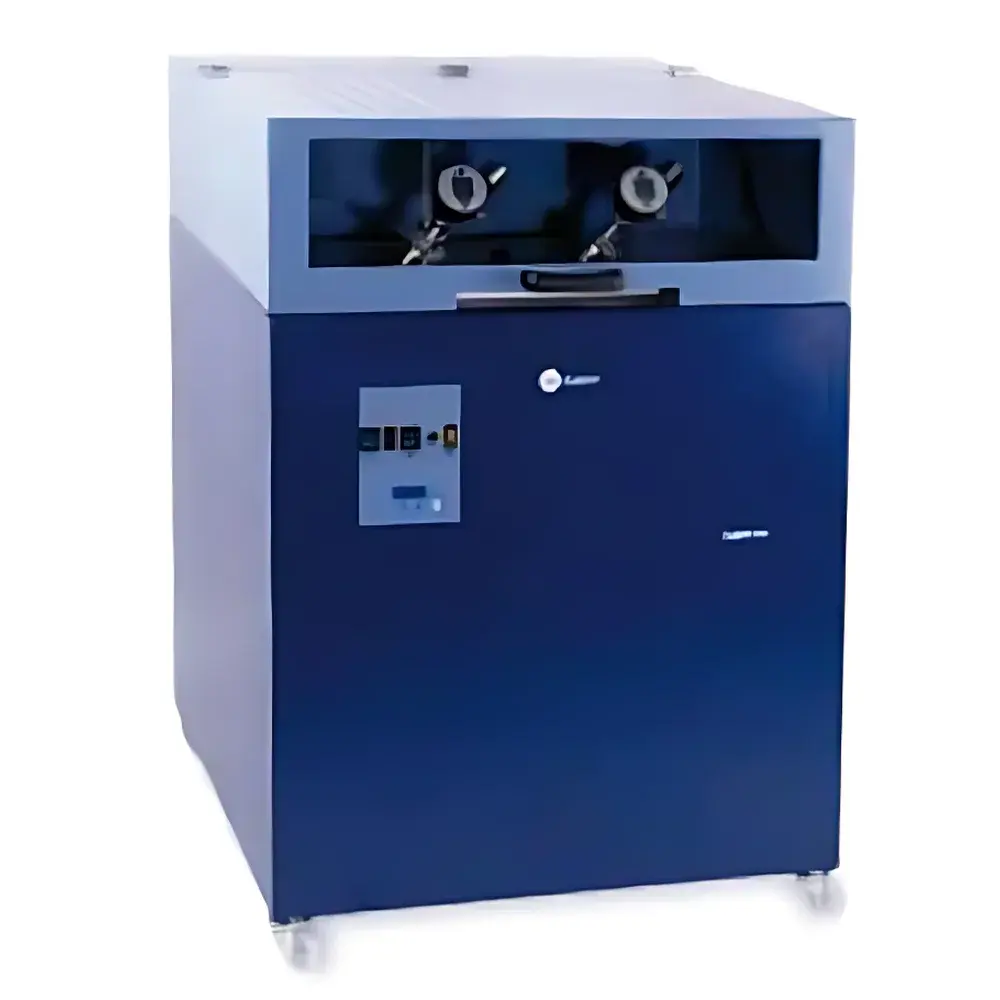
SETA Model 15200-5 Rotating Pressure Vessel Oxidation Stability Tester (RPVOT)
| Brand | SETA |
|---|---|
| Origin | United Kingdom |
| Model | 15200-5 |
| Temperature Range | Ambient to 160 °C |
| Temperature Stability | ±0.1 °C |
| Bath Volume | 72 L |
| Test Positions | 2 |
| Rotation Speed | 100 rpm |
| Voltage | 220–240 V, 50/60 Hz |
| Power Consumption | 3.2 kW |
| Dimensions (W×D×H) | 113 × 78 × 88 cm |
| Weight | 87 kg |
Overview
The SETA Model 15200-5 Rotating Pressure Vessel Oxidation Stability Tester (RPVOT) is a precision-engineered instrument designed for the quantitative assessment of oxidation resistance in lubricating oils, turbine oils, and other hydrocarbon-based fluids under accelerated, pressurized oxygen conditions. Based on the rotating pressure vessel principle—where a sample is sealed with oxygen in a stainless-steel vessel, rotated at 100 rpm in a precisely controlled thermal bath—the instrument measures the time elapsed until a defined pressure drop occurs, indicating onset of oxidative degradation. This method provides a reproducible, thermodynamically relevant proxy for long-term oxidative behavior under service conditions. The system complies with internationally recognized standard test methods including ASTM D2272, ASTM D4742, ASTM D2112, IP 229, and SH/T 0193, making it suitable for quality control laboratories, R&D centers, and third-party testing facilities operating under ISO/IEC 17025, ASTM, or API-aligned workflows.
Key Features
- Two independent test positions enable parallel analysis, improving throughput without compromising thermal uniformity or mechanical consistency.
- High-stability temperature control system maintains bath temperature within ±0.1 °C across the full operating range (ambient to 160 °C), critical for method compliance and inter-laboratory reproducibility.
- 72-liter high-capacity oil bath ensures stable thermal mass and minimal gradient variation across both vessels during extended tests (typically 1–10 hours).
- Robust gear-driven rotation mechanism replaces belt or motor-coupled systems, delivering consistent 100 rpm motion with low maintenance and high torque reliability over thousands of cycles.
- Integrated vacuum-assisted purge system facilitates rapid and complete removal of air prior to oxygen pressurization—reducing residual nitrogen interference and enhancing test fidelity.
- Optional automatic pressure monitoring module provides real-time digital pressure logging (with configurable sampling intervals), timestamped data export, and programmable alarm thresholds for pressure decay detection.
- Front-access design with hinged lid and ergonomic vessel loading supports safe, repeatable operator handling while minimizing exposure to hot surfaces.
Sample Compatibility & Compliance
The RPVOT 15200-5 accommodates standard 100-mL stainless-steel pressure vessels conforming to ASTM D2272 specifications. It accepts virgin and used lubricants—including mineral, synthetic, and semi-synthetic formulations—as well as base stocks, greases (after solvent dilution), and aviation turbine fuels (per D4742). All wetted components are constructed from 316 stainless steel and fluoropolymer-sealed to resist oxidation byproducts and acidic species formed during testing. The instrument’s operational parameters and procedural logic align with regulatory expectations for GLP-compliant environments; when equipped with the optional pressure logger and audit-trail-enabled software, it supports FDA 21 CFR Part 11 requirements for electronic records and signatures in pharmaceutical-grade lubricant qualification.
Software & Data Management
While the base unit operates via intuitive front-panel controls with LED status indicators and manual timer functionality, the optional PC-based software package provides comprehensive data acquisition and reporting capabilities. It captures pressure vs. time profiles, calculates induction period automatically using first-derivative threshold detection, and generates ASTM-formatted test reports with metadata (operator ID, calibration date, vessel ID, ambient humidity, barometric pressure). Raw data exports to CSV or XML formats ensure compatibility with LIMS integration and statistical process control (SPC) platforms. Calibration logs, user access levels, and electronic signature fields support traceability in regulated settings compliant with ISO 17025 clause 7.7 and internal QA protocols.
Applications
- Quality assurance of new turbine oils prior to commissioning in power generation assets.
- Comparative evaluation of antioxidant package efficacy during lubricant formulation development.
- Monitoring oxidative depletion in in-service oils recovered from transformers, hydraulic systems, and marine engines.
- Supporting OEM specification compliance (e.g., GEK 32568, Siemens TLV 9013, Rolls-Royce RRES 90061).
- Generating input data for remaining useful life (RUL) models in predictive maintenance programs.
- Validation of re-refined base oil stability for sustainability certification schemes.
FAQ
What standards does the SETA 15200-5 fully support?
ASTM D2272 (primary), ASTM D4742, ASTM D2112, IP 229, and SH/T 0193—all verified through factory performance qualification using NIST-traceable reference oils.
Is bath oil included with the instrument?
No. Users must supply a thermally stable, low-volatility silicone or polyglycol-based bath fluid rated for continuous operation up to 160 °C (e.g., Dow Corning 200 Fluid or equivalent).
Can the system be integrated into an automated lab workflow?
Yes—via RS-232 or optional Ethernet interface, enabling remote start/stop commands, pressure data streaming, and event-triggered notifications through SCADA or MES platforms.
How often does the instrument require recalibration?
Temperature sensors and pressure transducers are calibrated annually per ISO/IEC 17025 recommendations; verification checks using certified reference standards are advised before each daily test sequence.
Does the unit meet CE and UKCA marking requirements?
Yes—the 15200-5 carries full CE and UKCA declarations of conformity for electromagnetic compatibility (EMC Directive 2014/30/EU) and low voltage safety (LVD Directive 2014/35/EU), with documentation available upon request.





