
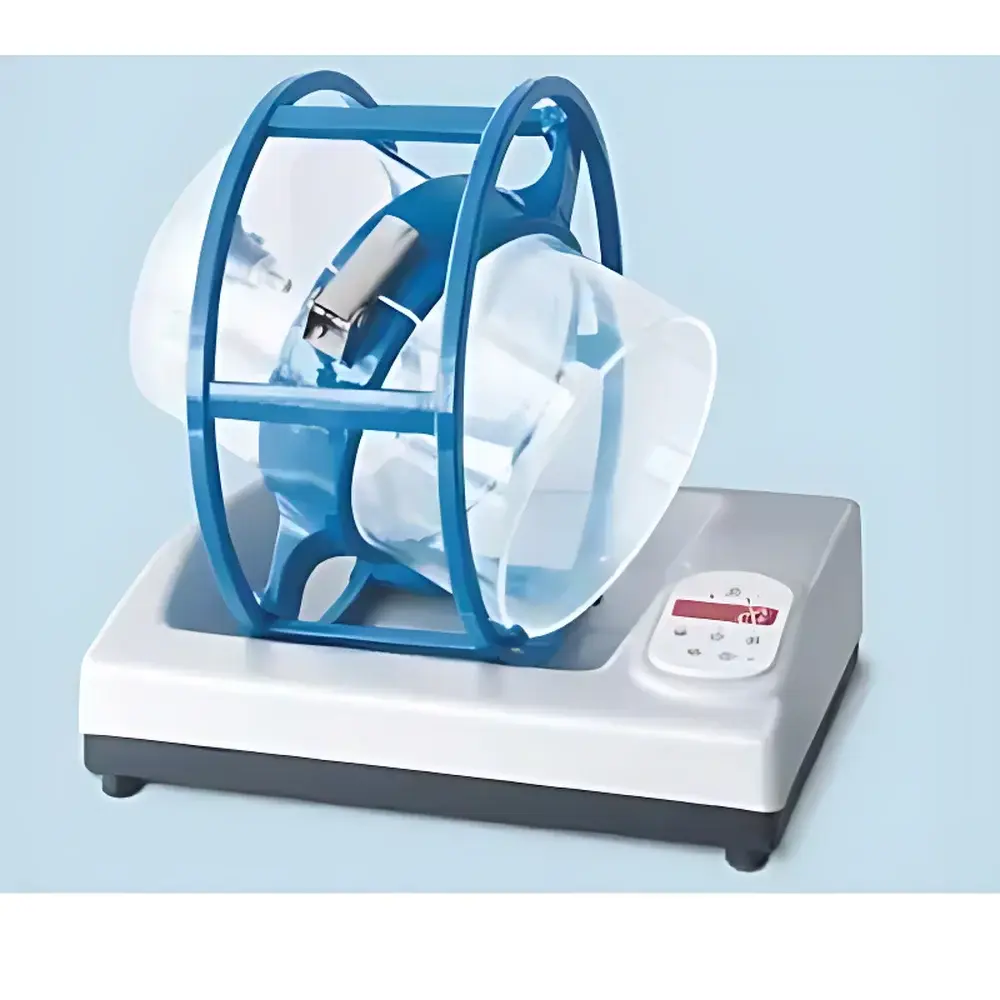
Engelsmann MINI II Tumbler Mixer
| Brand | Engelsmann |
|---|---|
| Origin | Germany |
| Model | MINI II |
| Speed Range | 5–100 rpm (infinitely variable) |
| Maximum Batch Capacity | 5 kg |
| Noise Level | ≤70 dB(A) per DIN 45635 |
| Net Weight | 9 kg |
| Dimensions (W×D×H) | 280 × 350 × 350 mm |
| Design | Compact, low-footprint tumbler mixer with 3D motion kinematics |
| Compliance | Designed for GLP-compliant laboratories and GMP-aligned production environments |
Overview
The Engelsmann MINI II Tumbler Mixer is a precision-engineered laboratory-scale mixing system designed for high-uniformity dry and wet blending of powders, granules, and solid–liquid suspensions. It operates on the principle of three-dimensional tumbling motion—combining translation, rotation, and inversion—to ensure complete material turnover without mechanical agitation or internal blades. This kinematic approach eliminates shear-induced degradation, segregation, and dead zones, making it especially suitable for sensitive pharmaceutical actives, fine chemical intermediates, and functional food ingredients where particle integrity and compositional homogeneity are critical. Unlike ribbon or paddle mixers, the MINI II relies solely on gravitational reorientation within a fixed-axis, tilted drum mounted on a robust drum-type support frame—ensuring reproducible mixing kinetics across batch sizes from 100 g to 5 kg.
Key Features
- Infinitely variable speed control (5–100 rpm) enables precise optimization of mixing time and intensity for diverse material rheologies—from free-flowing lactose to cohesive silica nanoparticles.
- Acoustically engineered enclosure meets DIN 45635 noise emission limits (≤70 dB(A)), permitting safe operation in shared laboratory spaces without dedicated acoustic shielding.
- Compact footprint (280 × 350 × 350 mm) and lightweight construction (9 kg net weight) facilitate benchtop deployment, mobile lab integration, and cleanroom-compatible relocation.
- Seamless stainless-steel drum with zero internal corners ensures full discharge, minimal residue retention, and rapid cleaning—validated for multi-product use under cGMP Annex 1 and ISO 22000 hygiene requirements.
- Gravity-driven mixing mechanism eliminates lubricants, seals, and moving parts inside the process chamber—reducing contamination risk and eliminating routine maintenance schedules.
- Compatible with both dry blending (e.g., API–excipient pre-blends) and wet granulation support (e.g., solvent-assisted color dispersion in polymer masterbatches).
Sample Compatibility & Compliance
The MINI II accepts materials ranging from sub-10 µm nano-powders to 3 mm granules, including hygroscopic, electrostatic-prone, and heat-sensitive compounds. Its sealed drum design supports optional inert gas purging (N₂/Ar) for oxygen-sensitive formulations. The unit complies with EU Machinery Directive 2006/42/EC and carries CE marking. While not intrinsically rated for ATEX Zone 21, its spark-free operation and static-dissipative drum options (upon request) align with IEC 60079-0 general safety provisions for combustible dust handling. Documentation packages include Factory Acceptance Test (FAT) reports, material traceability certificates (EN 10204 3.1), and IQ/OQ protocol templates compliant with FDA 21 CFR Part 11 and EU GMP Annex 15.
Software & Data Management
The MINI II operates via an integrated analog speed controller with digital RPM readout; no embedded software or data logging is included in the base configuration. However, optional RS-485 Modbus RTU interface enables integration into centralized SCADA or MES platforms for batch parameter recording (speed, duration, cycle count). For regulated environments, users may deploy third-party validated electronic logbooks (e.g., LabVantage, Thermo Fisher SampleManager) to capture operator ID, timestamped start/stop events, and deviation flags—supporting ALCOA+ data integrity principles and audit readiness for FDA, EMA, or PMDA inspections.
Applications
- Pharmaceutical: Homogenization of low-dose API blends prior to direct compression; excipient pre-mixing for hot-melt extrusion feedstocks.
- Chemicals: Pigment dispersion in thermoplastic color concentrates; catalyst support loading onto ceramic carriers.
- Food & Nutrition: Vitamin-mineral premixes for fortified cereals; probiotic–carrier blending under low-shear conditions.
- Electronics: Uniform distribution of conductive fillers (Ag/Cu flakes) in polymer binders for printed electronics inks.
- Research: Kinetic studies of powder mixing efficiency using tracer particles and image-based segregation analysis (e.g., via X-ray microtomography).
FAQ
What types of materials are unsuitable for the MINI II?
Highly viscous pastes (>10⁴ Pa·s), fibrous aggregates (e.g., cellulose pulp), or materials requiring intense shear or dispersion (e.g., carbon black in rubber) fall outside its operational envelope.
Can the MINI II be validated for GMP manufacturing?
Yes—its mechanical simplicity, absence of internal wear parts, and repeatable motion profile make it well-suited for prospective validation per ASTM E2500 and ISPE GAMP 5, with documented IQ/OQ/UQ protocols.
Is cleaning verification supported?
The smooth 316L stainless-steel drum surface allows swab sampling per USP and visual inspection; residue limits can be established using HPLC or TOC methods per PDA Technical Report No. 29.
Does Engelsmann provide installation qualification services?
Qualified field engineers offer on-site FAT and IQ support globally; OQ execution remains the responsibility of the end-user’s qualified personnel per regulatory delegation frameworks.



