
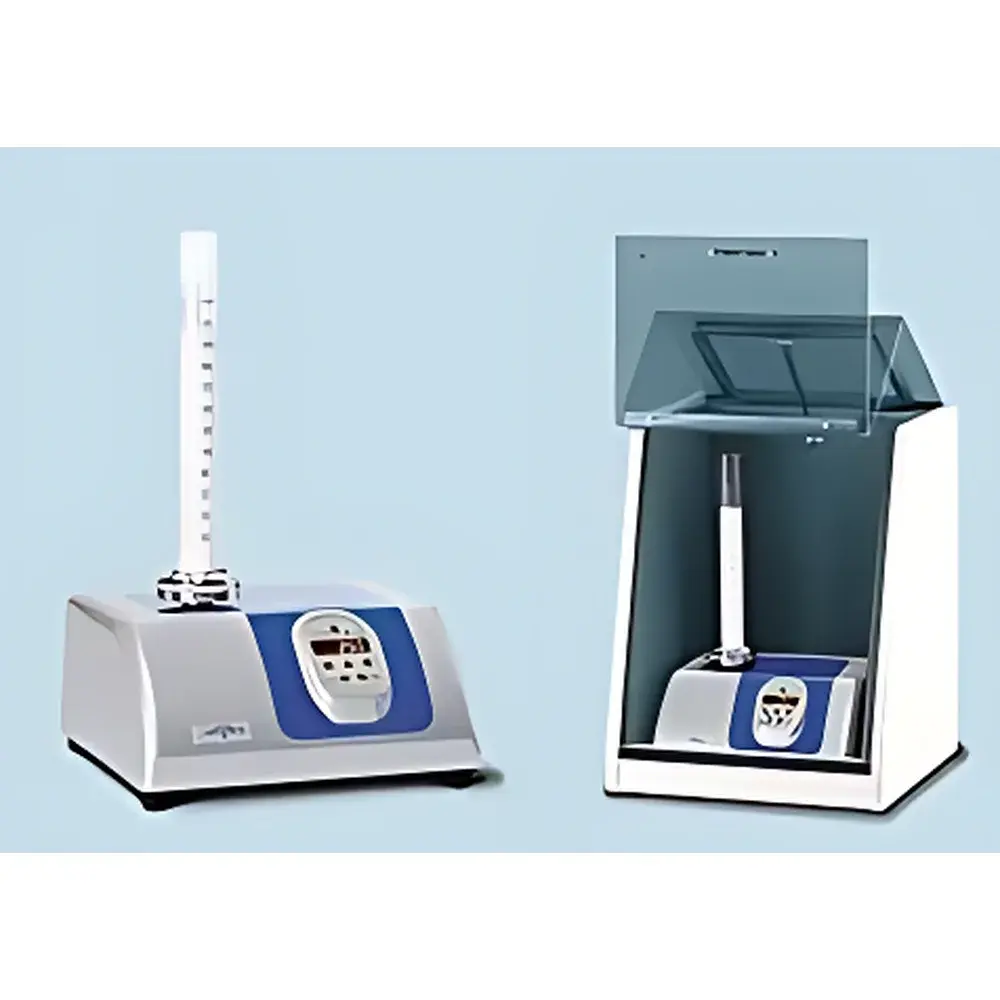
Engelsmann STAV II Tap Density Tester
| Brand | Engelsmann |
|---|---|
| Origin | Germany |
| Model | STAV II Tap Density Tester |
| Instrument Type | Bulk Density Tester |
| Portability | Benchtop (not portable) |
| Sample Form | Powders, Granules, Fibers |
| Compliance | DIN ISO 787-11, ISO 3953, ASTM B527-93 |
| Cylinder Options | 10–1000 mL (standard set: 10, 25, 50, 100, 250, 500, 1000 mL) |
| Tapping Frequency | 250 rpm ±15 rpm |
| Stroke Amplitude | 3.0 mm ±0.1 mm |
| Maximum Sample Mass | 670 g ±45 g |
| Mass Resolution | 0.001 g |
| Operating Temperature | Ambient (15–30 °C recommended) |
| Minimum Sample Volume | 10 mL |
| Power Supply | Single-phase AC, 50 W |
| Noise Level | 80 dB (unshielded), 58 dB (with acoustic damping viewport) |
| Dimensions (W×D×H) | 290 × 330 × 180 mm |
| Net Weight | 9 kg |
Overview
The Engelsmann STAV II Tap Density Tester is an engineered benchtop instrument designed for the standardized determination of bulk (tap) density of free-flowing and cohesive solid particulates—including pharmaceutical powders, metal and ceramic granules, food ingredients, catalysts, and fibrous materials. It operates on the principle of controlled mechanical tapping, where a calibrated sample container undergoes vertical, repetitive downward motion under defined amplitude and frequency. This process induces particle rearrangement and compaction until volume stabilization, enabling calculation of bulk density (g/mL) as the ratio of sample mass to tapped volume. The STAV II adheres strictly to internationally recognized methodologies—specifically DIN ISO 787-11 (Pigments and extenders), ISO 3953 (Metallic powders), and ASTM B527-93 (Standard Test Method for Tap Density of Metal Powders)—ensuring data comparability across laboratories and regulatory submissions.
Key Features
- Precision-mechanical tapping mechanism with stable 250 rpm ±15 rpm rotational speed and 3.0 mm ±0.1 mm stroke amplitude—guaranteeing high reproducibility between runs and operators.
- Modular cylinder system supporting seven standardized volumetric options (10, 25, 50, 100, 250, 500, and 1000 mL), enabling method flexibility for diverse sample masses and flow behaviors.
- Integrated acoustic damping viewport reduces operational noise from 80 dB (baseline) to 58 dB—critical for shared laboratory environments and routine QC workflows requiring extended use.
- Robust aluminum-alloy frame and vibration-isolated base minimize energy transmission to adjacent instrumentation, preserving measurement integrity in multi-instrument labs.
- Single-phase analog motor drive (50 W nominal power) delivers consistent torque without electronic interference—ideal for GMP-aligned facilities where electromagnetic compatibility (EMC) and long-term calibration stability are prioritized.
- Compact footprint (290 × 330 × 180 mm) and low net weight (9 kg) allow flexible placement on fume hoods, balance benches, or dedicated density workstations without structural reinforcement.
Sample Compatibility & Compliance
The STAV II is validated for use with dry, non-hygroscopic, and non-adhesive solid phases ranging from fine sub-10 µm pharmaceutical actives to coarse 2 mm polymer granules. Its design accommodates fibrous matrices (e.g., cellulose derivatives, milled botanicals) and irregularly shaped particles (e.g., dendritic metal powders), provided samples remain free of agglomeration during tapping. All test procedures comply with pharmacopoeial requirements for bulk density assessment in drug substance and product development (EP 2.9.34, USP ). Full traceability is supported via documented adherence to ISO/IEC 17025 calibration practices for mass and volume metrology. The instrument meets CE marking requirements for laboratory equipment (2014/30/EU EMC Directive and 2014/35/EU Low Voltage Directive).
Software & Data Management
The STAV II operates as a stand-alone mechanical tester with no embedded digital control or software interface—intentionally designed to eliminate firmware dependencies, cybersecurity risks, and validation overhead associated with computer-linked instruments. All parameters (tapping count, cylinder volume, tare mass, final mass) are recorded manually or integrated into LIMS via external analytical balances compliant with ISO/IEC 17025 and FDA 21 CFR Part 11 (when paired with audit-trail-enabled weighing systems). User-defined tap counts (e.g., 100, 500, 1250 taps) align with material-specific protocols outlined in ISO 3953 Annex A and ASTM B527 Section 7. Calibration certificates for included cylinders and optional certified reference weights are supplied with each unit.
Applications
- Pharmaceutical formulation: Excipient characterization, blend uniformity assessment, capsule fill weight prediction, and powder flow index derivation (e.g., Carr Index, Hausner Ratio).
- Advanced materials R&D: Density profiling of additive manufacturing feedstocks (Ti-6Al-4V, Inconel 718 powders), battery electrode slurries (post-drying), and catalyst supports prior to impregnation.
- Quality control in chemical manufacturing: Batch release testing of pigment dispersions, detergent builders, and agrochemical granules per ISO 8781-2.
- Food science: Evaluation of starch, milk powder, and spice blends for packaging density optimization and shelf-life modeling.
- Academic research: Fundamental studies on particle packing dynamics, interparticle friction, and consolidation behavior under gravity-driven compaction.
FAQ
Is the STAV II suitable for hygroscopic or moisture-sensitive powders?
No—samples must be preconditioned to constant mass at standard laboratory humidity (≤40% RH) prior to testing. The instrument lacks environmental control; use desiccators or gloveboxes for handling sensitive materials.
Can the tapping frequency or amplitude be adjusted?
No—the STAV II is factory-set to 250 rpm and 3.0 mm stroke to ensure strict compliance with ISO 3953 and ASTM B527. Non-standard settings invalidate regulatory conformance.
What maintenance is required?
Annual verification of stroke amplitude (using dial indicator), motor belt tension, and cylinder calibration against NIST-traceable volumetric standards is recommended. No lubrication or firmware updates are needed.
Does Engelsmann provide IQ/OQ documentation?
Yes—customizable Installation Qualification (IQ) and Operational Qualification (OQ) protocols are available upon request, aligned with EU GMP Annex 15 and ASTM E2500-07 guidelines.
Is the 10 mL cylinder suitable for all applications?
It is appropriate for high-value, low-volume samples (e.g., clinical trial APIs), but minimum fill height requirements (≥10 mm depth) must be met to avoid wall effects; larger cylinders improve statistical robustness for heterogeneous batches.



