
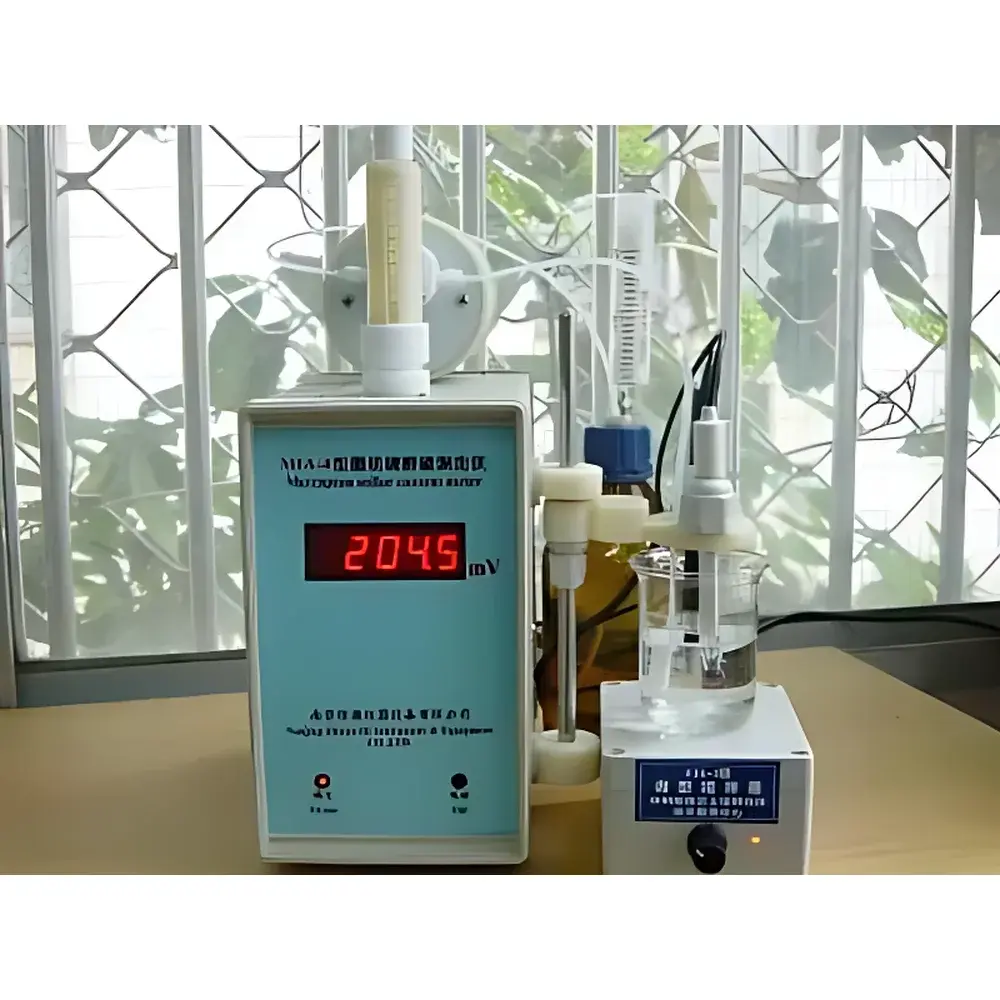
English Product Name
| Origin | Jiangsu, China |
|---|---|
| Manufacturer Type | Authorized Distributor |
| Origin Category | Domestic (PRC) |
| Model | MIA-4 |
| Instrument Type | Mercaptan Sulfur & Basic Nitrogen Analyzer |
| Measurement Range | ≥3 µg/g |
| Potentiometric Range | 0 to ±1999.9 mV, Resolution: 0.1 mV |
| Accuracy | ±0.025% of reading + 2 digits |
| Input Impedance | ≥1 × 10¹² Ω |
| Burette Capacity | 10 mL, Minimum Dispensing Volume: 0.01 mL |
| Relative Error | ≤5% |
| Repeatability | Compliant with GB/T 1792 and ASTM D3227 |
| Dimensions (W×D×H) | 240 × 120 × 210 mm |
| Weight | 5 kg |
| Power Consumption | ≤10 W |
Overview
The Kew MIA-4 Microcomputer-Based Potentiometric Titrator for Mercaptan Sulfur Analysis is an automated electrochemical instrument engineered for precise, trace-level quantification of mercaptan sulfur (R–SH) in hydrocarbon fuels—specifically jet fuel, gasoline, kerosene, and light diesel—per the standardized potentiometric titration methodology defined in GB/T 1792–1988 and ASTM D3227. The instrument operates on the principle of argentometric titration: in an anhydrous, non-aqueous medium (sodium acetate in isopropanol), mercaptan sulfur reacts stoichiometrically with standardized silver nitrate in ethanol solution to form insoluble silver mercaptide (AgSR), generating a distinct potentiometric endpoint detectable via a dual-electrode system. A pH glass electrode serves as the reference electrode, while a dedicated mercaptan-selective indicator electrode monitors the potential shift across the titration curve. The resulting inflection point—characterized by a sharp, reproducible voltage jump—is automatically identified using a robust derivative-based algorithm, eliminating subjective visual endpoint interpretation and ensuring high inter-laboratory reproducibility.
Key Features
- Full automation of titration sequence—including reagent delivery, endpoint detection, data acquisition, and result calculation—minimizing operator intervention and human error.
- Integrated triple-electrode support (reference, indicator, and auxiliary) with dual high-impedance input circuitry (≥1 × 10¹² Ω), ensuring stable electrode potential and reliable endpoint discrimination even in low-conductivity organic solvents.
- Chemically resistant fluidic path constructed from PTFE, borosilicate glass, and corrosion-resistant stainless steel components; compatible with aggressive reagents including glacial acetic acid, perchloric acid, and concentrated sodium hydroxide solutions.
- Smart titration algorithm based on Smooth Transition Endpoint (STE) methodology—powered by embedded expert-system logic—to autonomously determine endpoints without requiring user-defined thresholds or slope parameters.
- Onboard auto-cleaning protocol with programmable rinse cycles using distilled water or solvent; optional manual cleaning via supplied syringe-based cleaning kit to prevent cross-contamination and crystallization blockage.
- Real-time graphical display of titration curves (E vs. volume) and intermediate calculations during analysis, synchronized with PC-based software interface for immediate visualization and verification.
- Automatic burette calibration function with mass-based volumetric correction, enabling traceable accuracy adjustments per ISO/IEC 17025 metrological requirements.
Sample Compatibility & Compliance
The MIA-4 is validated for use with clarified, sulfur-hydrogen–free petroleum distillates conforming to specification limits outlined in GB/T 1792–1988 and ASTM D3227. It accommodates samples with complex matrix effects—including colored, viscous, or oxidatively unstable fuels—without interference from background conductivity or redox-active species. All operational procedures, data handling protocols, and audit trails are structured to align with GLP (Good Laboratory Practice) frameworks. While not inherently 21 CFR Part 11–compliant out-of-the-box, the instrument’s software architecture supports configuration for electronic signature implementation and secure, time-stamped audit logs when deployed within regulated QA/QC environments under documented SOPs.
Software & Data Management
The proprietary Windows-based application provides full control over method development, instrument configuration, and post-run analysis. Each titration session generates a timestamped, immutable dataset comprising raw potential readings, volume increments, first-derivative plots, final concentration values (% w/w or µg/g), and statistical summaries (e.g., RSD across replicates). Data export is supported in CSV, PDF, and XML formats for integration into LIMS platforms. All method files, calibration records, and user activity logs are stored locally with folder-level access controls. Software updates are distributed via secure download channels with version-controlled release notes and validation documentation available upon request.
Applications
- Quantitative determination of mercaptan sulfur content in aviation turbine fuels to assess odor impact, elastomer compatibility, and copper corrosion potential per ASTM D130 and IP 154.
- Routine QC testing of refinery streams and finished gasoline blends to ensure compliance with Tier 3 sulfur specifications and downstream catalyst protection requirements.
- Simultaneous evaluation of basic nitrogen compounds (e.g., pyridines, quinolines) in crude fractions using alternate titration modes—leveraging the same electrode architecture and solvent system.
- Research applications involving structure–reactivity correlation studies of organosulfur species in alternative fuels and bio-derived hydrocarbons.
- Support for method transfer and cross-validation studies between central labs and satellite testing facilities due to its standardized hardware–software interface and deterministic endpoint logic.
FAQ
What sample preparation is required prior to analysis?
Samples must be free of hydrogen sulfide (H₂S) and particulate matter; filtration through a 0.45 µm membrane filter is recommended. No derivatization or extraction is needed—the method uses direct dissolution in sodium acetate–isopropanol solvent.
Is the instrument capable of analyzing dark-colored fuels such as heavy gas oils?
Yes—the potentiometric endpoint detection is independent of sample color or turbidity, unlike spectrophotometric or visual-indicator methods.
Can the MIA-4 be integrated into an existing laboratory network or LIMS?
It supports standard COM/RS-232 communication and exports structured data files compatible with common LIMS ingestion protocols; custom API integration may be developed under NDA.
What maintenance routines are recommended for long-term reliability?
Daily rinsing of electrodes and fluidic paths with distilled water after use; quarterly verification of burette accuracy using gravimetric calibration; annual inspection of valve seals and electrode junction integrity.
Does the system comply with ISO/IEC 17025 accreditation requirements?
The instrument meets technical performance criteria referenced in ISO/IEC 17025:2017 Clause 6.4 (Equipment); full accreditation readiness requires documented method validation, uncertainty budgeting, and staff competency records maintained by the end-user laboratory.
Related Products





