
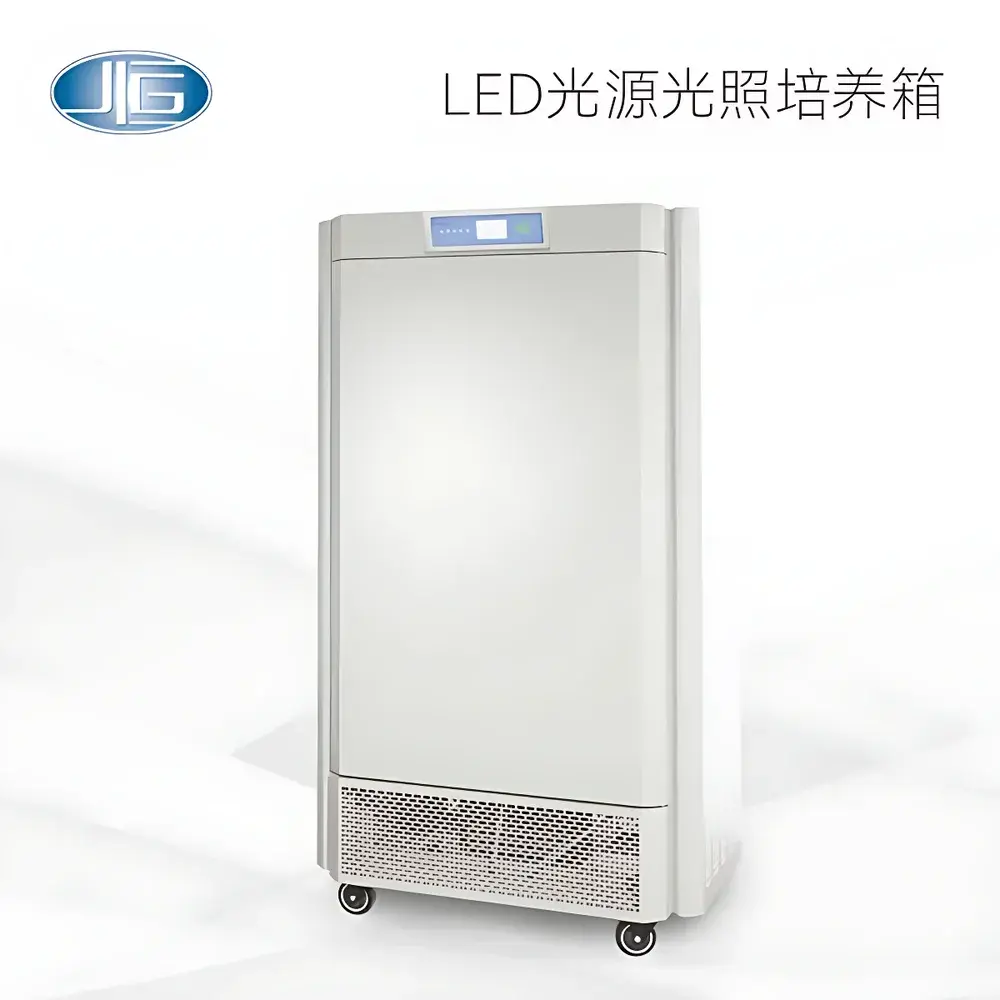
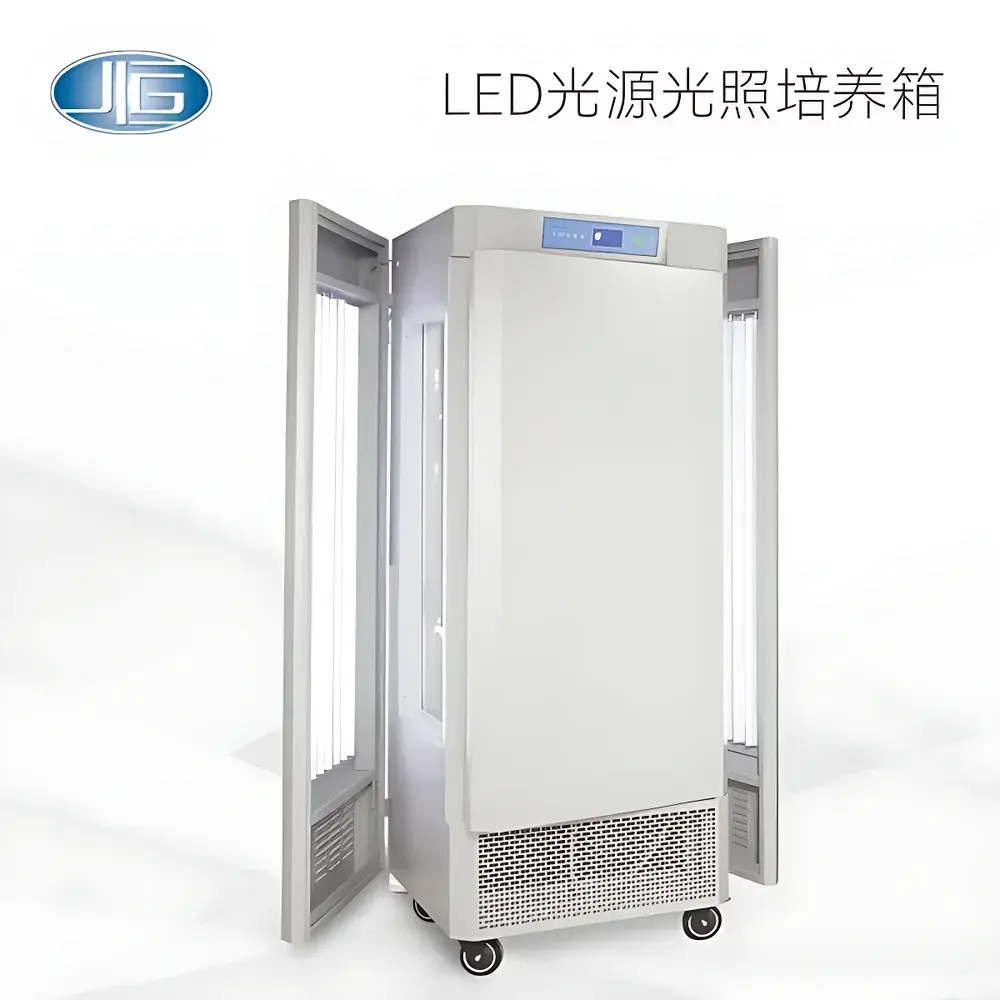
English Product Name
| Brand | YiHeng |
|---|---|
| Origin | Shanghai, China |
| Manufacturer Type | Direct Manufacturer |
| Country of Origin | China |
| Model Numbers | MGC-100BP-2L, MGC-1500BP-2L |
| Illumination Method | Triple-sided LED lighting |
| Light Source | High-efficiency white + UV-emitting LEDs |
| Spectral Range | UV-A (315–400 nm) and photosynthetically active radiation (PAR)-optimized spectrum |
| Temperature Control Range | 0–60 °C |
| Humidity Control Range | 50–90 % RH |
| Temperature Uniformity | ±1 °C |
| Illuminance Range | 0–18,000 lx (6-step adjustable) |
| Internal Dimensions (W×D×H) | 550×400×670 mm / 600×610×830 mm |
| External Dimensions (W×D×H) | 690×800×1410 mm / 760×815×1550 mm |
| Programmability | Up to 30 multi-segment programs, each with duration from 1 min to 99 h 59 min |
| Optional CO₂ Control | Infrared CO₂ sensor, range selectable (0–5000 ppm or 0–20 % vol) |
Overview
The YiHeng MGC-series LED Illuminated Plant Growth Chambers are engineered for precision-controlled plant physiology research, tissue culture, seed germination, microbial cultivation, and environmental aging studies. These chambers integrate advanced thermoelectric and refrigeration-based climate control with spectrally optimized triple-sided LED illumination—designed to replicate natural photoperiodic and diurnal cycles while minimizing thermal load on specimens. Unlike conventional fluorescent or halogen-based systems, the integrated LED array delivers high photon flux density (PPFD) across a biologically relevant spectrum—including targeted UV-A emission—without significant radiant heating, ensuring stable microclimate conditions essential for reproducible experimental outcomes in controlled-environment biology.
Key Features
- Fully programmable multi-stage control system supporting up to 30 independent protocols, each configurable for temperature, relative humidity, light intensity (6-level adjustment), and timing sequence.
- Triple-sided LED illumination architecture ensures uniform photon distribution across the entire working volume, eliminating shadowing and reducing positional bias in growth response studies.
- Mirror-finish stainless steel interior with radius-rounded corners and tool-free removable shelves enable rapid decontamination and compliance with GLP cleaning validation requirements.
- Dual-compressor redundancy system (imported brand) enables continuous operation over extended durations—critical for long-term phenotyping, stress acclimation, or circadian rhythm assays.
- Intelligent power-loss recovery: All user-defined parameters and active program states are retained in non-volatile memory and automatically resume upon re-powering.
- Independent overtemperature cut-off circuit with audible/visual alarm provides fail-safe protection aligned with IEC 61010-1 safety standards for laboratory equipment.
- Optional infrared CO₂ sensing module (selectable 0–5000 ppm or 0–20 % v/v range) offers fast (<5 s response), temperature- and humidity-insensitive CO₂ concentration feedback—ideal for photosynthetic rate quantification and carbon assimilation experiments.
Sample Compatibility & Compliance
These chambers accommodate a broad range of biological and material specimens: Arabidopsis thaliana and crop seedlings, callus cultures, fungal isolates, Drosophila melanogaster colonies, BOD test bottles, and polymer/wood/composite samples undergoing accelerated aging per ASTM G154 or ISO 4892-3. The UV-capable LED spectrum supports photomorphogenic studies requiring UVR8-mediated signaling pathway activation. All models comply with CE marking requirements for electromagnetic compatibility (EN 61326-1) and electrical safety (EN 61010-1). Humidity and temperature control performance is validated per ISO 17025-accredited procedures where applicable, and data logging functionality supports audit readiness under FDA 21 CFR Part 11 when paired with compliant software configurations.
Software & Data Management
The embedded controller features a 7-inch TFT-LCD touchscreen with intuitive menu navigation and real-time overlay of up to six concurrent parameters (e.g., chamber T/RH, light level, elapsed time, CO₂ if equipped). Internal data logging stores timestamped records at user-selectable intervals (1 min to 24 h), exportable via USB to CSV format for integration into LIMS or statistical analysis platforms (e.g., R, Python pandas, JMP). Optional PC-based monitoring software enables remote parameter adjustment, historical trend visualization, and alarm event reporting—supporting 21 CFR Part 11 electronic signature and audit trail capabilities when deployed in regulated environments.
Applications
- Photobiology: Quantitative assessment of phototropism, photoperiodism, and UV-B tolerance mechanisms in model and crop species.
- Tissue Culture: Maintenance of meristematic explants under defined spectral and hygrometric conditions to suppress hyperhydricity and improve regeneration efficiency.
- Microbial Physiology: Controlled incubation of phototrophic bacteria (e.g., Rhodobacter sphaeroides) and algae (Chlamydomonas reinhardtii) under tunable PAR+UV regimes.
- Environmental Simulation: Accelerated weathering tests on biomaterials, pharmaceutical packaging, and construction composites per ISO 4892-3 cyclic irradiation protocols.
- Eco-Toxicology: Standardized BOD₅ assays under regulated temperature and dissolved oxygen conditions using built-in humidity stabilization.
- Entomology: Rearing of dipteran and lepidopteran model organisms under precisely timed light-dark cycles mimicking geographic photoperiod gradients.
FAQ
What is the spectral output profile of the standard LED array?
The default configuration emits a broad-spectrum white light (400–700 nm) with peak intensity in the blue (450 nm) and red (660 nm) regions, supplemented by a calibrated UV-A component (365 nm) at ≤5 % of total photon flux—consistent with published PAR+UVR8 activation thresholds in angiosperm models. Custom spectral tuning is available upon request.
Can the chamber maintain humidity setpoints below 50 % RH?
No—the system is designed for humidification only, with operational range limited to 50–90 % RH. For desiccation studies, external dry-air purge integration is required.
Is the CO₂ option compatible with long-term unattended operation?
Yes—the IR sensor exhibits no drift over 12-month intervals under typical lab conditions and requires no routine calibration; zero-point verification is recommended annually using certified N₂ gas.
How is temperature uniformity verified across the chamber volume?
Uniformity is characterized per ISO 17025 using nine NIST-traceable PT100 probes placed at standardized positions (center, corners, mid-height); results consistently demonstrate ≤±0.8 °C deviation at 25 °C setpoint.
Does the unit support integration with building management systems (BMS)?
An optional RS-485 Modbus RTU interface is available for protocol-level integration with third-party HVAC or facility monitoring platforms.





