
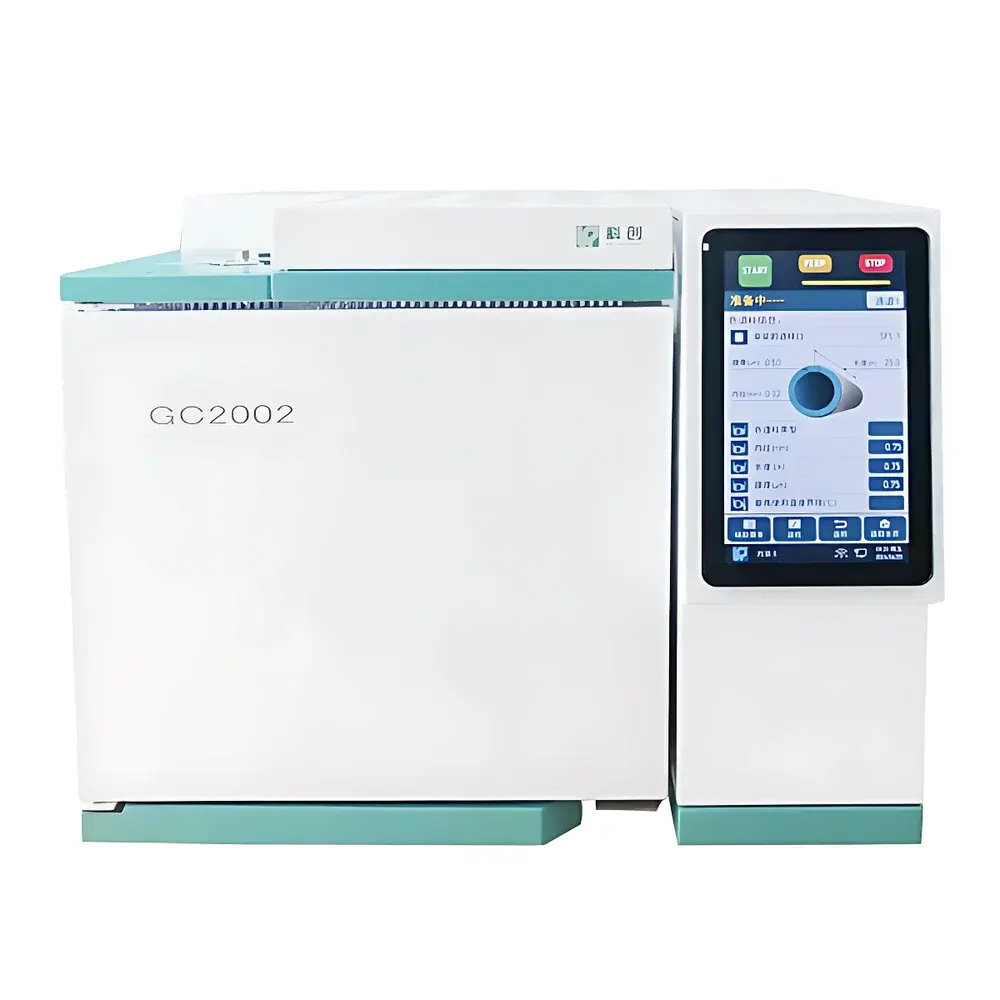
English Product Name
| Brand | Kechuang |
|---|---|
| Origin | Shanghai, China |
| Manufacturer Type | OEM Manufacturer |
| Instrument Type | Laboratory Gas Chromatograph |
| Application | High-Purity Gas Analysis |
| Oven Temperature Range | Ambient + 3 °C to 450 °C |
| Maximum Ramp Rate | 120 °C/min (adjustable in 0.1 °C/min increments) |
| Cooling Rate | 350 °C → 50 °C in ≤5 min (with motorized rear door) |
| Carrier Gas Pressure Control Range | 0–100 psi (0–689 kPa) |
| Carrier Gas Flow Control Range | 0–1200 mL/min |
| Inlet Temperature Max | 300 °C |
| Inlet Pressure Setting Range | 0–100 psi |
| Electronic Pressure/Flow Control (EPC/EFC) Precision | ±0.001 psi / ±0.001 mL/min |
| Temperature Stability | ±0.1% of setpoint |
| Temperature Display Resolution | 0.01 °C |
| Programmable Temperature Steps | Up to 16 stages (expandable to unlimited via firmware) |
| Retention Time RSD | <0.008% |
| Peak Area RSD | <1.0% |
| Power Supply | 220 V ±10%, 50 Hz ±5% |
| Dimensions (W×D×H) | 570 × 570 × 506 mm |
| Weight | ≤55 kg |
| Max Power Consumption | ≤3000 W |
Overview
The Kechuang GC2002 is a dedicated network-enabled gas chromatograph engineered for high-precision compositional analysis of natural gas and other high-purity gaseous mixtures. It operates on the fundamental principle of differential partitioning of analytes between a mobile phase (carrier gas) and a stationary phase (capillary or packed column), enabling separation based on volatility, polarity, and molecular interaction. Designed specifically for compliance with ISO 6974 (natural gas analysis), ASTM D1945, ASTM D1946, and GB/T 13610 (Chinese national standard for natural gas composition), the GC2002 delivers robust, reproducible retention and quantification of C₁–C₆ hydrocarbons, CO₂, N₂, O₂, H₂S, and inert gases. Its dual-oven architecture supports simultaneous or sequential analysis using multiple columns—such as PLOT Al₂O₃/KCl for permanent gases and DB-1 or equivalent for hydrocarbon speciation—ensuring full-range coverage without column switching or hardware reconfiguration.
Key Features
- 10-channel independent temperature control system, including two fully programmable column ovens with 16-stage (expandable) ramp profiles and thermal stability of ±0.1% at all setpoints.
- RJ45 Ethernet interface enabling native TCP/IP communication; integrates seamlessly with LIMS and enterprise SCADA systems; supports up to 253 instruments per subnet under centralized software supervision.
- Electronic Pressure and Flow Control (EPC/EFC) across up to 24 independent pneumatic channels, offering selectable modes: constant pressure, constant flow, or multi-step programmed pressure/flow ramps (up to 8 steps).
- 10-inch industrial-grade capacitive touchscreen with real-time baseline monitoring, integrated spectral display, and direct instrument reverse control—no external dongles or proprietary drivers required.
- Modular detector bay accommodating TCD, FID, ECD, and FPD simultaneously; all detectors feature wide-dynamic-range amplifiers (non-saturating solvent peak response) and auto-zero calibration routines.
- Self-diagnostic firmware with continuous hardware health monitoring; automatic thermal shutdown if any zone exceeds user-defined safety thresholds; ambient temperature compensation algorithm ensures <0.1 °C oven deviation per 10 °C ambient shift.
Sample Compatibility & Compliance
The GC2002 is validated for use with compressed natural gas (CNG), liquefied petroleum gas (LPG), biogas, syngas, and refinery off-gas streams. Sample introduction is compatible with gas-tight syringes, automated valve loops (6- or 10-port), and online sampling interfaces (e.g., ASTM D7165-compliant gas cylinders with regulated pressure regulators). All pneumatic components meet ISO 8573-1 Class 2 purity requirements for carrier gas delivery. The system conforms to GLP and GMP data integrity principles: audit trails are embedded in firmware, raw acquisition files are write-once/read-many (WORM), and electronic signatures comply with FDA 21 CFR Part 11 when paired with validated chromatography data systems (CDS). Optional hydrogen leak detection meets IEC 60079-29-1 for hazardous area deployment.
Software & Data Management
The GC2002 ships with Kechuang ChromaSuite™ v4.x—a 64-bit, Windows-based CDS supporting method development, sequence scheduling, peak integration, and report generation in PDF/XLS formats. It enables cross-detector signal routing: users may assign TCD and FID outputs to separate processing channels or merge them into a single unified chromatogram with time-aligned retention markers. Remote access is supported via HTTPS-secured web console; real-time instrument status, current chromatogram, and alarm logs are viewable without client installation. Raw data (.KCD) files include embedded metadata (temperature programs, EPC settings, detector voltages) and are compatible with third-party tools including OpenChrom and Chromeleon™ (via .CDF export). All software updates are delivered over-the-air with SHA-256 signature verification.
Applications
- Quantitative determination of methane, ethane, propane, butanes, pentanes, hexanes, nitrogen, carbon dioxide, oxygen, hydrogen sulfide, and helium in pipeline-quality natural gas per ISO 6974-2.
- Calibration gas certification and verification in metrology labs accredited to ISO/IEC 17025.
- Trace impurity profiling (ppb-level H₂S, COS, mercaptans) using sulfur-selective FPD or pulsed discharge helium ionization detection (PDHID).
- Process gas monitoring in LNG liquefaction plants, compressor stations, and gas-to-power facilities with optional 24/7 unattended operation via autosampler integration.
- Environmental emissions testing of flare gas composition and VOC speciation in accordance with EPA Method 18 and EN 15467.
FAQ
Does the GC2002 support ASTM D1945-compliant natural gas analysis out-of-the-box?
Yes—factory-loaded methods include full ASTM D1945 workflows with certified calibration standards, column configurations, and reporting templates aligned with GPA 2261 and ISO 6974-2.
Can the instrument operate in an unattended mode for extended periods?
Yes—equipped with 8 programmable external event triggers and onboard sequence memory, it supports >72-hour continuous operation with automated valve actuation, column backflushing, and detector optimization cycles.
Is the EPC/EFC system compatible with hydrogen carrier gas?
Yes—the system supports H₂, He, N₂, and Ar; hydrogen-specific safety logic includes automatic pressure ramp limiting and optional integration with external H₂ sensors per UL 2075.
What cybersecurity protocols are implemented for network-connected operation?
The embedded Linux RTOS enforces TLS 1.2 encryption, role-based access control (RBAC), and configurable firewall rules; no default credentials or exposed Telnet/FTP services are enabled.
How is traceability maintained for regulatory audits?
All method parameters, raw signals, integration events, and user actions are timestamped and cryptographically hashed in immutable binary logs compliant with ALCOA+ principles.
Related Products






