
English Product Name
| Brand | Tuofeng |
|---|---|
| Origin | Shanghai, China |
| Manufacturer Type | Direct Manufacturer |
| Instrument Type | Electromechanical Universal Testing Machine |
| Model | TFW-163 |
| Max Test Load | 5–100 kN (configurable) |
| Accuracy Class | 0.5 |
| Force Measurement Range | 0.4–100% FS |
| Force Indication Error | ±0.5% of reading |
| Force Resolution | 1/500,000 of full scale, unsegmented |
| Deformation Measurement Range | 0.2–100% FS |
| Deformation Error | ±0.5% of reading |
| Deformation Resolution | up to 1/300,000 |
| Displacement Error | ±0.5% of reading |
| Column Spacing | 840 mm |
| Crosshead Travel | 1000 mm (subject to chamber clearance) |
| Dimensions (W×D×H) | 1250 × 560 × 2400 mm |
| Weight | ~380 kg |
| Power Supply | AC 220 V / 50 Hz ±10%, 750 W |
| Environmental Chamber Temp Range | −40 °C to +100 °C |
| Chamber Internal Dimensions | 360 × 300 × 500 mm (W×D×H) |
| Chamber Heating Power | 1.5 kW |
| Chamber Temperature Stability | ±2 °C over 100 mm vertical zone |
| Chamber Ramp Rate | ≤30 min to +100 °C from ambient |
| Temperature Equilibration Time | ≤5 min (both above and below 0 °C) |
| Chamber Control | Programmable PID with Pt100 sensors, LCD controller, dual-port access (50 mm Ø), sliding thermal barrier inserts, stainless steel 304/316 construction, silicone door seal, centrifugal blower, compressor + resistive heating system |
Overview
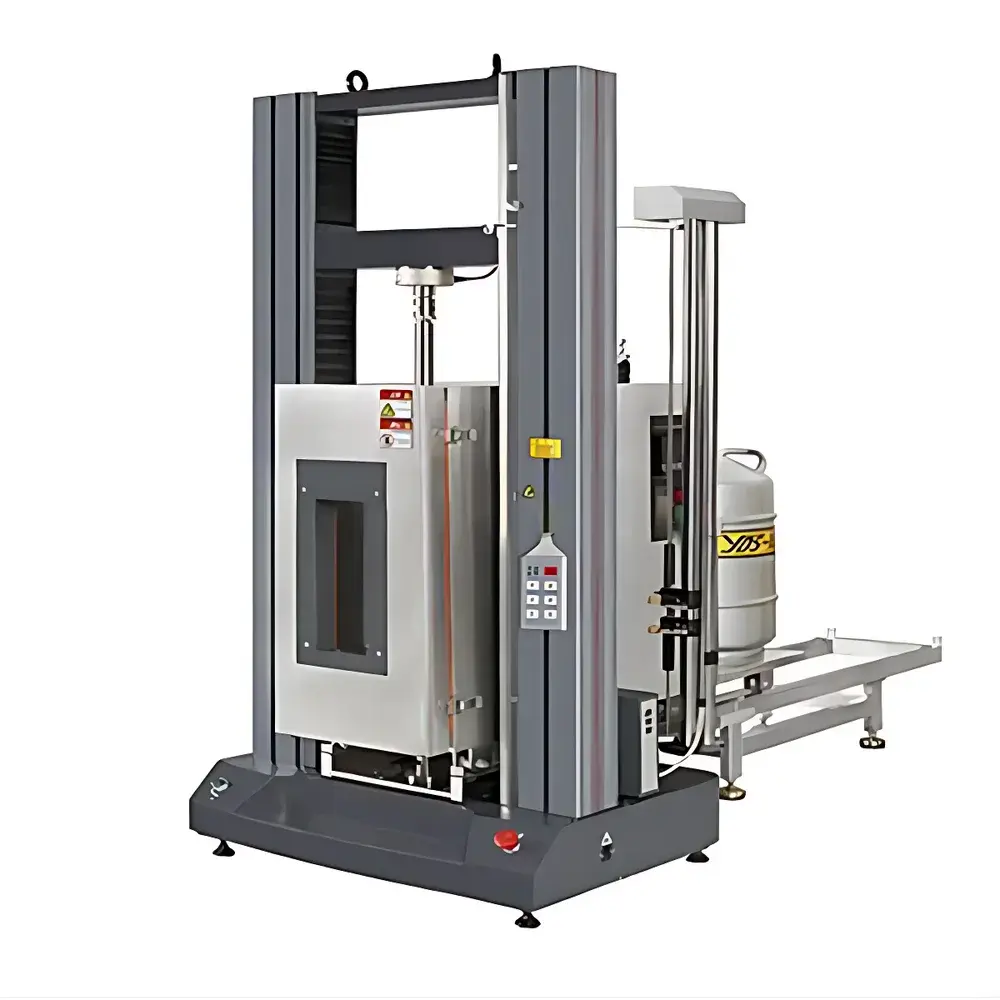
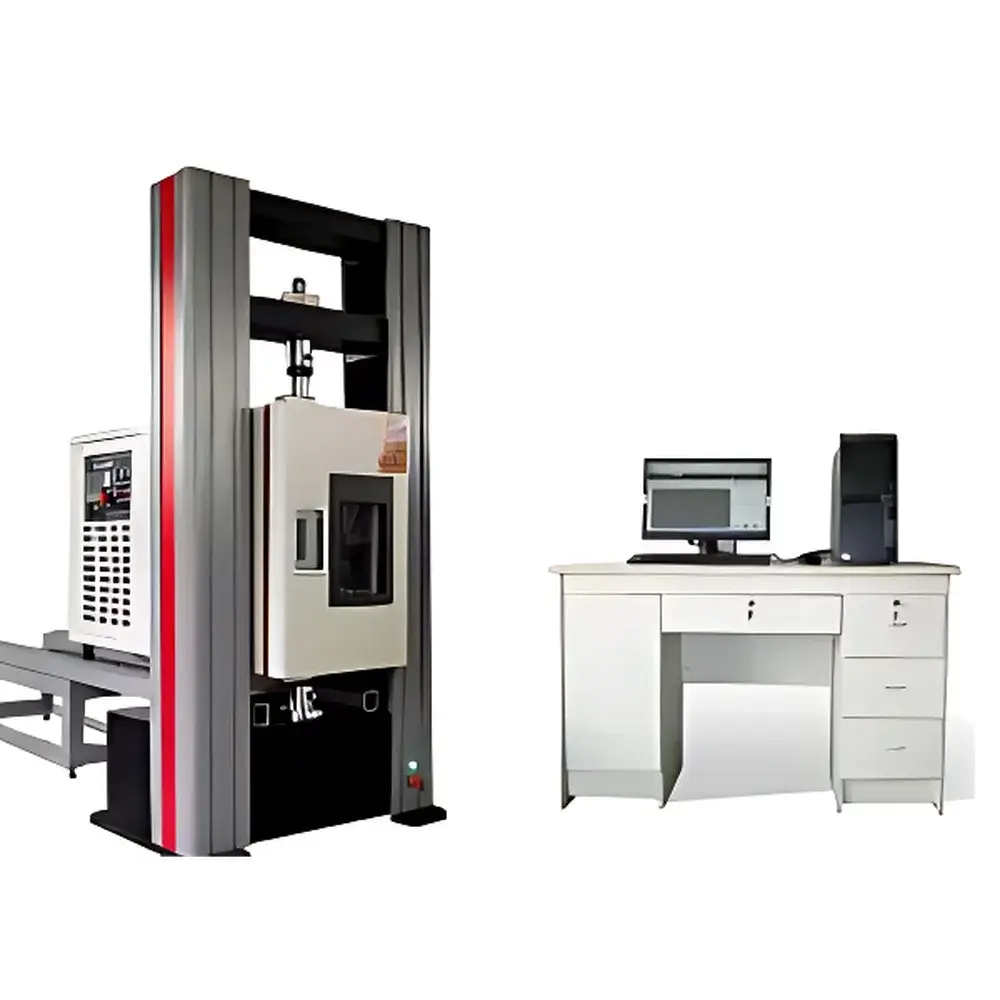
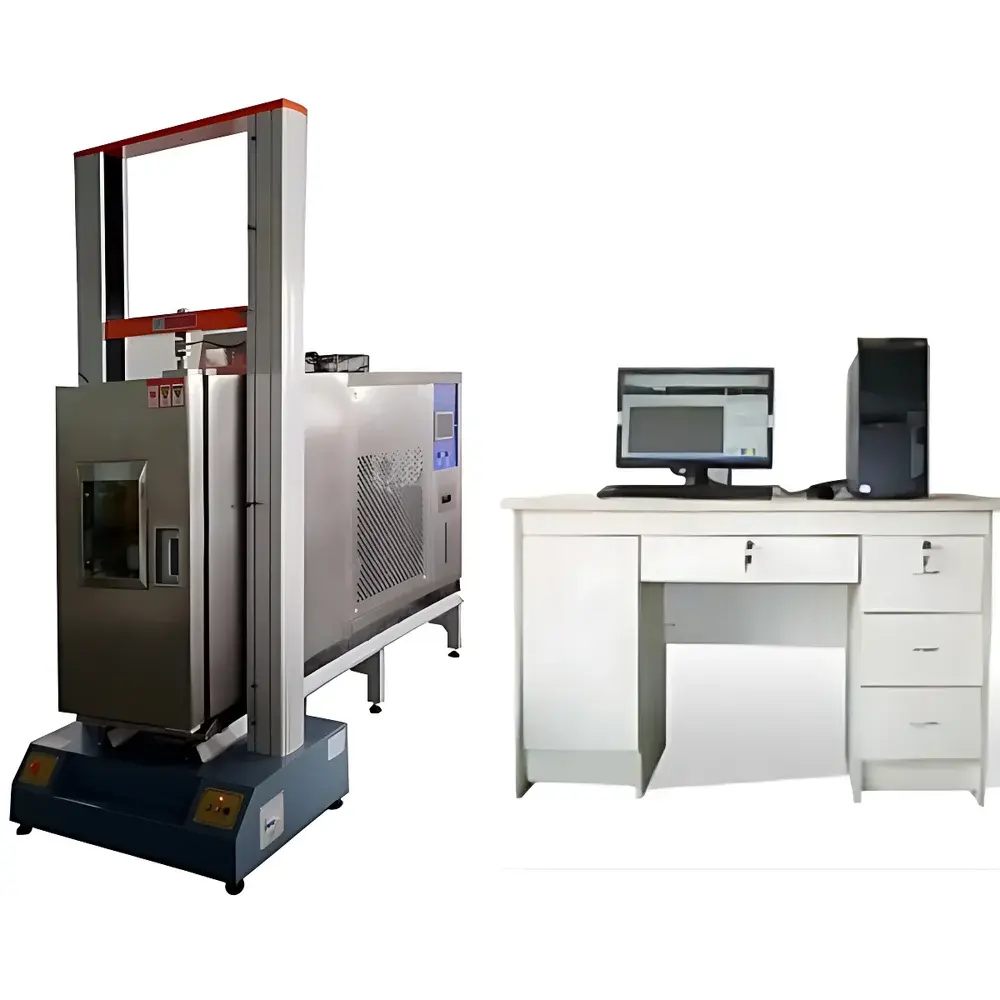
The Tuofeng TFW-163 Universal Testing Machine is an electromechanical force-testing platform engineered for high-fidelity mechanical characterization of cables, wires, insulation sheaths, and related polymeric or metallic specimens under precisely controlled thermal conditions. Unlike standard ambient-only tensile testers, the TFW-163 integrates a fully programmable environmental chamber—capable of sustained operation from −40 °C to +100 °C—directly into the load frame architecture. This configuration enables true in-situ mechanical testing where temperature is not merely a preconditioning variable but an actively modulated parameter during force-displacement acquisition. The system operates on the principle of servo-controlled crosshead displacement, measuring axial load via high-stability load cells and deformation via calibrated extensometers or encoder-based crosshead travel, all synchronized with real-time chamber temperature feedback. Designed for compliance-driven laboratories, it supports static and quasi-static test modes per ISO 527, ASTM D638, ASTM D882, IEC 60811-501, GB/T 2951.11, and EN 60811-501, making it suitable for qualification of power transmission cables, aerospace wiring harnesses, automotive EV charging cords, and telecom fiber-reinforced cables subjected to thermal cycling in service environments.
Key Features
- Electromechanical drive system with closed-loop servo control, delivering smooth, repeatable crosshead motion across full travel (1000 mm)
- High-precision load cell options (5 kN to 100 kN), certified to ISO 7500-1 Class 0.5 accuracy, with force resolution down to 1/500,000 of full scale and no range switching required
- Integrated environmental chamber featuring dual-zone thermal management: refrigeration compressor + NiCr resistive heating, enabling stable setpoint maintenance within ±2 °C over 100 mm vertical measurement zone
- Chamber constructed from 304 stainless steel exterior and 316 mirror-finish interior panels, insulated with high-density alumina-silicate fiber for low thermal leakage and rapid equilibration (≤5 min stabilization time)
- Dual 50 mm diameter access ports with sliding ceramic-coated thermal barriers, permitting uninterrupted specimen mounting and real-time extensometer attachment without chamber venting
- Modular software architecture supporting ASTM E4-compliant calibration traceability, multi-channel analog input for auxiliary sensors (e.g., strain gauges, thermocouples), and GLP/GMP-ready audit trails
Sample Compatibility & Compliance
The TFW-163 accommodates cable specimens ranging from fine-diameter coaxial assemblies (≥0.5 mm OD) to armored power cables (up to 40 mm OD), using interchangeable wedge-action, pneumatic, or hydraulic grips with serrated jaws and adjustable clamping pressure. Specimen alignment is verified via integrated optical leveling guides and lateral adjustment screws to minimize bending moments during axial loading. All mechanical test protocols align with international standards including ISO 6892-1 (metallic materials), ISO 527-2 (plastics), ASTM D3032 (wire and cable), IEC 60227 (PVC-insulated cables), and UL 1581 (reference standard for flame-retardant wire). The chamber’s thermal performance complies with IEC 60068-2-1 (cold) and IEC 60068-2-2 (dry heat), while the full system meets CE Machinery Directive 2006/42/EC and EMC Directive 2014/30/EU requirements. Optional documentation packages include factory calibration certificates traceable to NIM (China) and optional UKAS-accredited verification.
Software & Data Management
The Windows-based test control software provides real-time synchronization of load, displacement, strain, and chamber temperature data at configurable sampling rates up to 1 kHz. It supports automated test sequences—including ramp-hold-ramp, cyclic tension-compression, and stress-relaxation—with programmable thermal profiles (e.g., “hold at −30 °C for 30 min → ramp to +85 °C at 3 °C/min → hold → tensile test”). All raw data are stored in vendor-neutral ASCII CSV format with embedded metadata (operator ID, sample ID, calibration IDs, environmental timestamps). Audit trail functionality logs user actions, parameter changes, and calibration events in accordance with FDA 21 CFR Part 11 requirements when enabled. Report generation includes customizable templates compliant with ISO/IEC 17025 laboratory accreditation criteria, with export options for PDF, Excel, and XML. Software modules support extension for third-party integration via TCP/IP API or OPC UA.
Applications
- Evaluation of tensile strength retention in polymer-insulated cables after low-temperature embrittlement exposure (e.g., arctic-grade utility cables)
- Measurement of elongation-at-break and modulus degradation in cross-linked polyethylene (XLPE) sheaths under elevated thermal soak (e.g., underground duct bank simulations)
- Interfacial adhesion testing between conductor strands and jacketing materials under thermal gradient conditions
- Qualification of fire-resistive cable systems per IEEE 383 and UL 2196, including post-fire tensile integrity assessment
- Research into creep behavior of halogen-free flame-retardant (HFFR) compounds across −20 °C to +90 °C ranges
- QC release testing for aerospace MIL-DTL-27500 wiring, requiring mechanical verification at both cold-soak and hot-soak conditions
FAQ
Can the TFW-163 perform simultaneous temperature ramping and mechanical loading?
Yes—the system executes coordinated thermal-mechanical profiles where chamber temperature and crosshead displacement are independently programmed and synchronized in real time.
Is the environmental chamber validated for temperature uniformity per ISO 17025 requirements?
Yes; optional IQ/OQ documentation includes 9-point temperature mapping reports with uncertainty budgets, performed using NIST-traceable Pt100 probes.
What grip types are recommended for small-diameter fiber-optic cables?
We recommend pneumatic side-action grips with soft jaw inserts (e.g., rubber-coated aluminum) and low-clamp-force calibration to prevent core deformation prior to yield.
Does the system support ASTM D638 Type I specimen geometry for cable jacket material extraction?
Yes—standardized dog-bone die sets and alignment fixtures are available as accessories for ISO/ASTM-compliant dumbbell specimen testing.
How is data integrity ensured during long-duration creep tests spanning >100 hours?
The controller features non-volatile memory buffering and automatic failover to external NAS storage; all timestamps are synchronized to GPS-derived UTC via optional network time protocol (NTP) module.
Related Products



