
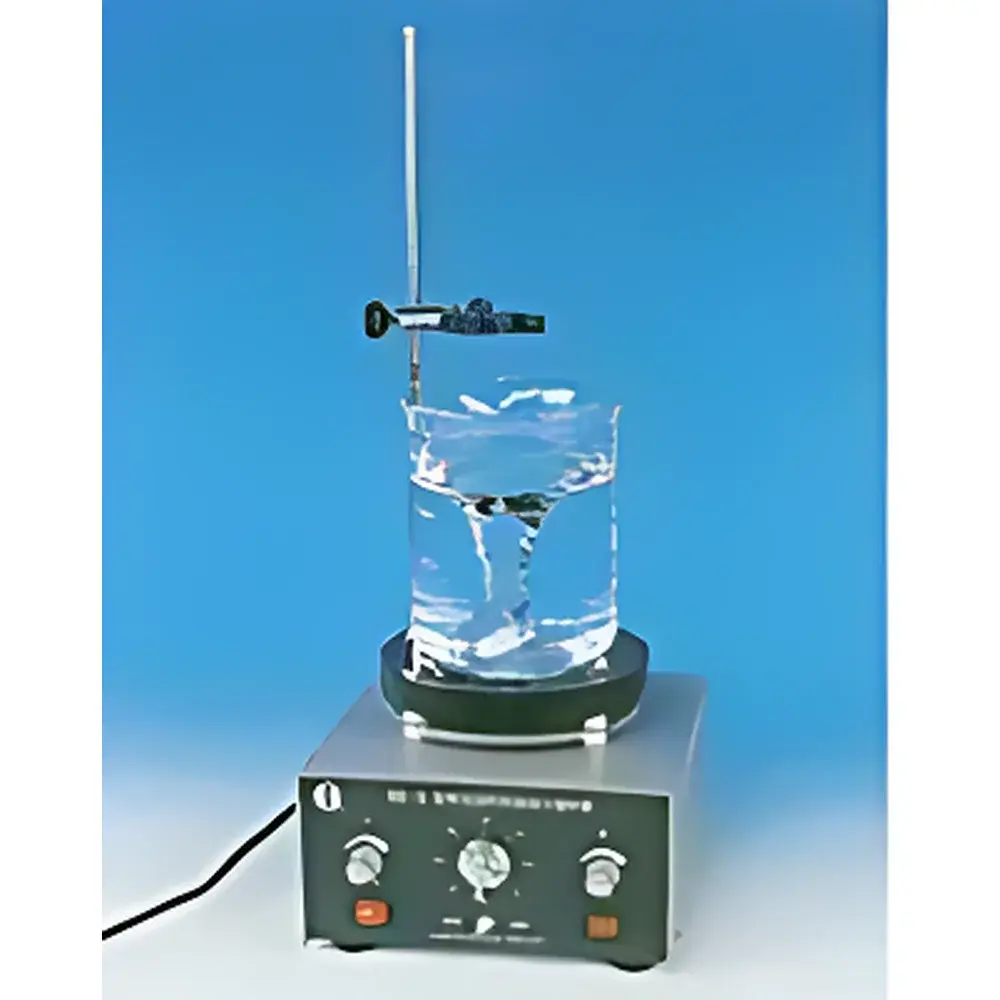
English Product Name
| Origin | Shanghai, China |
|---|---|
| Manufacturer Type | Authorized Distributor |
| Product Origin | Domestic (China) |
| Model | 90-3 / 90-2 |
| Price | USD 105 (FOB Shanghai) |
| Stirring Capacity | 20–3000 mL |
| Speed Range | 0–1250 rpm (infinitely variable) |
| Temperature Control Range | Ambient to 150 °C |
| Heating Power | 0–350 W (infinitely adjustable) |
| Timer Range | 0–120 min |
| Dual-Direction Mode | 90-3 only |
| Display | Digital LED for speed, temperature, and timer |
| Construction | Die-cast aluminum housing |
| Stir Bar Material Compatibility | Standard stainless-steel rods (e.g., PTFE-coated, ceramic-core) |
| Safety Features | Over-temperature cutoff, thermal insulation, sealed electronics enclosure |
Overview
The Lab Companion 90-3 and 90-2 magnetic stirrers are precision-engineered benchtop instruments designed for reproducible, thermally stable mixing in research, quality control, and teaching laboratories. Based on the principle of contactless torque transmission via rotating permanent magnets—driven by a brushless DC motor—the system induces controlled rotational motion in ferromagnetic or magnetically responsive stir bars immersed in liquid samples. Unlike mechanical overhead stirrers, this design eliminates shaft seals, lubrication requirements, and contamination risks, making it ideal for sterile, vacuum, or sealed-vessel applications. The 90-3 variant uniquely supports bidirectional rotation (clockwise/counter-clockwise alternation), enhancing homogenization efficiency for viscous, particulate-laden, or phase-separated systems where unidirectional shear may induce stratification or wall adhesion. Both models integrate resistive heating plates with PID-regulated temperature control, enabling simultaneous stirring and thermal conditioning—critical for kinetic studies, dissolution testing, polymerization initiation, and reagent pre-equilibration.
Key Features
- Dual-directional stirring mode (90-3 model only): Programmable alternating rotation improves suspension stability and reduces vortexing in high-viscosity media (e.g., agarose gels, polymer melts, colloidal dispersions)
- Digital LED interface: Simultaneously displays real-time setpoints and actual values for speed (rpm), plate temperature (°C), and remaining timer duration (min)
- PID temperature regulation: Achieves ±2 °C accuracy across 25–150 °C range; heating power continuously modulated from 0–350 W to minimize thermal overshoot
- Brushless DC motor: Delivers consistent torque up to 1250 rpm with no carbon dust generation, extended service life (>10,000 hr MTBF), and low electromagnetic interference
- Die-cast aluminum chassis: Provides structural rigidity, efficient heat dissipation, and corrosion resistance; non-porous surface facilitates decontamination per ISO 14644 cleanroom protocols
- Mechanical timer with auto-shutoff: Configurable 1–120 min countdown; system powers down heating and agitation upon completion, supporting unattended operation under GLP-compliant workflows
Sample Compatibility & Compliance
These stirrers accommodate standard laboratory glassware—including beakers (50–2000 mL), Erlenmeyer flasks, and jacketed reactors—provided bottom geometry permits effective stir bar coupling. Compatible with PTFE-, glass-, or ceramic-coated stir bars up to 60 mm length. Not recommended for use with strongly paramagnetic solvents (e.g., gadolinium chelates) or ferrofluids without empirical validation. Complies with IEC 61010-1:2010 safety standards for electrical equipment used in laboratory environments. Thermal control functionality aligns with ASTM E2928-21 guidelines for temperature uniformity assessment in heated stirring platforms. No CE marking; intended for export markets requiring self-declaration of conformity per local regulatory frameworks.
Software & Data Management
The 90-3/90-2 series operates as a standalone instrument with no embedded firmware update capability or USB/RS-232 connectivity. All operational parameters are configured locally via membrane keypad. For audit-trail compliance in regulated environments (e.g., pharmaceutical QC labs adhering to FDA 21 CFR Part 11), users must manually log setpoints, start/stop times, and observed outcomes in bound laboratory notebooks or validated electronic lab notebook (ELN) systems. The digital display retains last-used settings after power cycling—facilitating repeatable method execution without reconfiguration.
Applications
- Chemical synthesis: Homogenizing reaction mixtures during reflux, esterification, or condensation reactions requiring precise thermal management
- Pharmaceutical QA/QC: Dissolution testing per USP , buffer preparation, and standard solution dilution under temperature-controlled conditions
- Environmental analysis: Digestion of soil/water samples prior to heavy metal quantification (EPA Method 3050B)
- Food science: Viscosity equalization of sauces, emulsions, and dairy formulations; thermal stabilization during sensory panel sample prep
- Academic instruction: Demonstrating Arrhenius kinetics, Le Chatelier’s principle, or heat-transfer dynamics in undergraduate physical chemistry labs
FAQ
Does the 90-3 model support continuous bidirectional rotation, or is it alternating?
The 90-3 executes programmable alternating direction cycles—user-selectable dwell time per direction (default: 30 s clockwise, 30 s counter-clockwise)—not simultaneous dual-axis motion.
Can the unit maintain temperature setpoint while operating at maximum speed?
Yes; thermal regulation remains active independent of stirring speed. However, convective cooling from rapid surface agitation may slightly extend time-to-setpoint at >1000 rpm in low-volume (<100 mL) samples.
Is the heating plate compatible with borosilicate glass vessels only?
It is optimized for borosilicate (e.g., Pyrex®) but also supports quartz, ceramic, and certain high-temp polymers (e.g., PEEK) provided thermal expansion coefficients permit secure contact without cracking.
What maintenance is required beyond routine cleaning?
No scheduled maintenance; periodic inspection of stir bar integrity and verification of temperature calibration using a traceable NIST-certified thermometer is recommended annually.
Can the timer function be disabled for continuous operation?
Yes—setting timer to “0” disables auto-shutoff, allowing indefinite operation until manual power interruption.



