
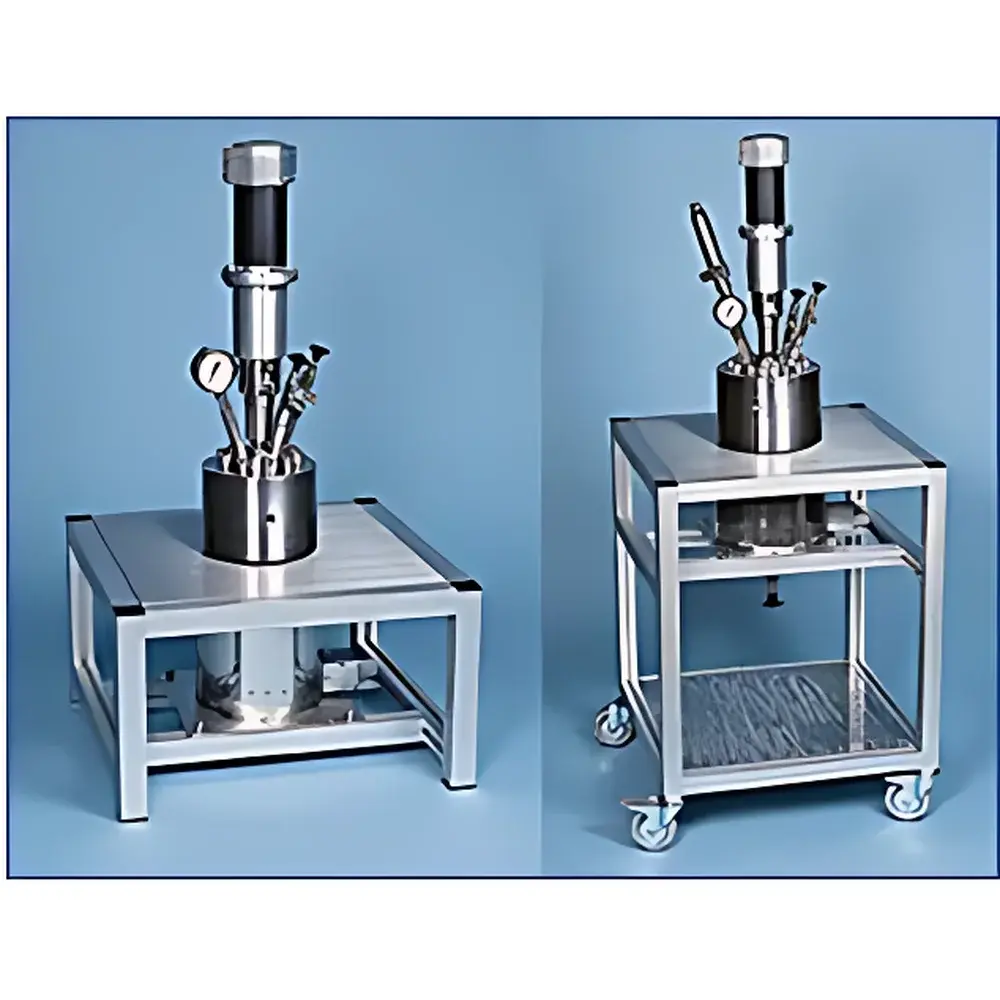
English Product Name
| Origin | United Kingdom |
|---|---|
| Supplier Type | Authorized Distributor |
| Import Status | Imported |
| Model | 5L Benchtop |
| Usable Volume Range | 150 mL – 5 L |
| Operating Pressure | Up to 350 bar |
| Operating Temperature | Up to 350 °C |
| Construction Material | Stainless Steel (316 SS), Hastelloy C-276, Inconel 625, Tantalum, or Titanium |
| Heating System | Electric, PID-Controlled |
| Stirring Options | Magnetic Drive (2000 bar / 650 °C / 3000 rpm) or Mechanical Drive (200 bar / 500 °C / 200 rpm) |
| Sealing Mechanism | Dual-clamp + Automatic Metal C-Ring Seal |
Overview
The Parr 5L Benchtop High-Pressure Reaction Vessel is an engineered solution for controlled synthesis, catalytic screening, hydrogenation, hydrothermal synthesis, and supercritical fluid processing under rigorously defined thermodynamic conditions. Designed in accordance with ASME BPVC Section VIII Div. 1 and PED 2014/68/EU standards, this reactor employs a dual-clamp mechanical closure system integrated with an automatic metal C-ring sealing architecture—ensuring leak-tight integrity at pressures up to 350 bar and temperatures up to 350 °C. Its modular construction supports interchangeable vessel liners and standardized flange interfaces, enabling rapid reconfiguration across reaction scales from 150 mL to 5 L without compromising pressure containment or thermal uniformity. The vessel operates on the principle of sealed batch reaction kinetics, where precise control over p–T–t (pressure–temperature–time) profiles enables reproducible kinetic modeling and phase behavior studies in heterogeneous and homogeneous catalytic systems.
Key Features
- Dual-clamp locking mechanism with automated C-ring compression seal, eliminating manual torque calibration and ensuring consistent gasket loading across repeated cycles.
- Modular vessel body design: compatible with interchangeable liners in stainless steel (316 SS), Hastelloy C-276, Inconel 625, tantalum, and titanium—selected per chemical compatibility requirements (e.g., HF resistance, chloride stress corrosion cracking mitigation).
- PID-controlled electric heating jacket with axial thermal gradient compensation; optional external cooling coil integration for exotherm management.
- Magnetic drive stirrer rated for 2000 bar and 650 °C, delivering up to 3000 rpm with real-time digital torque and speed feedback; mechanical drive alternative available for viscous media (200 bar / 500 °C / 200 rpm).
- Integrated instrumentation ports: pressure transducer (0–400 bar full scale), dual thermocouple wells (reactor core and wall temperature), gas inlet/outlet valves, rupture disc assembly, and sampling quill.
- Compliant with ISO 17025 traceability protocols for pressure and temperature sensors; all critical components supplied with material test reports (MTRs) per EN 10204 3.1.
Sample Compatibility & Compliance
This reactor accommodates a broad spectrum of sample types—including corrosive acids (e.g., HCl, H₂SO₄), halogenated solvents, supercritical CO₂, hydrogen gas, and slurries containing solid catalysts (e.g., Pd/C, Raney Ni). Material selection follows NACE MR0175/ISO 15156 guidelines for sour service environments. All pressure-retaining components undergo hydrostatic testing at 1.5× maximum allowable working pressure (MAWP), certified per ASME U-1 stamping. The system meets GLP audit requirements for pharmaceutical process development (ICH Q5A, Q5D) and complies with FDA 21 CFR Part 11 when paired with validated data acquisition software.
Software & Data Management
The reactor integrates with Parr’s proprietary WinParr™ control suite (v5.2+), supporting real-time logging of pressure, temperature, stir speed, torque, and heater power at 1 Hz resolution. Data export formats include CSV, XML, and ASTM E2918-compliant .parrlog files. Audit trail functionality records user actions, parameter changes, and alarm events with time-stamped digital signatures. Optional OPC UA server module enables seamless integration into LabVantage, DeltaV, or Siemens Desigo CCMS platforms for centralized lab automation.
Applications
- Catalytic hydrogenation and dehydrogenation studies under industrially relevant p–T conditions.
- Hydrothermal carbonization (HTC) and solvothermal nanomaterial synthesis (e.g., MOFs, perovskites).
- Supercritical water oxidation (SCWO) of organic waste streams.
- High-pressure polymerization kinetics (e.g., ethylene copolymerization).
- Thermodynamic property measurement: vapor–liquid equilibrium (VLE), solubility limits, and phase transition boundaries.
- Accelerated stability testing of battery electrolytes and solid-state electrolyte precursors.
FAQ
What safety certifications apply to this reactor?
It carries ASME U-Stamp certification, CE marking per PED 2014/68/EU, and conforms to ISO 4706 for high-pressure laboratory equipment.
Can the vessel be operated in continuous flow mode?
Yes—optional mass flow controllers, back-pressure regulators, and heated transfer lines enable steady-state continuous operation with residence time control.
Is remote monitoring supported?
Full remote access is available via Ethernet-connected WinParr™ with TLS 1.2 encryption and role-based authentication.
What documentation is provided upon delivery?
Each unit ships with Factory Acceptance Test (FAT) report, MTRs, pressure test certificate, EC Declaration of Conformity, and ISO 17025-calibrated instrument certificates.
How is maintenance performed on the magnetic drive system?
The magnetic coupling is hermetically sealed and requires no routine lubrication; annual verification of magnetic field strength and gap tolerance is recommended per manufacturer’s service bulletin SB-PARR-MAG-2023.



