
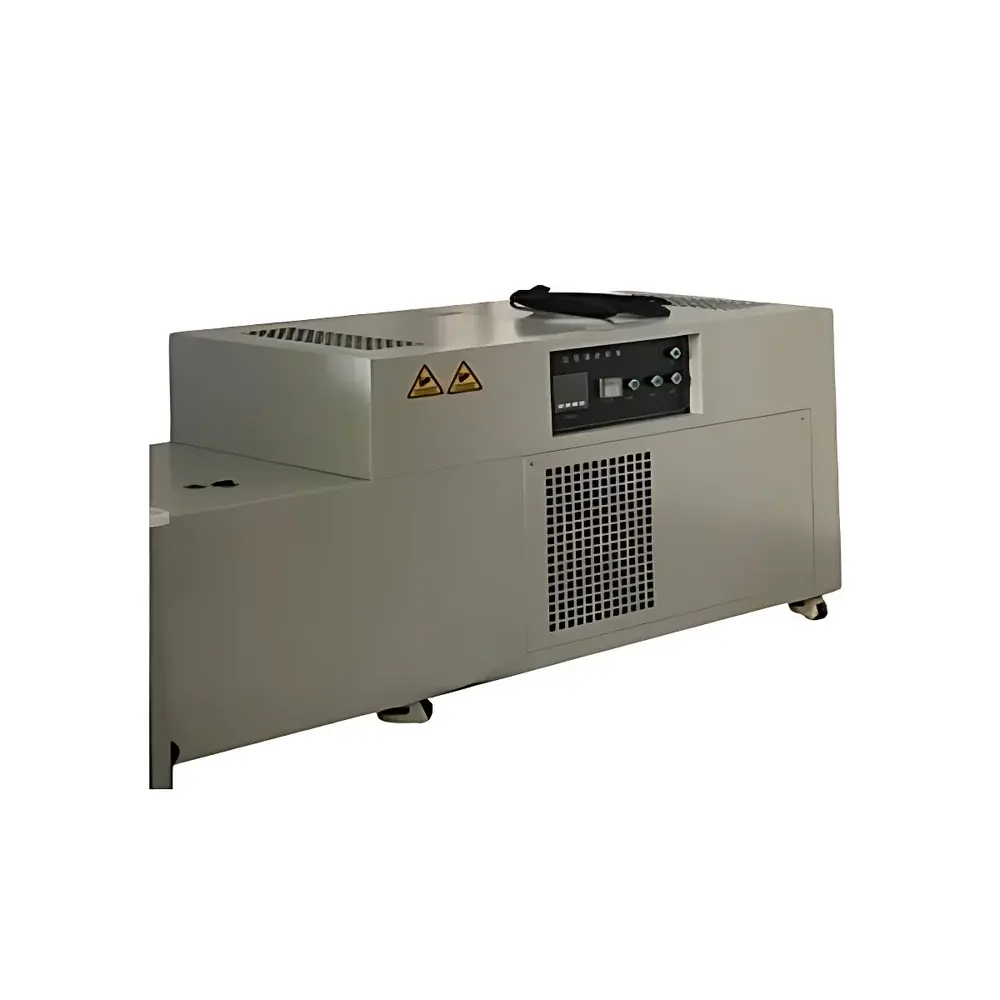
English Product Name
| Brand | Guance Instruments |
|---|---|
| Origin | Beijing, China |
| Model | GCCLC-AII |
| Impact Energy Range | 50–300 J |
| Impact Velocity | 2–5.5 m/s |
| Pendulum Torque (Impact Constant) | 15 N·m |
| Load Cell Capacity | 16 kN |
| Maximum Lifting Height | 1500 mm |
| Temperature Chamber Range | −40 °C to +100 °C |
| System Sampling Rate | 2 MHz |
| A/D Resolution | 16-bit |
| Frequency Response | 500 kHz |
| Dynamic Test Error | <2% |
| Overall Dimensions (w/o chamber) | 850 × 1700 × 3300 mm |
| Net Weight | 1200 kg |
Overview
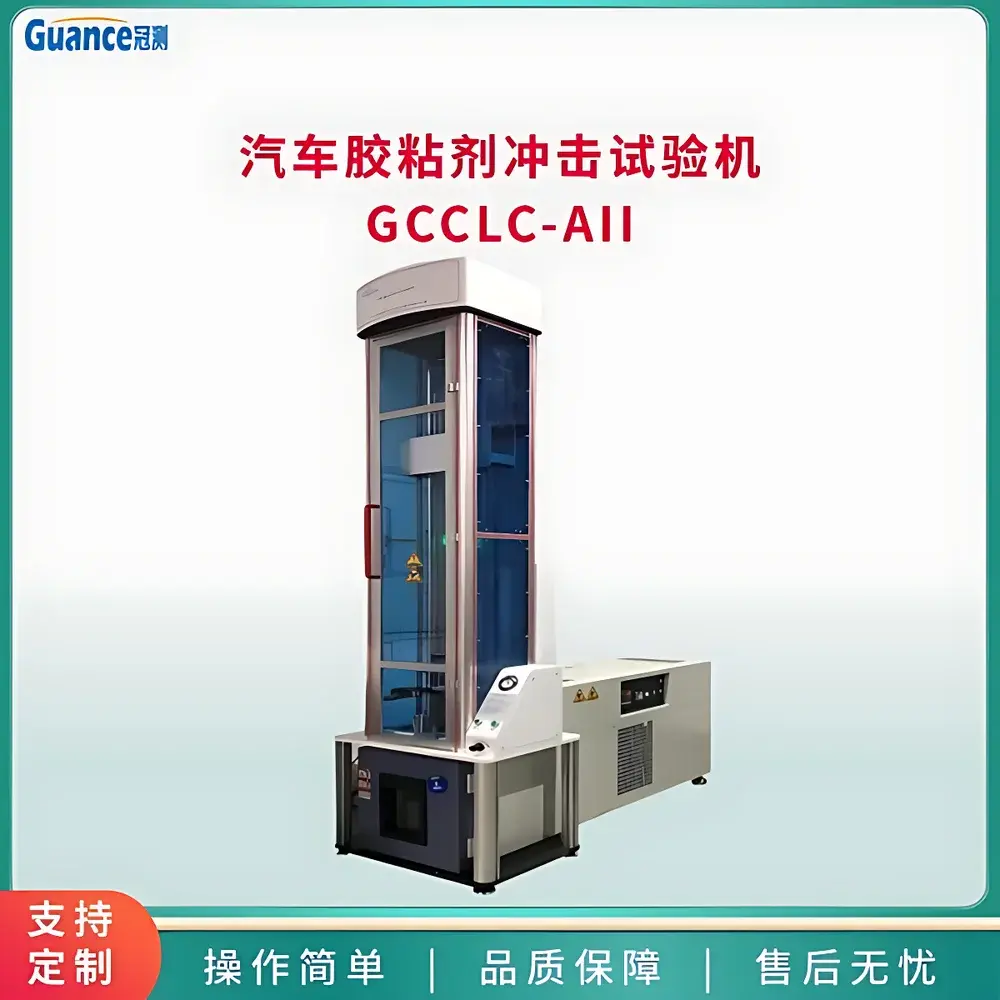
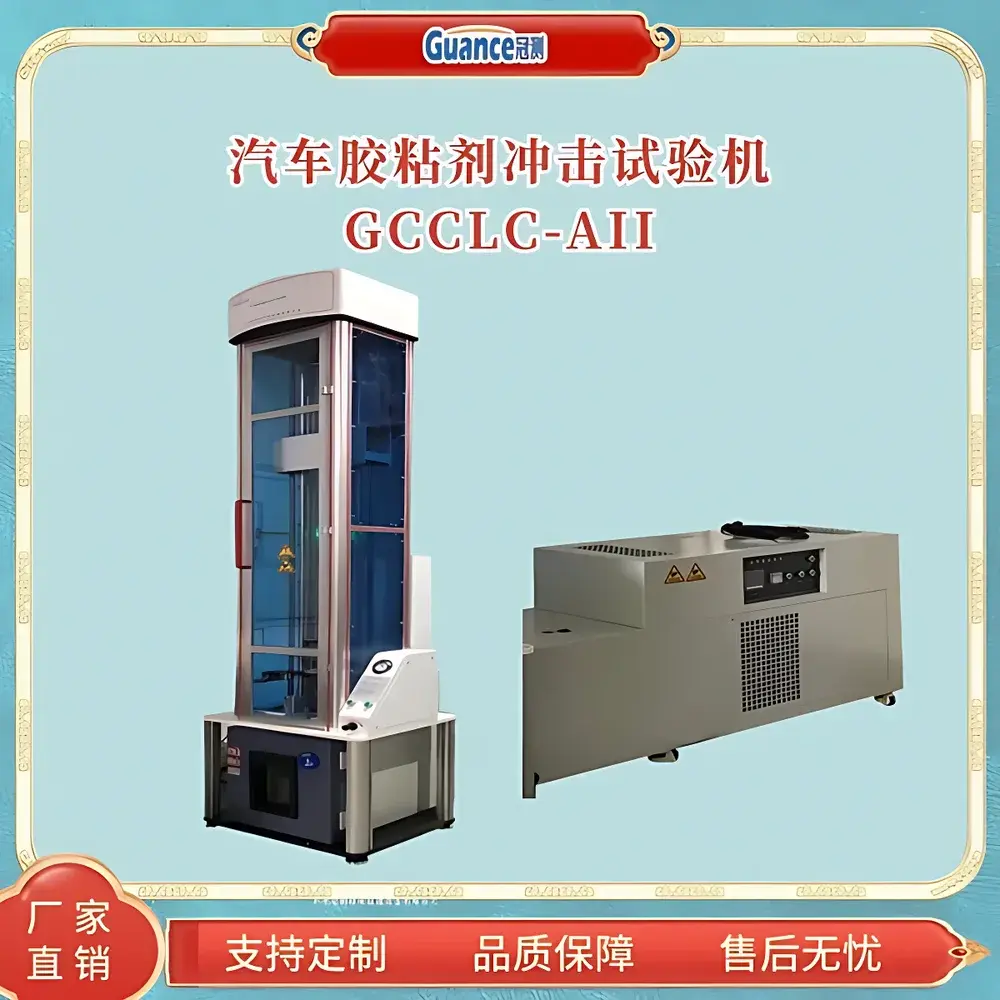
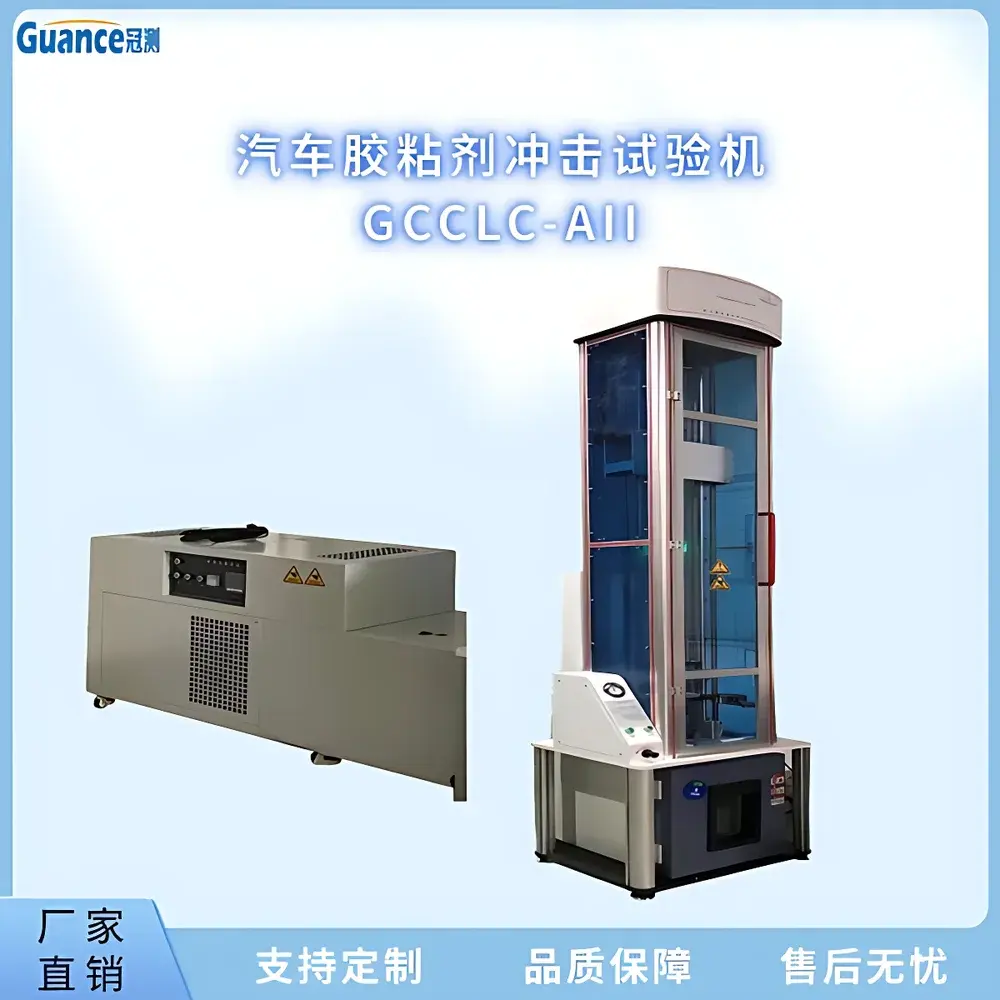
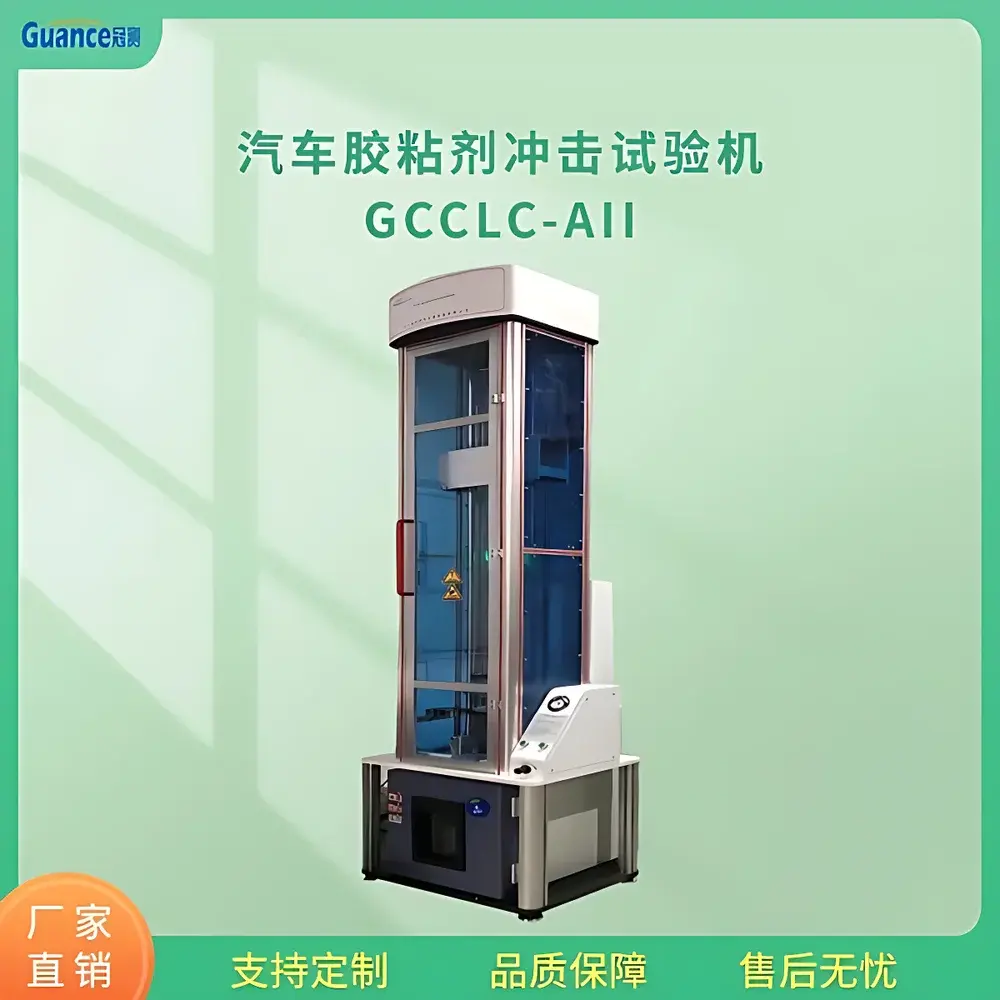
The Guance Instruments GCCLC-AII Automotive Adhesive Instrumented Wedge Impact Tester is a precision-engineered, instrumented drop-weight impact system designed specifically for evaluating the dynamic fracture resistance of structural adhesives under high-strain-rate wedge cleavage conditions. It operates on the principle of controlled pendulum or guided free-fall impact, where a calibrated hammer strikes a wedge-shaped insert positioned at the bondline between two metal substrates. The resulting transient force–displacement–energy response is captured in real time using a high-fidelity dynamic load cell and ultra-high-speed data acquisition (2 MHz sampling, 16-bit resolution, 500 kHz bandwidth). This enables quantitative determination of key fracture mechanics parameters—including peak load (Fm), total absorbed energy (Wt), and critical displacement at failure—under standardized dynamic loading conditions defined in ISO 11343:2019 and GB/T 36877–2018. Unlike conventional Charpy or Izod impact testers, the GCCLC-AII integrates full instrumentation, programmable lift control, and synchronized environmental conditioning (via optional −40 °C to +100 °C thermal chamber), making it suitable for R&D laboratories, automotive OEM validation centers, and adhesive formulation labs requiring traceable, repeatable, and GLP-compliant mechanical performance data.
Key Features
- Instrumented wedge impact methodology compliant with ISO 11343:2019 and GB/T 36877–2018 for adhesive cleavage strength assessment
- Adjustable impact energy range from 50 J to 300 J via interchangeable hammer masses (20–50 kg, ±1% tolerance) and precise height control (0.2–1.6 m, positioning accuracy ±1 mm)
- High-resolution dynamic load measurement using a 16 kN piezoelectric load cell with static linearity error ≤±1% FS (10–50% FS) and ≤±2% FS (50–100% FS)
- Ultra-fast data acquisition system: 2 MHz sampling rate, 16-bit A/D resolution, and 500 kHz frequency response for accurate capture of microsecond-scale force transients
- Integrated thermal chamber option (−40 °C to +100 °C, ±2 °C uniformity) with dual-compressor refrigeration and resistive heating for temperature-dependent adhesive characterization
- Modular hammer assembly with calibrated mass increments (0.5 kg, 1 kg, 2 kg ×2, 5 kg ×6) enabling fine-tuned energy calibration per ASTM E23 and ISO 148-1
- Rigid steel frame construction (1200 kg net weight) with vibration-damped base and safety interlocked enclosure meeting CE and ISO 12100 mechanical safety requirements
Sample Compatibility & Compliance
The GCCLC-AII accommodates standard lap-shear or wedge-cleavage specimens per ISO 11343 geometry—typically aluminum or steel substrates (e.g., 100 × 25 mm, 1.5–3 mm thickness) bonded with structural epoxy, polyurethane, or acrylic adhesives. Specimen clamping fixtures are designed to minimize bending moments and ensure pure mode-I crack initiation at the wedge tip. All test protocols align with international regulatory expectations for automotive adhesive qualification, including OEM-specific standards (e.g., Ford WSS-M99P1111-A, GMW15578). Data integrity complies with FDA 21 CFR Part 11 requirements when paired with audit-trail-enabled software; raw binary datasets (.bin) and processed .csv outputs support third-party validation and laboratory accreditation (ISO/IEC 17025). Calibration documentation includes traceable NIST-equivalent verification reports for load cell static linearity and hammer mass certification.
Software & Data Management
The system ships with Guance ImpactSuite™ v3.2—a Windows-based application supporting real-time waveform visualization, automated parameter extraction (Fm, Wt, δf), statistical batch reporting, and export to ASTM E1823-compliant fracture toughness formats. Software features include user-defined pass/fail thresholds, multi-curve overlay comparison, and automatic generation of compliance certificates per ISO 11343 Annex B. Raw time-series data is stored in binary format with embedded metadata (test ID, operator, timestamp, environmental conditions, calibration IDs), ensuring full traceability. Audit trail logs record all user actions, parameter changes, and report modifications—enabling full GxP adherence. Export options include PDF test reports, Excel-compatible CSV, and MATLAB-readable .mat files for advanced post-processing.
Applications
- Dynamic cleavage strength evaluation of aerospace-grade film adhesives and paste adhesives under crash-relevant strain rates (>100 s−1)
- Comparative screening of thermally aged or humidity-conditioned structural adhesives for automotive body-in-white bonding
- Fracture energy mapping across temperature gradients (−40 °C to +100 °C) to identify brittle-to-ductile transition behavior
- Validation of finite element models (FEM) simulating adhesive joint failure in side-impact or rollover scenarios
- Quality control testing of production batches against internal specification limits for Fm and absorbed energy dispersion
- Supporting ISO 25217-compliant adhesive fracture mechanics studies through derived J-integral approximations
FAQ
Does the GCCLC-AII meet ISO 11343:2019 requirements for instrumented wedge impact testing?
Yes—the system implements all mandatory hardware and procedural elements specified in Clause 6 (Apparatus) and Annex A (Calibration), including wedge geometry tolerances, hammer mass verification, and dynamic load cell validation protocols.
Can the system operate without the optional thermal chamber?
Absolutely—the base configuration supports ambient-temperature testing only; the chamber is a field-installable module with independent power and control interface.
Is third-party calibration support available for the dynamic load cell?
Guance provides factory calibration certificates traceable to national metrology institutes; users may engage accredited external labs for periodic re-calibration per ISO 17025, with full documentation templates included.
What specimen preparation standards does the GCCLC-AII assume?
Specimens must conform to ISO 11343 Figure 1 dimensions and surface finish requirements (Ra ≤ 0.8 µm); substrate material, adhesive application method, and cure schedule must be documented per GLP guidelines.
How is data security and electronic signature compliance handled?
When deployed with validated ImpactSuite™ configurations, the system supports role-based access control, electronic signatures (21 CFR Part 11 Subpart B), and immutable audit trails—all configurable per organizational SOPs.



