English Product Name
| Origin | Guangdong, China |
|---|---|
| Manufacturer Type | Authorized Distributor |
| Origin Category | Domestic (China-made) |
| Model | PY |
| Pricing | Available Upon Request |
Overview
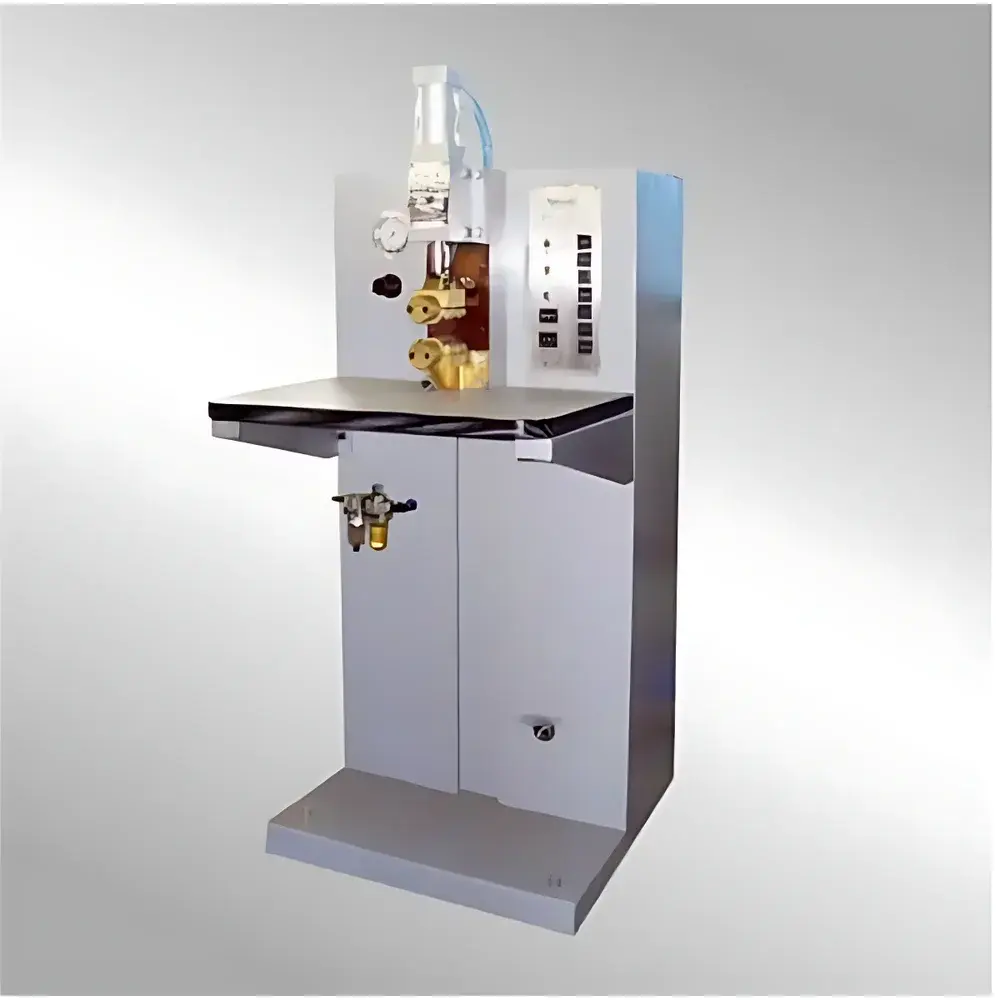
The PY Series Pneumatic AC Pulse Spot Welder is an industrial-grade resistance welding system engineered for high-reproducibility, low-spatter spot joining of conductive metallic components. It operates on the principle of controlled resistive heating—where a precisely timed, high-current AC pulse is delivered through water-cooled copper electrodes to generate localized Joule heating at the interface of two or more overlapped metal sheets. The system utilizes a custom-wound, low-impedance welding transformer constructed with high-permeability grain-oriented silicon steel laminations, enabling efficient voltage step-down from 380 VAC input to ≤10 VAC secondary output while sustaining peak currents up to 30 kA (dependent on model rating). This architecture ensures stable arc-free contact, minimal electrode wear, and consistent weld nugget formation—critical for applications demanding dimensional repeatability and metallurgical integrity, including semiconductor packaging interconnects, sensor housing assembly, and precision electronics enclosures.
Key Features
- Three-stage programmable pulse control: pre-heat → main weld → post-anneal cooling sequence—enabling tailored thermal profiles for high-carbon steels, zinc- or nickel-plated substrates, and dissimilar metal combinations (e.g., Cu–Al, Ni–Fe)
- Pneumatic force actuation with adjustable pressure range (0.1–1.2 MPa), synchronized with current delivery via real-time pressure-current coupling logic
- 24 VDC safety-rated control circuitry compliant with EN 60204-1 and CE Machinery Directive 2006/42/EC requirements
- Transformer core optimized for minimal hysteresis loss and thermal drift; delivers up to 15% higher effective welding power versus industry-standard units at equivalent kVA ratings (4–300 kVA models available)
- Integrated digital timer resolution of 10 ms, supporting weld durations from 50 ms to 5 s with ±1% timing accuracy
Sample Compatibility & Compliance
The PY welder accommodates sheet metal thicknesses from 0.1 mm to 7 mm per layer (stacked configuration), including cold-rolled low-carbon steel (SPCC), austenitic stainless steels (SUS304, SUS316), electrolytic tinplate, nickel alloys (Inconel 600, Monel 400), and clad materials used in semiconductor leadframe and heat sink fabrication. Electrode tip geometry (flat, truncated cone, radius-tipped) is configurable per ISO 5821 standards. All units undergo factory calibration against ASTM E2921-22 (Standard Practice for Calibration of Resistance Welding Equipment) and include traceable verification reports. Optional CE+RoHS+REACH documentation packages are available for export to EU markets.
Software & Data Management
Equipped with RS-485 Modbus RTU and optional Ethernet/IP interfaces, the PY controller supports integration into factory MES and SCADA environments. Weld parameter logs—including actual current waveform (via integrated Hall-effect sensor), electrode displacement (LVDT feedback), and cycle time—are timestamped and stored locally (SD card) with GLP-compliant audit trail functionality. Optional PC-based software (PY-WeldView v3.2) enables statistical process control (SPC) charting, Pareto analysis of weld defects, and automated report generation aligned with ISO 9001:2015 clause 8.5.2 (Identification and traceability).
Applications
- Semiconductor equipment manufacturing: bonding of vacuum chamber flanges, RF shielding enclosures, and wafer handling gripper components
- Power electronics: joining of IGBT module baseplates, heatsink-to-copper busbar interfaces, and battery tab connections (Ni–Cu–Al stacks)
- Medical device subassemblies: hermetic sealing of stainless-steel sensor housings and titanium alloy implant carriers
- Automotive electronics: production of fuse box terminals, relay contact bridges, and EV battery module interconnects
- Consumer appliance fabrication: assembly of induction cooktop coil retainers, dishwasher pump housings, and microwave oven cavity frames
FAQ
What is the maximum recommended stack thickness for stainless steel welding using the PY-150 model?
For SUS304 sheets with 50% overlap area and standard CuCrZr electrodes, the validated upper limit is 7 mm + 7 mm under 1.0 MPa electrode force and three-pulse regime.
Does the system support integration with PLC-based production lines?
Yes—native Modbus RTU protocol support enables direct communication with Siemens S7, Allen-Bradley ControlLogix, and Mitsubishi FX series PLCs without gateway hardware.
Is waveform monitoring available as a standard feature or optional upgrade?
Real-time current waveform capture (sampling rate ≥10 kHz) is included in all PY models above 40 kVA; lower-power variants offer it as a firmware-enabled option.
How often does the welding transformer require maintenance or recalibration?
Under continuous operation (8 hrs/day, 5 days/week), the transformer requires only annual visual inspection and insulation resistance testing per IEC 60076-3; no routine recalibration is needed due to solid-state current sensing architecture.
Related Products