
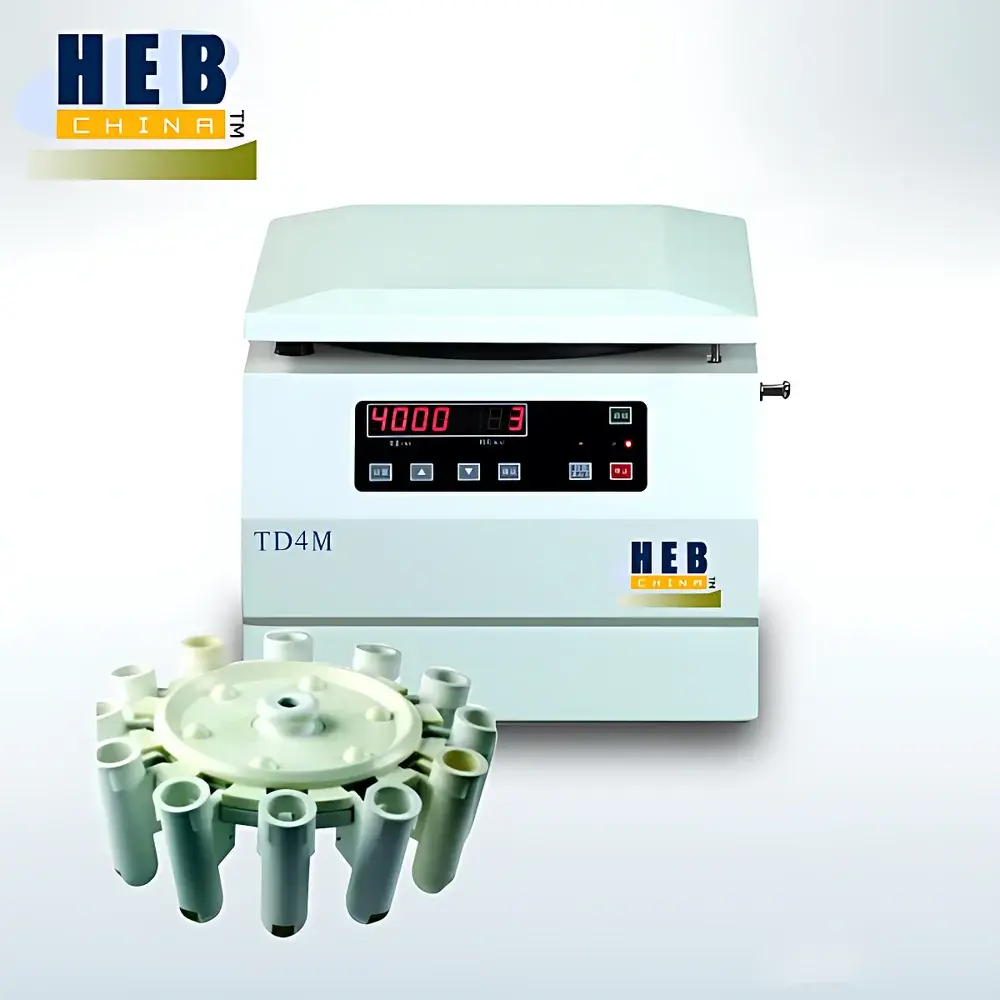
English Product Name
| Brand | Jihepu |
|---|---|
| Origin | Shandong, China |
| Model | TD4M |
| Type | Benchtop Low-Speed Centrifuge |
| Max Speed | 10,000 rpm |
| Max RCF | 2,000 × g |
| Max Capacity | 12 × (0.25–1 mL) |
| Rotor Options | HLA Lymphocyte Washing Rotor, SERO Erythrocyte Washing Rotor |
| Dimensions (W×D×H) | 385 × 320 × 270 mm |
| Net Weight | 15 kg |
| Power Supply | AC 220 ± 22 V, 50/60 Hz, 10 A |
| Rated Power | 100 W |
| Noise Level | ≤65 dB(A) |
| Rotor Cavity Diameter | Φ280 mm |
| Speed Accuracy | ±20 rpm |
Overview
The Jihepu TD4M Immunohematology Benchtop Centrifuge is a purpose-engineered low-speed centrifuge designed specifically for clinical immunohematology workflows—including red blood cell (RBC) washing, lymphocyte isolation, platelet depletion, and serological testing such as blood typing, crossmatching, and antiglobulin (Coombs) assays. It operates on the principle of sedimentation under controlled gravitational force (RCF), enabling precise separation of cellular components based on density and size differences in whole blood or prepared suspensions. Its fixed-angle and horizontal rotor configurations—particularly the dedicated HLA and SERO rotors—are optimized for standardized, reproducible processing of small-volume samples (0.25–1 mL and up to 7 mL) in accordance with CLSI EP05-A3 and ISO 15189 preanalytical requirements. The instrument’s compact footprint, stainless-steel centrifuge chamber, and brushless DC motor architecture ensure operational stability, thermal consistency, and long-term reliability in high-throughput clinical labs and blood bank environments.
Key Features
- Compact benchtop design (385 × 320 × 270 mm) minimizes spatial demand in constrained laboratory settings while maintaining full functional integrity.
- Brushless DC motor delivers maintenance-free operation, silent performance (≤65 dB[A]), and exceptional rotational stability—even during parameter adjustments mid-run.
- Real-time RCF calculation and digital display synchronized with speed input, ensuring accurate translation between rpm and relative centrifugal force per ISO 21501-4.
- Electronic safety interlock system prevents lid opening during operation and automatically halts rotation if imbalance exceeds tolerance thresholds.
- Full-steel structural frame and electropolished stainless-steel centrifuge chamber resist corrosion from saline, EDTA, and anticoagulant solutions commonly used in hematology protocols.
- Intuitive membrane keypad interface supports rapid program recall, time/speed/RCF entry, and immediate parameter modification without interrupting active runs.
Sample Compatibility & Compliance
The TD4M accommodates standard microcentrifuge tubes (0.25–1 mL) and 7 mL conical tubes using its interchangeable HLA and SERO rotors—each validated for specific immunohematology applications per manufacturer-defined protocols. The HLA rotor achieves 1,200 × g for lymphocyte isolation (180 s), 1,000 × g for platelet removal (3 s), and 1,000 × g for lymphocyte washing (60 s). The SERO rotor delivers 2,500 × g for blood typing agglutination (60 s), 1,000 × g for crossmatch validation (15 s), and 1,000 × g for RBC washing and serum/plasma recovery (60 s). All rotors are balanced to ISO 19934-1 specifications and compatible with common anticoagulants (EDTA-K₂, citrate, heparin). The system meets IEC 61010-1:2010 safety standards for laboratory equipment and supports GLP-compliant documentation when paired with external audit-trail-enabled lab information systems.
Software & Data Management
While the TD4M operates via embedded firmware without onboard data logging or PC connectivity, its interface enables repeatable manual protocol execution with consistent parameter recall. For regulated environments requiring traceability, users may integrate the device into broader quality management frameworks using external timers, calibrated tachometers, and paper-based or LIMS-linked run logs. The unit supports compliance with FDA 21 CFR Part 11 principles when operated within documented SOPs that define operator authorization, parameter verification, and result transcription procedures. Firmware versioning and mechanical calibration records (per ISO/IEC 17025) are maintained by authorized service providers.
Applications
- Blood bank serology: ABO/Rh typing, antibody screening, and identification using standardized RBC suspension centrifugation.
- Lymphocyte preparation for HLA typing, mixed lymphocyte culture (MLC), and flow cytometry analysis.
- Platelet-poor plasma (PPP) generation for coagulation factor assays and complement studies.
- SERO-based antigen–antibody reaction enhancement in gel card and tube agglutination methods.
- Pre-analytical sample conditioning for molecular diagnostics involving leukocyte-enriched fractions.
FAQ
What is the maximum RCF achievable with the TD4M using the SERO rotor?
The SERO rotor delivers up to 2,500 × g at 10,000 rpm for 0.25–1 mL tubes, optimized for rapid agglutination assessment in serological testing.
Can the TD4M be used for platelet-rich plasma (PRP) preparation?
No—the TD4M is not configured for PRP isolation; its maximum RCF and rotor geometry are intended for low-force washing and sedimentation, not differential centrifugation of platelets.
Is rotor calibration required before each use?
Rotor balance verification is recommended prior to each run; formal recalibration is performed annually or after impact events per ISO 15189 Annex A.3.2.
Does the TD4M support temperature-controlled operation?
No—it is a non-refrigerated centrifuge; ambient temperature control of the lab environment is advised for heat-sensitive immunoreagents.
How is compliance with blood bank accreditation standards verified?
Users must validate rotor-specific protocols against AABB Standards for Blood Banks and Transfusion Services (Section 5.12.1) using in-house performance checks and documented preventive maintenance records.



