
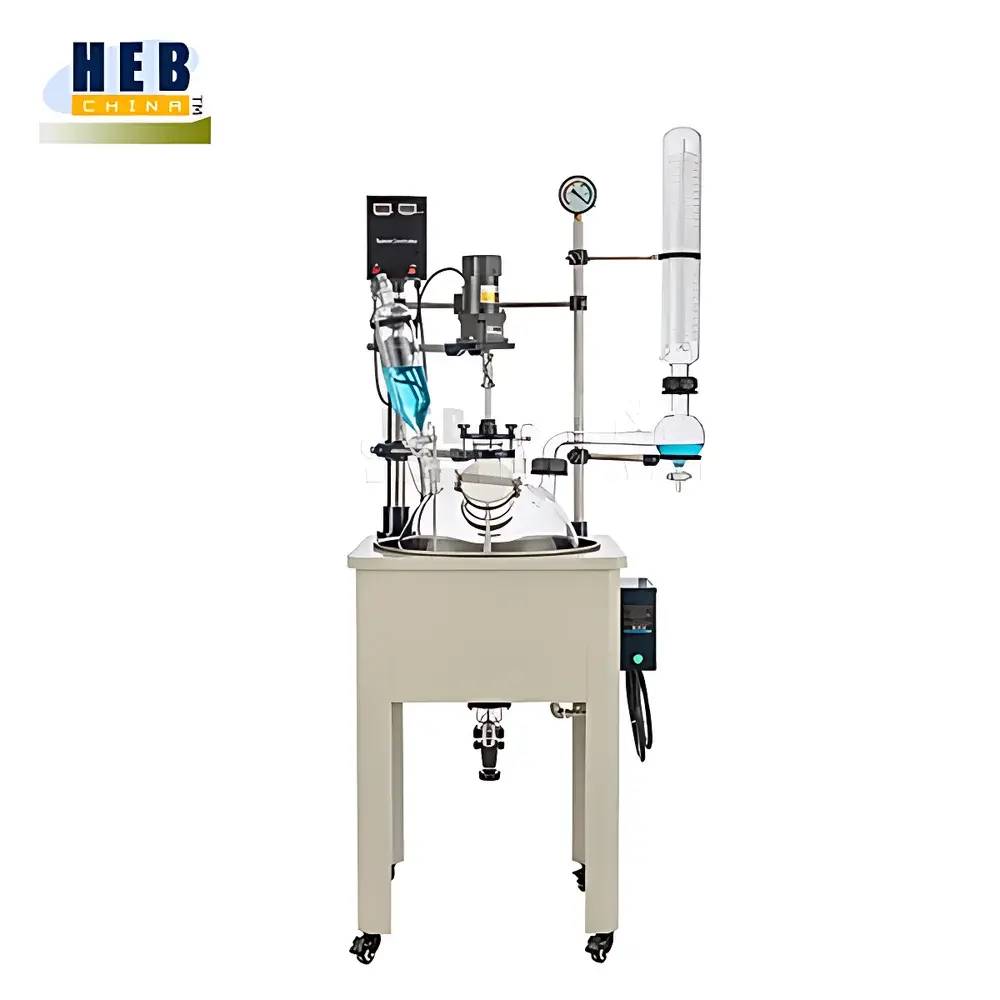
HePu F-10L Single-Layer Glass Reactor
| [Brand | HePu |
|---|---|
| Origin | Shandong, China |
| Model | F-10L |
| Capacity | 10 L |
| Vessel Material | Borosilicate Glass (GG-17) |
| Operating Pressure | Low-pressure / Vacuum Service (≤ −0.098 MPa gauge) |
| Temperature Range | −80 °C to +250 °C |
| Stirring Speed | 0–450 rpm |
| Stirring Power | 90 W, 220 V / 50 Hz |
| Heating Power | 3 kW, 220 V / 50 Hz |
| Sealing | PTFE-faced flange seals (Φ70 mm) |
| Stirrer Type | Paddle-type stainless steel shaft with PTFE coating |
| Base Frame | Stainless steel (304) and aluminum alloy structure with locking casters |
| Dimensions (W×D×H) | 600 × 440 × 1900 mm |
| Net Weight | 63 kg |
| Compliance | Designed for laboratory-scale synthesis, distillation, reflux, and vacuum-enabled reactions under GLP-aligned operational practices] |
Overview
The HePu F-10L Single-Layer Glass Reactor is an engineered laboratory-scale reaction system designed for controlled chemical synthesis, solvent reflux, fractional distillation, and vacuum-assisted processes. Its core architecture integrates a borosilicate glass (GG-17) reaction vessel—certified for thermal shock resistance (ΔT ≥ 120 °C), hydrolytic class HGB 1 per ISO 3585, and chemical inertness toward most organic solvents, dilute acids, and bases—with a rigid support frame fabricated from 304 stainless steel and aerospace-grade aluminum alloy. Unlike jacketed reactors, the F-10L relies on external thermal management: optional electric heating mantles (up to 250 °C) or copper cooling coils (compatible with circulators down to −80 °C) interface directly with the vessel wall. The reactor operates under low-pressure conditions, achieving a stable vacuum level of ≤ −0.098 MPa (equivalent to ~20 mbar abs), verified via calibrated analog vacuum gauge. All wetted seals utilize molded PTFE gaskets mounted on standardized Φ70 mm flanges, ensuring leak-tight performance across repeated thermal cycling and vacuum cycles without degradation.
Key Features
- Borosilicate glass (GG-17) vessel conforming to DIN ISO 3585 specifications: coefficient of linear expansion α = 3.3 × 10⁻⁶ K⁻¹; softening point ≥ 820 °C; acid resistance Class 1 (ISO 1776); alkali resistance Class 2.
- Electronically controlled, brushless DC stirrer motor (90 W, 220 V / 50 Hz) with planetary gear reduction (3:1 ratio), delivering high torque at low speeds (0–450 rpm) and eliminating commutator sparking—critical for solvent-rich or oxygen-sensitive environments.
- PTFE-coated stainless steel paddle agitator (Φ15 mm shaft) with optimized blade geometry to minimize dead zones; combined with a sloped bottom discharge valve (Φ80 mm flange), enabling complete evacuation of solids and viscous slurries.
- Seven standardized ground-glass ports (34/24/29/50 standard taper) accommodate condensers, dropping funnels, thermowells, vacuum lines, and inert gas inlets—fully modular and reconfigurable per reaction protocol.
- Integrated digital temperature monitoring via PT100 sensor (±0.3 °C accuracy) and LCD display; independent control of heating mantle power output (0–100% duty cycle).
- Mobility-enhanced base with four lockable swivel casters (φ100 mm, PU tread), allowing safe relocation within fume hoods or shared lab spaces without disassembly.
Sample Compatibility & Compliance
The F-10L supports batch processing of liquid-phase, slurry-phase, and heterogeneous catalytic reactions involving volumes up to 10 L. Its GG-17 glass construction ensures compatibility with common laboratory solvents (e.g., acetone, THF, ethanol, DMF, toluene), halogenated media (DCM, chloroform), and aqueous acidic/basic solutions below pH 1 or above pH 13 only under short-term, room-temperature exposure. For extended use with aggressive reagents (e.g., hot concentrated NaOH, HF, molten alkali metals), supplemental quartz liners or fluoropolymer-coated accessories are recommended. The system complies with general safety requirements outlined in ISO 15195 (laboratory equipment—safety principles), and its electrical components meet IEC 61010-1:2010 for laboratory electrical equipment. When equipped with optional EX-rated motors (IP65, Ex d IIB T4) and frequency inverters, it satisfies ATEX Directive 2014/34/EU Category 2G for Zone 1 hazardous areas.
Software & Data Management
While the base F-10L operates as a manually supervised instrument, optional digital upgrades enable traceable operation. An RS-485 interface (Modbus RTU protocol) allows integration with centralized lab control systems for remote logging of temperature setpoints, actual bath/vessel temperatures, stirring speed, and vacuum levels. Optional data acquisition modules record time-stamped parameters at user-defined intervals (1 s to 10 min resolution), generating CSV-compatible logs compliant with FDA 21 CFR Part 11 requirements when paired with electronic signature-capable software platforms. Audit trails—including operator ID, parameter changes, and alarm events—are retained for ≥18 months per GLP Annex 11 guidance.
Applications
- Condensation and esterification reactions under reflux with continuous solvent recovery using the vertical dual-path condenser (Φ60 mm × 600 mm).
- Vacuum distillation of heat-sensitive compounds (e.g., terpenes, pharmaceutical intermediates) at reduced boiling points.
- Heterogeneous hydrogenation using suspended catalysts (e.g., Pd/C), where uniform suspension and gas dispersion are maintained via the high-torque agitator.
- Polymerization initiation under inert atmosphere (N₂/Ar purge via 24# port), monitored by real-time viscosity trends inferred from motor load variation.
- Crystallization studies requiring precise supersaturation control via programmed cooling rates (−0.1 to −5 °C/min) enabled by external cryostat coupling.
- Photochemical reactions using optional quartz viewport inserts and UV-transparent lamp housings (not included).
FAQ
What is the maximum allowable operating temperature for the GG-17 glass vessel?
The glass vessel is rated for continuous service up to +250 °C; however, thermal gradients exceeding 120 °C between vessel wall and contents must be avoided to prevent fracture.
Can the F-10L be used for pressure reactions?
No—it is strictly a low-pressure/vacuum-rated system (max working pressure: ambient; max vacuum: −0.098 MPa). For pressurized synthesis, consider jacketed reactors with ASME-coded vessels.
Is the PTFE sealing system compatible with strong oxidizers like nitric acid?
PTFE exhibits excellent resistance to nitric acid up to 98% concentration at room temperature; however, prolonged exposure above 60 °C may accelerate creep deformation—use ceramic-sealed variants for elevated-temperature oxidizer applications.
How is temperature uniformity validated across the 10 L volume?
Uniformity is achieved through radial heat transfer from the mantle and axial mixing by the paddle agitator; users should verify spatial gradients using multiple calibrated PT100 probes during qualification runs per ISO/IEC 17025 clause 5.4.2.
Does the system support automated recipe execution?
Not natively—but third-party PLC-based controllers (e.g., Eurotherm, Watlow) can be interfaced via analog I/O or Modbus to sequence heating ramps, stirring profiles, and vacuum hold steps.
Related Products



