
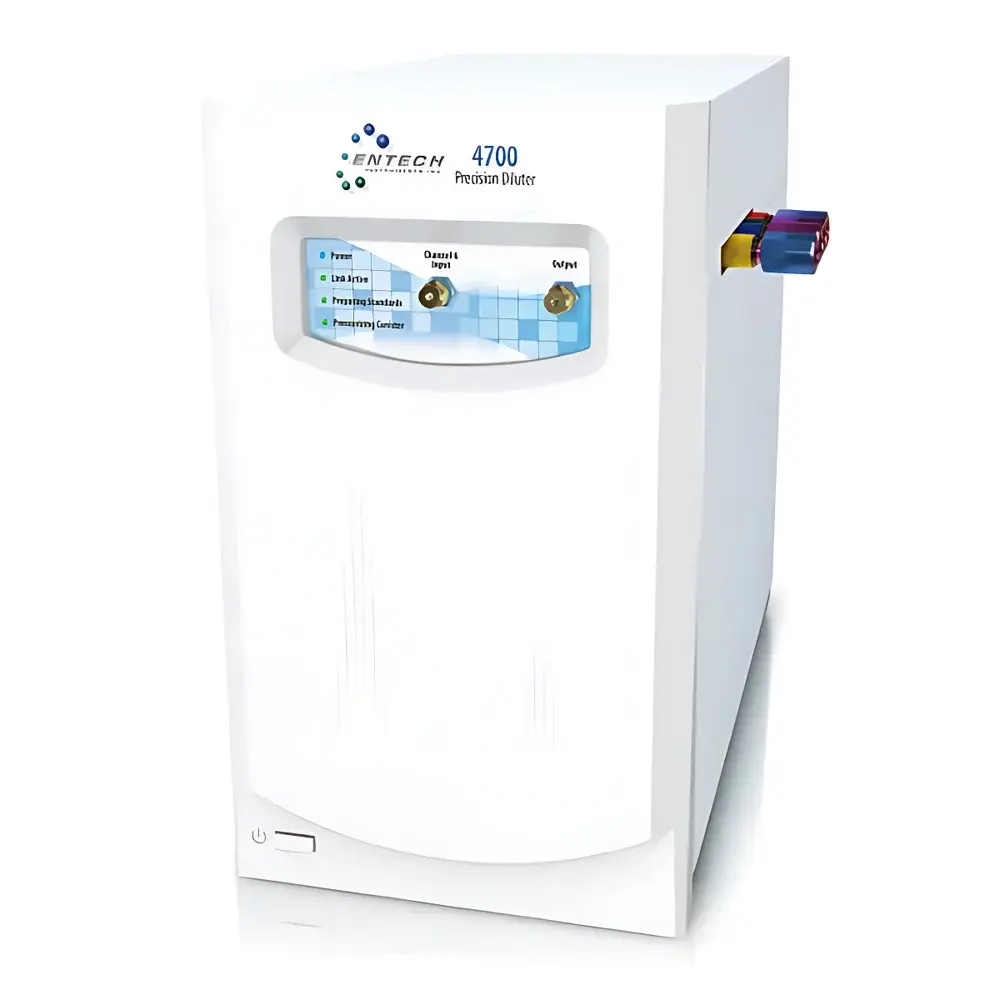
ENTECH 4700 High-Precision Gas Dilution System
| Brand | ENTECH |
|---|---|
| Model | 4700 |
| Dilution Range | ppb to sub-ppt |
| Maximum Total Dilution Factor | 10,000× |
| Pressure Sensor Accuracy | ±0.05% FS |
| Standard Configuration | 6-Channel Dilution |
| Calibration Method | Gravimetric Weighing |
| Compliance | EPA TO-15, ASTM D6420, ISO 16017-1 |
| System Pathway | Silonite®-treated ultra-inert flow path |
| Flow Control Principle | Differential Pressure-Based (MFC-Free) |
Overview
The ENTECH 4700 High-Precision Gas Dilution System is an engineered solution for trace-level calibration gas preparation in environmental air monitoring laboratories. Unlike conventional dilution systems relying on mass flow controllers (MFCs), the 4700 employs a differential pressure measurement principle—leveraging high-stability, traceable pressure transducers to quantify gas volumes with minimal drift and zero MFC-related nonlinearity, hysteresis, or gas-specific calibration dependencies. This architecture ensures metrological integrity across diverse VOC matrices (e.g., alkanes, aromatics, oxygenates, halocarbons) and enables reproducible generation of certified reference standards compliant with U.S. EPA Method TO-15 and ASTM D6420. Designed specifically for canister-based sampling workflows, the system integrates seamlessly with Silonite®-treated stainless-steel manifolds and valves—minimizing surface adsorption, memory effects, and catalytic degradation of reactive compounds such as formaldehyde, acetaldehyde, and unsaturated hydrocarbons.
Key Features
- Differential pressure-based dilution engine eliminates MFC-induced uncertainties including gas-composition dependence, temperature sensitivity, and long-term zero drift.
- Silonite®-coated internal flow path (per ENTECH’s proprietary passivation process) provides ultra-low reactivity—validated per EPA TO-15 Annex B for <1% breakthrough of C₂–C₁₀ VOCs after 72-hour static hold.
- 6 independent dilution channels support parallel preparation of multiple calibration levels (e.g., zero air, span gases, multi-point calibrants) without cross-contamination.
- Integrated high-accuracy pressure sensors (±0.05% full scale) traceable to NIST standards enable gravimetric validation in accordance with ISO/IEC 17025 requirements.
- Programmable dilution sequencing with real-time pressure logging allows audit-ready documentation of each dilution step—including inlet pressure, manifold equilibration time, and final partial pressure calculation.
- Modular design accommodates integration with automated canister fill stations, GC/GC-MS autosamplers, and LIMS via RS-232 or Ethernet (MODBUS TCP).
Sample Compatibility & Compliance
The 4700 is validated for use with electropolished stainless-steel SUMMA® canisters and SilcoCan® canisters treated with Silonite® coating. It supports dilution of compressed standard gases (in N₂, air, or He matrices) across concentration ranges from 1 ppb to 100 ppm, achieving sub-ppt effective detection limits when coupled with cryogenic preconcentration (e.g., ENTECH 7100 series). All operational parameters comply with regulatory frameworks governing calibration gas certification: U.S. EPA Method TO-15 Section 8.3 (calibration verification), ASTM D6420-22 (dilution accuracy criteria), and ISO 16017-1:2022 (ambient air VOC analysis). The system meets GLP data integrity requirements through hardware-enforced audit trails, electronic signatures, and 21 CFR Part 11–compliant software options (available upon configuration).
Software & Data Management
The ENTECH 4700 operates with optional DiluSoft™ v3.2 control software, providing ISO/IEC 17025-aligned workflow management. Software features include: customizable dilution protocols with parameter locking; automatic calculation of uncertainty budgets per GUM (JCGM 100:2008); export of CSV/Excel reports containing timestamped pressure readings, calculated mole fractions, and operator metadata; and secure user role assignment (admin, analyst, reviewer). Raw sensor data is stored locally on industrial-grade SD card with SHA-256 hash verification. For enterprise deployment, API endpoints support bidirectional communication with laboratory information management systems (LIMS) using HL7 or RESTful JSON protocols.
Applications
- Preparation of EPA TO-15 calibration standards for ambient air monitoring networks (e.g., CASTNet, SEARCH, IMPROVE).
- Generation of multi-level calibration curves for GC-MS/FID/PID analysis of indoor air, workplace exposure, and fugitive emission sources.
- Trace-level spiking studies requiring precise addition of analytes to blank canisters for method validation (MDL/IDL determination).
- Support of regulatory compliance testing under EU Directive 2008/50/EC (ambient air quality) and China’s HJ 759–2015 (ambient VOC monitoring).
- Research applications involving stable isotope-labeled VOC tracers, where isotopic integrity must be preserved during dilution.
FAQ
Does the 4700 require periodic recalibration of its pressure sensors?
Yes—annual recalibration against NIST-traceable deadweight testers is recommended per ISO/IEC 17025 Clause 6.5.2; ENTECH provides certified calibration certificates with uncertainty statements.
Can the 4700 dilute humidified gas streams?
No—condensation risk compromises pressure transducer stability and introduces adsorption artifacts; sample gas must be dried to <−40 °C dew point prior to introduction.
Is Silonite® treatment compatible with hydrogen sulfide or chlorine-containing compounds?
Silonite® demonstrates >99.5% recovery for H₂S and Cl₂ at ppb levels over 48 hours; however, routine exposure to >1 ppm concentrations is not advised without post-run purging protocols.
What validation documentation accompanies the system?
Each unit ships with Factory Acceptance Test (FAT) report, pressure sensor calibration certificates, Silonite® coating verification data (XPS analysis), and TO-15-compliant performance verification using certified PAMS standards.
How is system inertness verified during commissioning?
Commissioning includes a 72-hour static hold test per EPA TO-15 Annex B, followed by GC-MS analysis of blank canisters to confirm <1% analyte loss for C₂–C₁₀ compounds.



