
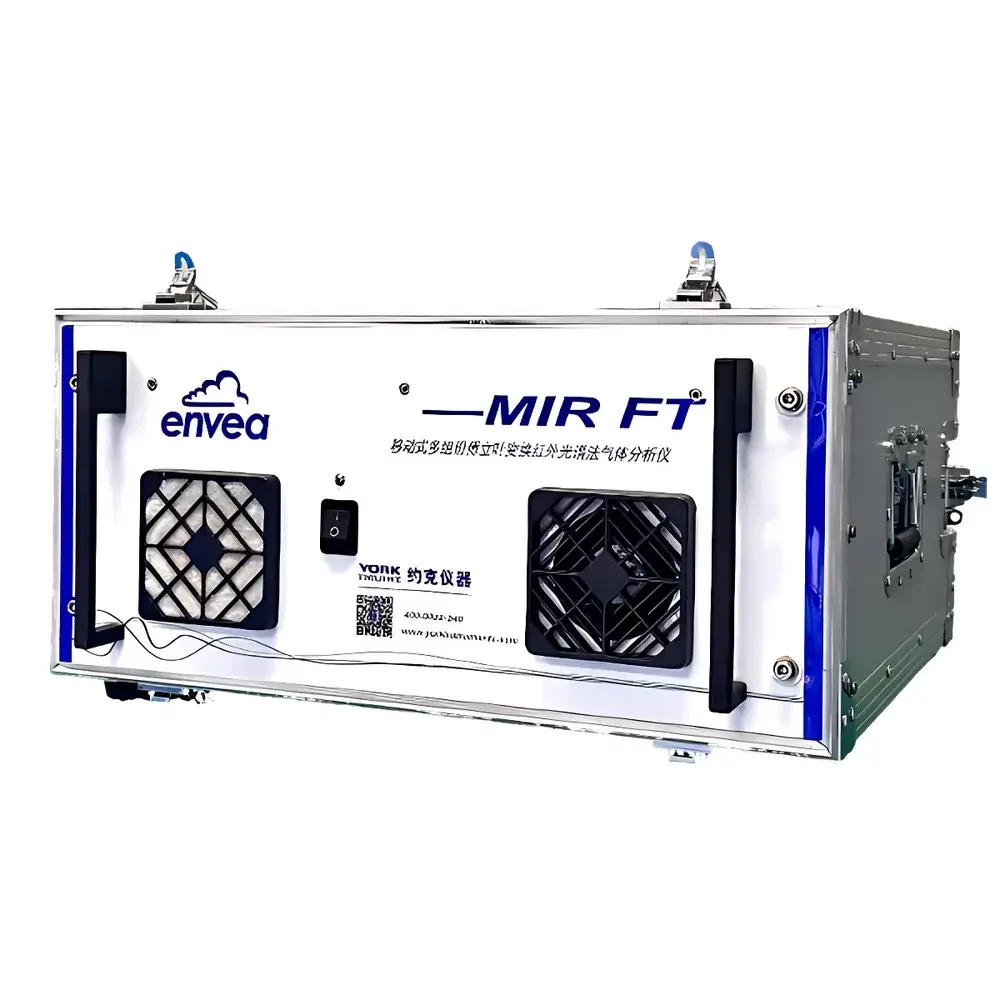
Envea MIR-FT/P Portable Fourier Transform Infrared (FTIR) Gas Analyzer
| Brand | Envea |
|---|---|
| Origin | France |
| Model | MIR-FT/P |
| Measurement Principle | Fourier Transform Infrared Spectroscopy (FTIR) |
| Detectable Gases | HCl, NO, NO₂ (NOₓ), CO, CO₂, CH₄ (TOC), SO₂, HC, NH₃, HF, H₂O |
| Response Time | <60 s (gas-dependent) |
| Repeatability | ±2% FS |
| Interferometer Resolution | 8 cm⁻¹ |
| Multi-pass Cell Path Length | 5 m |
| Operating Temperature | +10 °C to +35 °C |
| Dimensions | 616 × 483 × 220 mm (L×W×H) |
| Weight | ~20 kg |
| Power Supply | 220 V ±15%, 50–60 Hz, 200 VA |
Overview
The Envea MIR-FT/P is a field-deployable, high-performance Fourier Transform Infrared (FTIR) gas analyzer engineered for real-time, multi-component quantification of regulated and emerging pollutants in industrial exhaust streams and ambient air. It operates on the fundamental principle of molecular absorption spectroscopy in the mid-infrared (MIR) region (typically 4000–600 cm⁻¹), where rotational–vibrational transitions of gaseous species produce unique, fingerprint-like absorption spectra. Light from a broadband thermal source passes through a Michelson interferometer—comprising a beamsplitter and two orthogonal mirrors (one fixed, one moving at constant velocity)—generating an interferogram that encodes spectral intensity as a function of optical path difference. A fast Fourier transform (FFT) algorithm converts this time-domain interferogram into a frequency-domain absorbance spectrum, enabling simultaneous identification and concentration calculation of multiple analytes via multivariate calibration models (e.g., classical least-squares or partial least-squares regression). The system is purpose-built for compliance-grade monitoring under dynamic, high-moisture, and chemically aggressive conditions typical of waste incineration, cement kilns, biomass combustion, and SCR/SNCR de-NOₓ processes.
Key Features
- Simultaneous quantification of up to 14 target gases—including NO, NO₂, NOₓ, CO, CO₂, SO₂, CH₄, N₂O, HCl, HF, NH₃, H₂O, O₂ (optional), and total hydrocarbons (HC)—without cross-interference compensation hardware
- Heated multi-reflection measurement cell (5 m effective path length) maintained at 180 °C to prevent condensation and adsorption losses, especially critical for polar and reactive species (e.g., NH₃, HCl)
- Integrated heated sampling train: stainless steel (SS316T) sampling line with PTFE or Hastelloy coating, ceramic particulate filter (5 µm or 20 µm), and PA braided or corrugated protective sheath; fully flexible, field-serviceable, and temperature-controlled to 200 °C
- Automatic spectral interference correction using reference library matching and baseline normalization algorithms, minimizing drift-induced quantification errors
- Robust optical architecture with sealed, alignment-free interferometer and thermally stabilized detector (DTGS or MCT optional), delivering long-term zero and span stability (±1% FS over 30 days)
- Compliance-ready firmware supporting QAL1 (EN 14181), QAL3 (EN 15267-3), and MCERTS certification protocols, including audit-trail logging, user access control, and electronic signature capability per FDA 21 CFR Part 11 requirements
Sample Compatibility & Compliance
The MIR-FT/P is validated for direct analysis of hot, wet, and corrosive flue gases without external dilution or chemical scrubbing. Its heated sampling interface ensures representative sampling of condensable and reactive species across moisture contents up to 25% v/v and particulate loadings ≤100 mg/m³. The system meets the instrumental performance requirements of EU Directives 2000/76/EC (Waste Incineration Directive) and 2001/80/EC (Large Combustion Plants Directive), and conforms to EN 15267-3 (QAL1-certified design), EN 14181 (QA/QC procedures), and U.S. EPA Performance Specification 18 (PS-18) for FTIR-based CEMS. Certified to CPA (UK), CCEP (China), and MCERTS (UK) standards, it supports GLP/GMP-aligned data integrity frameworks and is suitable for regulatory reporting in jurisdictions requiring ISO/IEC 17025-compliant measurement systems.
Software & Data Management
Operation is managed via Envea’s Windows-based PC software suite, which provides real-time spectral visualization, automated calibration validation, trend logging, and configurable alarm thresholds. All raw interferograms, processed spectra, and quantitative results are timestamped and stored in encrypted binary format compliant with IEC 62443-3-3 cybersecurity guidelines. The software supports export to CSV, XML, and MODBUS TCP for integration with SCADA, DCS, or LIMS platforms. Audit trails record all user actions—including method changes, calibration events, and data edits—with immutable timestamps and operator ID attribution. Remote diagnostics and firmware updates are supported via secure TLS-encrypted Ethernet or optional 4G LTE module.
Applications
- Continuous emission monitoring (CEM) at municipal solid waste, hazardous waste, and medical waste incinerators
- Combustion optimization and regulatory compliance verification in coal-, gas-, and biomass-fired power plants
- Process gas analysis in cement rotary kilns, lime calciners, and glass melting furnaces
- De-NOₓ system performance evaluation (SCR and SNCR) via real-time NH₃ slip and NOₓ reduction efficiency calculation
- Stack testing and periodic source testing per EPA Methods 320 and ASTM D6348
- Research applications in atmospheric chemistry, landfill gas characterization, and biogas upgrading process control
FAQ
What gases can the MIR-FT/P quantify simultaneously?
The analyzer is calibrated for simultaneous measurement of NO, NO₂, NOₓ, CO, CO₂, SO₂, CH₄, N₂O, HCl, HF, NH₃, H₂O, O₂ (optional), and total hydrocarbons (HC), with additional components available via custom calibration.
Is the system suitable for high-moisture flue gas?
Yes—the entire sampling path (line, filter, and cell) is actively heated to 180–200 °C, eliminating condensation and ensuring accurate quantification of water-soluble and reactive gases.
Does the MIR-FT/P meet international regulatory standards?
It fulfills EN 14181 (QAL1/QAL3), EN 15267-3, MCERTS, CPA, CCEP, and U.S. EPA PS-18 requirements, and supports 21 CFR Part 11-compliant data governance.
How often does the system require calibration?
Zero and span checks are recommended daily or per EN 14181 S1 schedule; full multi-point calibration is performed quarterly or after maintenance, with automated drift correction between intervals.
Can the instrument be integrated into existing plant control systems?
Yes—via analog outputs (0–10 V / 4–20 mA), digital I/O, MODBUS TCP, or OPC UA, enabling seamless connection to DCS, PLC, or cloud-based environmental data platforms.







