
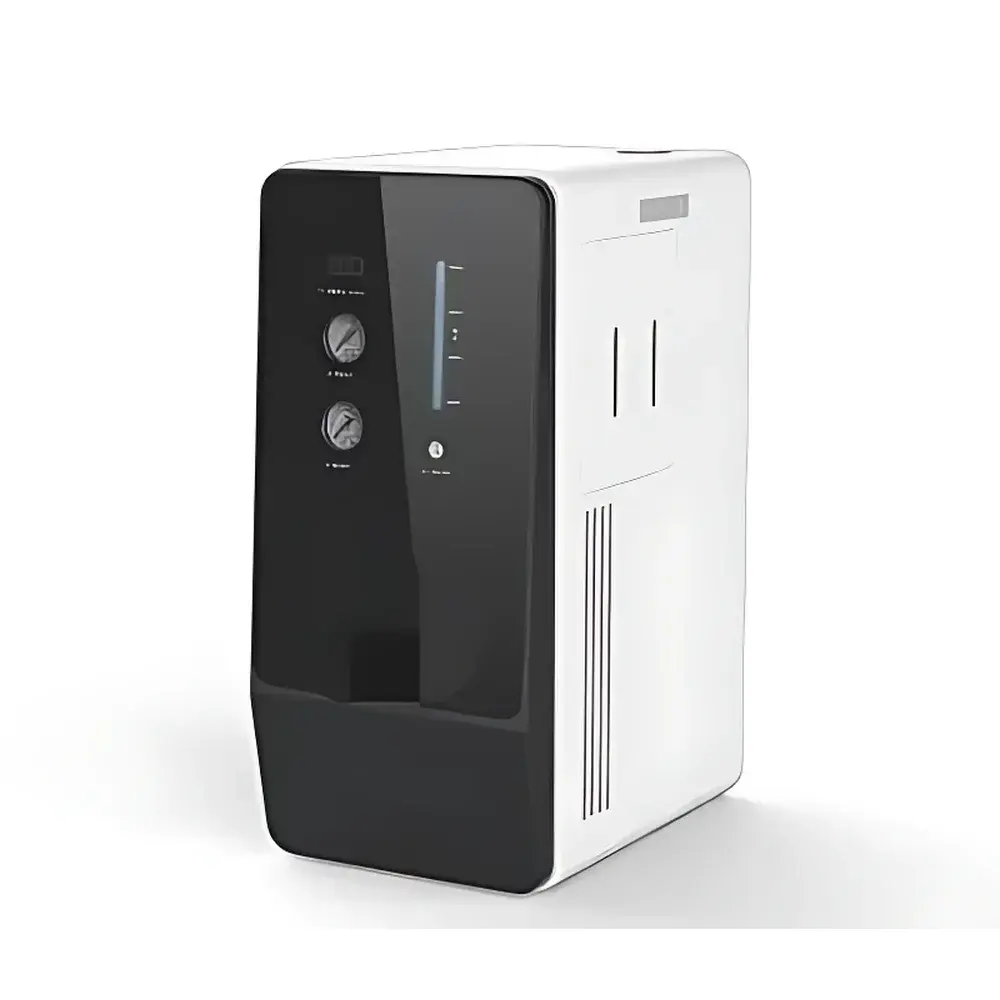
Hailong HLHA-300G / HLHA-500G Hydrogen & Air Integrated Gas Generator
| Brand | Hailong |
|---|---|
| Origin | Shanghai, China |
| Model | HLHA-300G, HLHA-500G |
| H₂ Purity | >99.999% |
| Air Quality | Oil-free, Dry, Triple-Filtered |
| H₂ Flow Range | 0–300 mL/min (HLHA-300G) / 0–500 mL/min (HLHA-500G) |
| Air Flow Range | 0–2000 mL/min (HLHA-300G) / 0–5000 mL/min (HLHA-500G) |
| Output Pressure | 0–0.5 MPa (factory-set at 0.4 MPa for both gases) |
| Power Supply | 220 V ±10%, 50 Hz ±5% |
| Max. Power | 750 W (HLHA-300G) / 800 W (HLHA-500G) |
| Dimensions (W×D×H) | 300 × 400 × 660 mm |
| Weight | 36 kg |
| Operating Temp. | 10–40 °C |
| Relative Humidity | ≤85% RH |
| Safety | Overpressure protection, alkaline backflow prevention, auto-drain stainless steel air tank |
Overview
The Hailong HLHA-300G and HLHA-500G Hydrogen & Air Integrated Gas Generators are engineered for continuous, on-demand supply of ultra-high-purity hydrogen and instrument-grade compressed air—specifically designed to serve gas chromatography (GC), GC–MS, flame ionization detectors (FID), thermal conductivity detectors (TCD), and other analytical instruments requiring stable, contamination-free carrier and support gases. Unlike traditional high-pressure gas cylinders, these generators utilize PEM (Proton Exchange Membrane) electrolysis for hydrogen production and a brushless, oil-free diaphragm compressor for air generation—eliminating hydrocarbon contamination, oil carryover, and logistical constraints associated with cylinder handling and certification. The integrated architecture consolidates two critical gas sources into a single footprint, minimizing lab space requirements while maintaining independent pressure and flow control for each gas stream. All internal wetted parts contacting hydrogen are constructed from corrosion-resistant stainless steel or fluoropolymer-lined components, ensuring long-term stability and compatibility with trace-level analytical workflows.
Key Features
- Oil-free dual-gas architecture: Independent PEM-based hydrogen generation and brushless air compression eliminate lubricant-derived contaminants—critical for low-detection-limit applications.
- Triple-stage gas purification: Hydrogen passes through three sequential desiccant and particle filters; air undergoes two-stage pressure stabilization and triple filtration (coalescing, activated carbon, and sub-micron final filter) to achieve <1 ppb hydrocarbon and <0.01 µm particulate removal.
- Stainless steel auto-drain air storage tank: Integrated condensate management prevents moisture accumulation and ensures consistent dew point performance without manual intervention.
- Robust safety system: Real-time overpressure shutdown, electrolyte level monitoring, automatic alkaline backflow prevention in the electrolyzer cell, and thermal cut-off protect against operational anomalies.
- Compact benchtop design (300 × 400 × 660 mm): Optimized for shared instrumentation labs and modular GC setups where floor space and cable/gas line routing efficiency are prioritized.
- Intuitive front-panel interface: Digital display of real-time H₂ and air flow rates, output pressures, system status, and maintenance alerts—including filter life estimation and electrolyte top-up reminders.
Sample Compatibility & Compliance
The HLHA series is validated for use with all major GC and detector platforms requiring hydrogen as fuel gas (e.g., FID, NPD, PID) and clean, dry air as oxidant or makeup gas. Its certified output purity (>99.999% H₂, <0.1 ppm O₂ + N₂ impurities; air meeting ISO 8573-1 Class 1:2:1 for particles, water, and oil) supports compliance with ASTM D6299 (precision and bias in GC analysis), USP (chromatographic system suitability), and ISO/IEC 17025 method validation requirements. While not inherently 21 CFR Part 11 compliant, the generator’s deterministic operation, non-volatile memory logging, and hardware-based safety interlocks provide auditable operational integrity suitable for GLP and GMP environments when paired with laboratory information management systems (LIMS) that enforce electronic record controls.
Software & Data Management
The HLHA series operates as a standalone hardware platform without proprietary software dependencies. All operational parameters—including runtime hours, total gas volume delivered, and filter service intervals—are stored in non-volatile EEPROM and accessible via the front-panel display. Optional RS-232 or analog 0–10 V output interfaces enable integration with building management systems (BMS) or centralized lab monitoring platforms for remote status verification and predictive maintenance scheduling. No cloud connectivity or firmware updates are required; calibration and verification are performed using traceable flow meters and gas analyzers per ISO 6142 and ISO 8573-7 protocols.
Applications
- Routine GC–FID analysis of volatile organic compounds (VOCs) in environmental water and soil extracts.
- Residual solvent testing in pharmaceutical APIs per ICH Q2(R2) guidelines.
- Fuel gas supply for portable GC systems deployed in field laboratories or mobile analytical units.
- Long-duration unattended operation in quality control labs performing daily batch release testing.
- Replacement of high-pressure hydrogen cylinders in regulated facilities seeking reduced audit burden and improved personnel safety posture.
FAQ
What is the expected service life of the PEM electrolyzer stack?
Under normal operating conditions (≤8 h/day, ambient temperature ≤35 °C), the electrolyzer is rated for ≥5,000 hours of cumulative operation before scheduled replacement.
Can the HLHA generator be used with nitrogen-purged GC ovens?
Yes—the hydrogen and air outputs are fully isolated from the internal nitrogen purge circuit; no cross-contamination risk exists when used alongside external nitrogen generators or cylinder supplies.
Is deionized water required for operation?
Yes. The system requires Type II or higher purity deionized water (resistivity ≥1 MΩ·cm, silica <50 ppb) to prevent scaling and maintain electrolyte conductivity and membrane longevity.
How often must the air and hydrogen filters be replaced?
Under typical lab conditions (20 °C, 50% RH), the air pre-filter and coalescing filter should be replaced every 6 months; the final sub-micron and hydrogen desiccant cartridges every 12 months—or sooner if flow rate degradation exceeds 10% at setpoint.
Does the unit support variable pressure setpoints for different detector configurations?
Yes. Both hydrogen and air output pressures are independently adjustable from 0 to 0.5 MPa via calibrated front-panel potentiometers, allowing optimization for FID (typically 0.35–0.45 MPa) versus TCD (0.1–0.3 MPa) requirements.



