
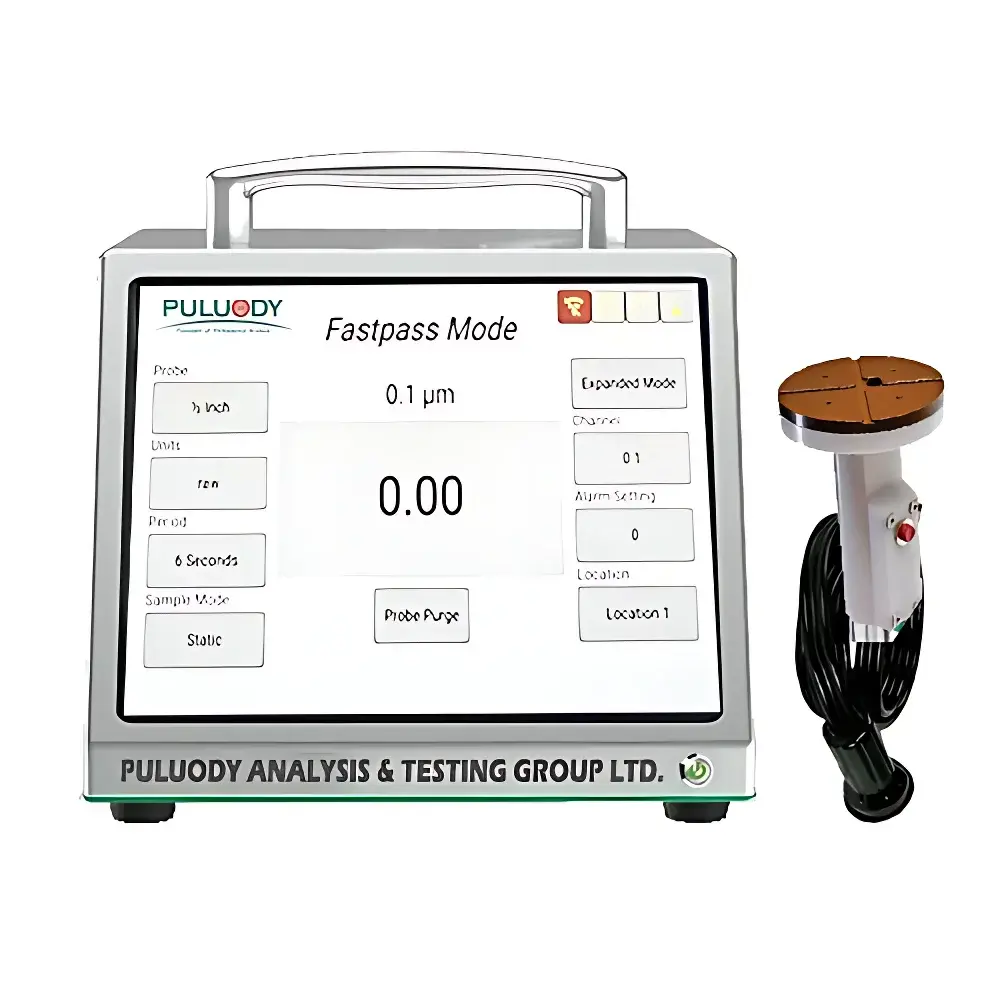
PULUODY Surface Particle Analyzer P-III
| Brand | PULUODY |
|---|---|
| Model | P-III (or P3) |
| Instrument Type | Optical Surface Particle Counter |
| Detection Principle | Light Scattering (Laser-Based) |
| Particle Size Channels | Configurable across six channel sets (A–F), ranging from 0.1 µm to 25.0 µm |
| Size Accuracy | ≤ ±30% |
| Concentration Accuracy | ≤ ±30% |
| Repeatability | ≤ ±10% FS |
| Coincidence Error | ≤ 5% |
| Flow Rate Options | 2.83 L/min or 28.3 L/min |
| Sampling Duration | Programmable (3–60 s) |
| Operating Temperature | –40 °C to +120 °C |
| Environmental Range | 5–45 °C, ≤90% RH (non-condensing) |
| Power Supply | AC 100–240 V, 50/60 Hz |
| Compliance | ISO 14644-1, ISO 14644-9, ISO 21501-4, JIS B 9921 |
| Data Integrity Features | Role-based access control, audit trail, electronic records (21 CFR Part 11 ready) |
| Interface Options | RS232, RS485, LAN, USB |
| Storage | Configurable real-time/timed logging with unlimited capacity |
| Alarm Outputs | Customizable particle count/mass thresholds |
| Probe Options | Straight probe (UK4400302), 90° angled probe (UK4400304), multifunctional surface probe (UK44003012) |
Overview
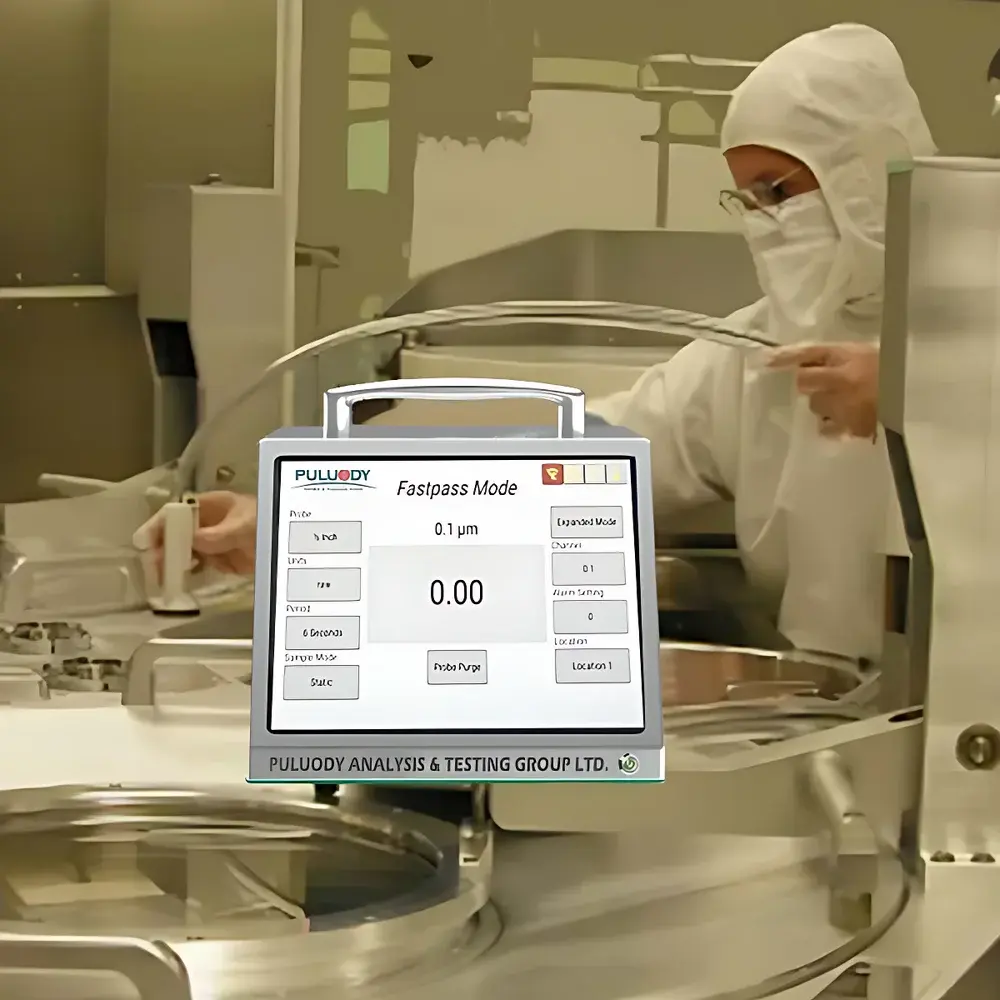
The PULUODY Surface Particle Analyzer P-III is an ISO-compliant optical surface particle counter engineered for quantitative contamination assessment on solid planar and curved surfaces in high-cleanliness environments. Unlike airborne particle counters, the P-III employs a calibrated laminar airflow sampling head coupled with high-sensitivity laser scattering detection to extract and characterize particles directly from surfaces—without contact, solvent use, or tape lift. Its measurement principle follows the Mie scattering theory under controlled flow conditions, enabling traceable size-resolved counting (0.1 µm to 25.0 µm) and mass-equivalent estimation based on user-defined density assumptions. Designed specifically for semiconductor front-end process validation, flat panel display (FPD) module assembly, medical device packaging line release, and critical cleanroom equipment qualification, the P-III delivers metrologically sound data aligned with ISO 14644-9’s surface cleanliness classification framework.
Key Features
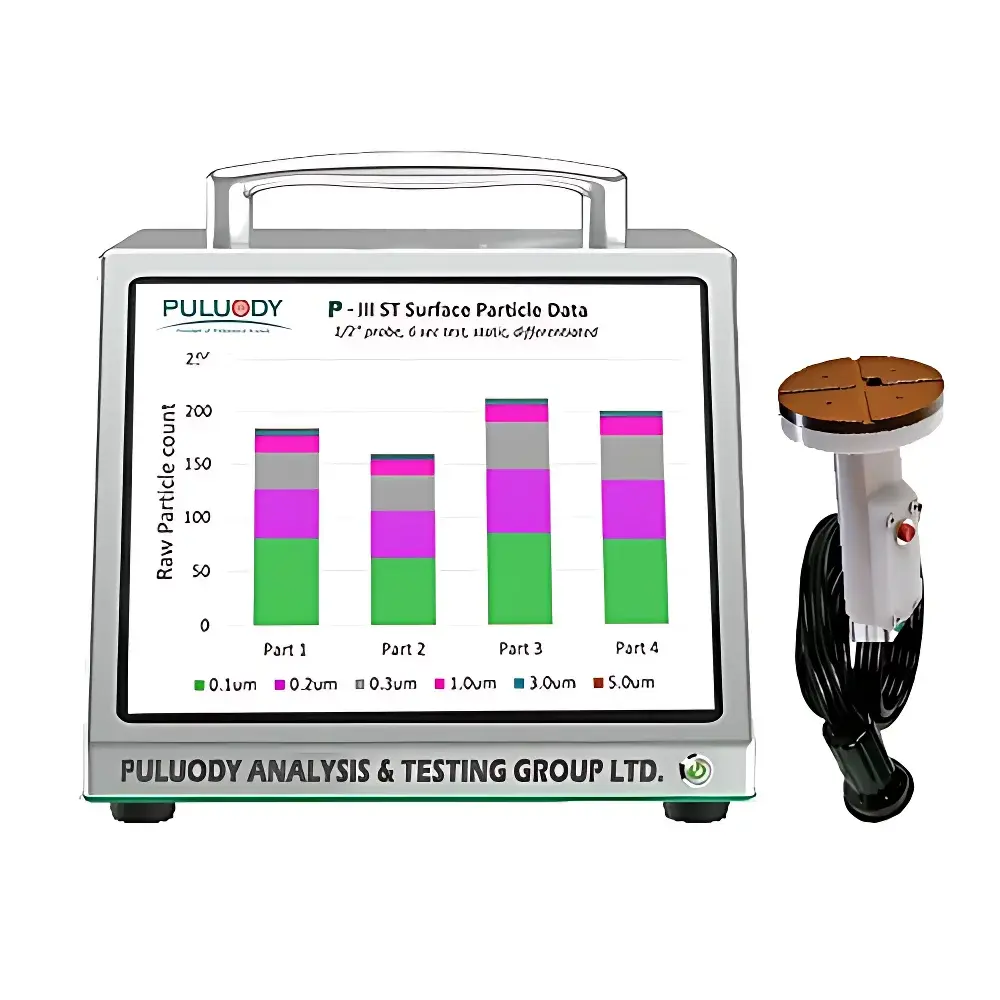
- 7-inch high-resolution capacitive touch display with intuitive GUI for real-time scatter plot visualization, histogram overlay, and on-device report generation.
- Dual hot-swappable battery system ensures uninterrupted operation during extended shift-based monitoring—no system reboot or calibration drift upon battery exchange.
- Configurable multi-channel sizing matrix (six preset configurations A–F) supports application-specific binning, including sub-micron resolution down to 0.1 µm (Channel F) and coarse particulate screening up to 25.0 µm (Channel E).
- Quantified surface cleanliness metrics—including particles per cm², cumulative/differential counts, and mass-weighted indices—enable direct correlation with process yield loss models and PM cycle optimization.
- Integrated pump with selectable flow rates (2.83 L/min for ISO 14644-1 alignment; 28.3 L/min for accelerated surface scanning) maintains laminar flow profile across probe geometries to minimize turbulence-induced particle re-entrainment.
- Full 21 CFR Part 11 readiness: electronic signatures, immutable audit trail, role-based user permissions (admin/operator/viewer), and encrypted local database storage.
Sample Compatibility & Compliance
The P-III accommodates non-porous, semi-porous, and textured surfaces—including silicon wafers (bare and patterned), quartz reticles, glass substrates (LCD/OLED), stainless-steel tooling surfaces, polymer medical trays, and anodized aluminum fixtures. Its modular probe architecture (straight, 90° bent, and multifunctional surface-contact probes) enables access to recessed cavities, wafer chucks, vacuum chamber walls, and conveyor-mounted optics. Regulatory alignment includes ISO 14644-1 (airborne reference), ISO 14644-9 (surface particle classification), ISO 21501-4 (calibration and verification of light-scattering particle counters), and JIS B 9921 (Japanese standard for cleanroom instrumentation). All factory calibrations are traceable to NIST-traceable PSL standards, and system verification protocols support GLP/GMP audit requirements.
Software & Data Management
The embedded firmware supports configurable data logging modes—real-time streaming, timed interval capture (3–60 s), or event-triggered acquisition. Raw scatter pulse data, size-binned histograms, and environmental metadata (temperature, humidity, flow rate, probe ID) are stored locally with timestamp precision to ±10 ms. USB export generates CSV-compatible reports compliant with internal QA templates or third-party LIMS ingestion. Optional LAN connectivity enables remote configuration, centralized fleet monitoring via SNMP, and integration into MES platforms using Modbus TCP or custom RESTful API wrappers. Audit logs record every parameter change, user login/logout, calibration event, and alarm activation—with hash-secured immutability and retention configurable up to 12 months.
Applications
- Semiconductor manufacturing: Wafer surface cleanliness verification pre-lithography, post-etch, and after chamber maintenance; quantification of residual photoresist flakes, metal splatter, or polishing slurry residues.
- Advanced packaging: Bond pad contamination screening on flip-chip substrates and underfill inspection zones prior to die attach.
- Flat panel display production: TFT array substrate defect mapping, color filter alignment plate verification, and touch sensor film surface integrity checks.
- Medical device assembly: ISO 11137-compliant surface bioburden proxy assessment on sterile barrier packaging components and Class 7/8 cleanroom tooling.
- Aerospace component qualification: Residual abrasive media detection on turbine blade cooling holes and additive-manufactured fuel nozzles.
FAQ
What surface materials can the P-III analyze without risk of damage or electrostatic interference?
The P-III uses non-contact, low-velocity airflow extraction (≤0.5 m/s at probe exit) and grounded conductive housings; it is validated for use on Si, SiO₂, fused quartz, borosilicate glass, 316L stainless steel, anodized Al, and PET/PVC films.
Does the instrument require annual recalibration—and if so, what standards are used?
Yes—annual verification against NIST-traceable PSL suspensions (e.g., Duke Scientific 3000 series) is recommended per ISO 21501-4 Annex B; full calibration certificate includes uncertainty budget per GUM guidelines.
Can the P-III differentiate between organic and inorganic particles?
No—it provides size and concentration data only; elemental composition requires complementary SEM-EDS or Raman analysis.
Is the system compatible with cleanroom gowning protocols (e.g., ISO Class 3 or better)?
Yes—the handheld probe assembly weighs <1.2 kg, features static-dissipative casing (10⁶–10⁹ Ω), and operates silently (<45 dB(A)) to meet ISO 14644-2 operational noise limits.
How is data integrity ensured during network transmission to a central server?
All LAN-sent packets are TLS 1.2 encrypted; digital signatures verify payload authenticity, and sequence numbering prevents replay or out-of-order ingestion.



