
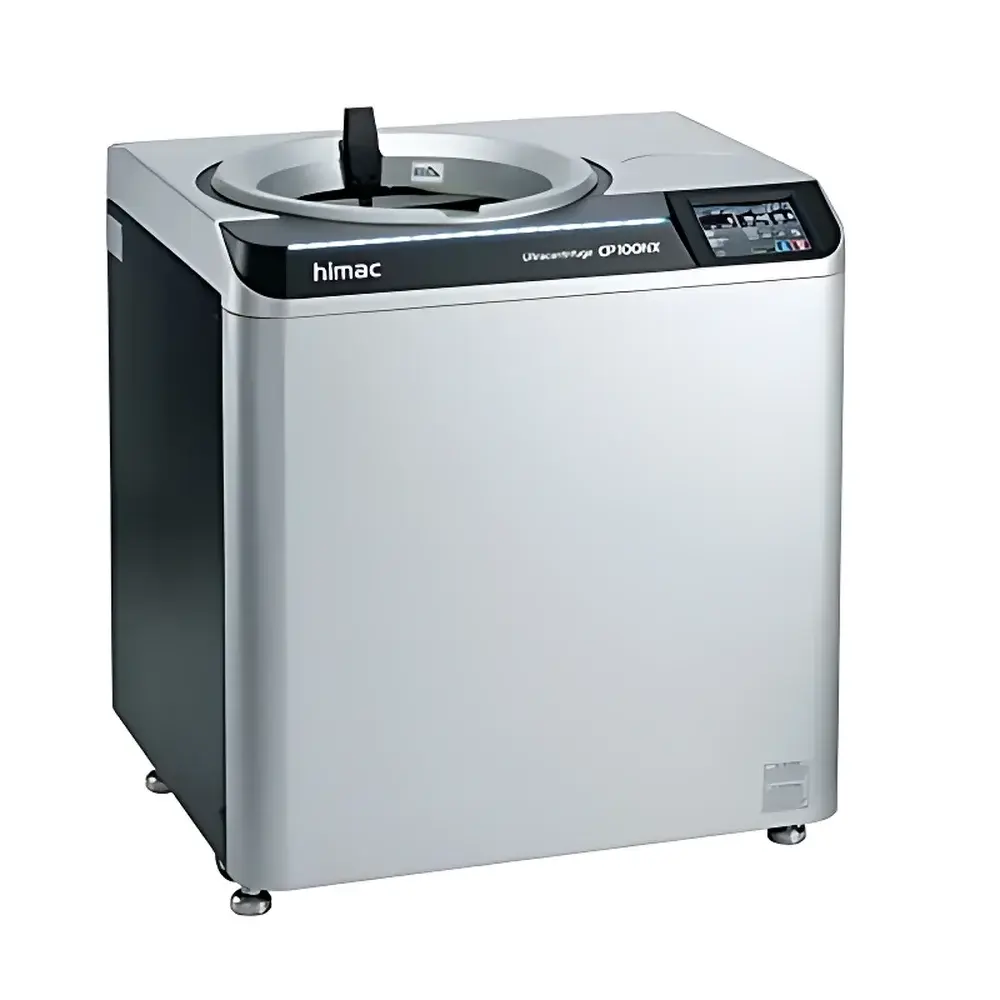
Eppendorf CP-NX Series Ultracentrifuge (Himac)
| Brand | Eppendorf |
|---|---|
| Origin | Japan |
| Manufacturer Type | Original Equipment Manufacturer (OEM) |
| Product Category | Imported Instrument |
| Models | CP100NX / CP90NX / CP80NX |
| Instrument Type | Floor-standing Ultracentrifuge |
| Speed Class | >30,000 rpm |
| Function | Refrigerated Ultracentrifuge |
| Configuration | Fixed-angle Rotor System |
| Separation Target | Organelles, Viruses, Exosomes, Macromolecular Complexes |
| Max Capacity | 1,690 mL (P32ZT rotor) / 1,380 mL (P21A2 rotor) |
| Max Speed | 100,000 rpm (CP100NX), 90,000 rpm (CP90NX), 80,000 rpm (CP80NX) |
| Max RCF | 803,000 × g (CP100NX), 700,000 × g (CP90NX), 615,000 × g (CP80NX) |
| Dimensions | 790 × 690 × 880 mm |
| Noise Level | 51 dB(A) |
| Cooling System | CFC/HCFC/HFC-free Thermo-module |
| Temperature Control Accuracy | ±0.5 °C |
| Vacuum System | Rotary Oil Pump + Oil Diffusion Pump |
| Acceleration Modes | 10 |
| Deceleration Modes | 11 (including coast-down) |
| Brake System | Regenerative Braking with Energy Recovery |
| Display | 6.5" Color LCD Touchscreen |
| User Management | 3-Tier Access Control |
| Program Storage | Up to 1,000 Protocols |
| Interface | 2× USB (host/device), 1× LAN |
| Power Supply | AC 200–240 V, 50/60 Hz, ≤1,000 W |
| Weight | 390 kg |
Overview
The Eppendorf CP-NX Series Ultracentrifuge (Himac) represents the pinnacle of high-performance ultracentrifugation technology for demanding life science and biopharmaceutical applications. Engineered for precision, safety, and operational continuity, this floor-standing refrigerated ultracentrifuge leverages vacuum-assisted rotor dynamics and advanced thermo-module cooling to deliver reproducible separation at ultra-high gravitational forces—up to 803,000 × g (CP100NX). Its core principle relies on sedimentation equilibrium and rate-zonal centrifugation under controlled thermal and vacuum environments, enabling isolation of subcellular structures—including mitochondria, lysosomes, ribosomes, enveloped viruses, extracellular vesicles (exosomes), and macromolecular assemblies—without thermal denaturation or aggregation artifacts. Designed and manufactured in Japan by Hitachi High-Technologies (under OEM partnership with Eppendorf), the CP-NX platform complies with international electrical safety standards (IEC 61010-1) and is validated for use in GLP- and GMP-regulated environments where audit-ready traceability is required.
Key Features
- Automated Rotor Life Management (RLM): Embedded optical memory chips in compatible rotors record cumulative run time, rotational history, and thermal exposure—eliminating manual logbooks and supporting ISO 17025-compliant maintenance scheduling.
- Tool-Free Rotor Auto-Locking Mechanism: Utilizes centrifugal force engagement to secure the rotor onto the drive shaft; no wrenches, keys, or manual torque application are required—reducing installation error and operator fatigue.
- Non-Contact Imbalance Detection: Monitors axial and radial vibration signatures in real time using piezoelectric sensors. Tolerates liquid level differences up to 5 mm between symmetric tubes (2 mm for P21A2 rotor), bypassing traditional balance-by-mass workflows while maintaining IEC 61010-2-020 mechanical safety compliance.
- Regenerative Braking System: Recovers kinetic energy during deceleration and feeds it back into the power grid—reducing net energy consumption and minimizing thermal load on the refrigeration system.
- CFC/HCFC/HFC-Free Thermo-Module Cooling: Maintains sample chamber temperature between −10 °C and +40 °C with ±0.5 °C stability across full speed range, critical for cold-sensitive nucleic acid and protein complexes.
- Vacuum-Assisted Operation: Integrated rotary oil pump and oil diffusion pump maintain chamber pressure 80,000 rpm.
Sample Compatibility & Compliance
The CP-NX series accommodates a broad spectrum of biological and synthetic samples—from clarified cell lysates and plasma-derived exosomes to synthetic nanoparticles and polymer colloids. Compatible rotor families include fixed-angle (e.g., P32ZT, P21A2), vertical, and near-vertical configurations optimized for pelleting, density gradient, and isopycnic separations. All rotors undergo ASME BPVC Section VIII and ISO 21501-4 certified fatigue testing. The system supports ASTM F2150 (exosome isolation), ISO 13319 (particle size distribution by sedimentation), and USP (subvisible particle analysis) workflows. Full audit trail functionality—including user ID, timestamp, parameter set, rotor serial number, and RLM data—is exportable via USB or LAN for FDA 21 CFR Part 11–compliant electronic records.
Software & Data Management
The 6.5-inch capacitive touchscreen interface runs a deterministic real-time OS with three-tier user authentication (Operator, Supervisor, Administrator). Each protocol stores rotor-specific acceleration/deceleration profiles, temperature ramp rates, vacuum ramp sequences, and hold conditions. Up to 1,000 protocols can be stored locally with checksum validation. Data logging includes per-run metadata: actual RCF vs. setpoint deviation, vacuum decay rate, compressor duty cycle, and imbalance event logs. Export formats include CSV and PDF for integration with LIMS and ELN platforms. Optional software modules enable remote monitoring via Ethernet, scheduled maintenance alerts, and automated calibration report generation aligned with ISO/IEC 17025 Clause 6.4.3.
Applications
- Isolation of extracellular vesicles (EVs) and exosomes from biofluids (plasma, urine, CSF) using differential ultracentrifugation or iodixanol gradients
- Purification of viral vectors (AAV, lentivirus) for gene therapy manufacturing under cGMP-aligned process validation
- Subcellular fractionation of organelles (mitochondria, peroxisomes, Golgi) for functional proteomics and metabolomics
- Characterization of protein aggregates, amyloid fibrils, and ribonucleoprotein complexes via sedimentation velocity AUC
- Nanoparticle size distribution analysis by analytical ultracentrifugation (AUC) in pharmaceutical development
- Preparative separation of plasmid DNA, RNA, and CRISPR ribonucleoproteins with minimal shearing
FAQ
What is the difference between CP100NX, CP90NX, and CP80NX models?
The primary distinction lies in maximum rotational speed and corresponding RCF: CP100NX achieves 100,000 rpm / 803,000 × g; CP90NX reaches 90,000 rpm / 700,000 × g; CP80NX operates up to 80,000 rpm / 615,000 × g. All share identical footprint, cooling architecture, vacuum system, and software platform.
Does the CP-NX support regulatory-compliant data integrity?
Yes. It provides full 21 CFR Part 11–aligned electronic records, including user authentication, immutable audit trails, electronic signatures, and exportable raw data with metadata—validated for GLP, GMP, and ISO 17025 environments.
Can I use non-Eppendorf rotors with this system?
No. Only Eppendorf-certified Himac rotors with integrated RLM chips are recognized and enabled by the firmware; unauthorized rotors will not initialize.
How does the thermo-module cooling compare to traditional compressor-based systems?
The solid-state thermo-module eliminates refrigerant gases, offers faster cooldown (≤15 min from ambient to −10 °C), superior temperature uniformity (<±0.3 °C across chamber), and zero oil carryover risk—critical for sensitive macromolecular applications.
Is vacuum maintenance required by the end user?
Routine oil changes for the rotary pump are recommended every 6 months or 1,000 operating hours; the oil diffusion pump is sealed and requires no scheduled servicing under normal operation.



