
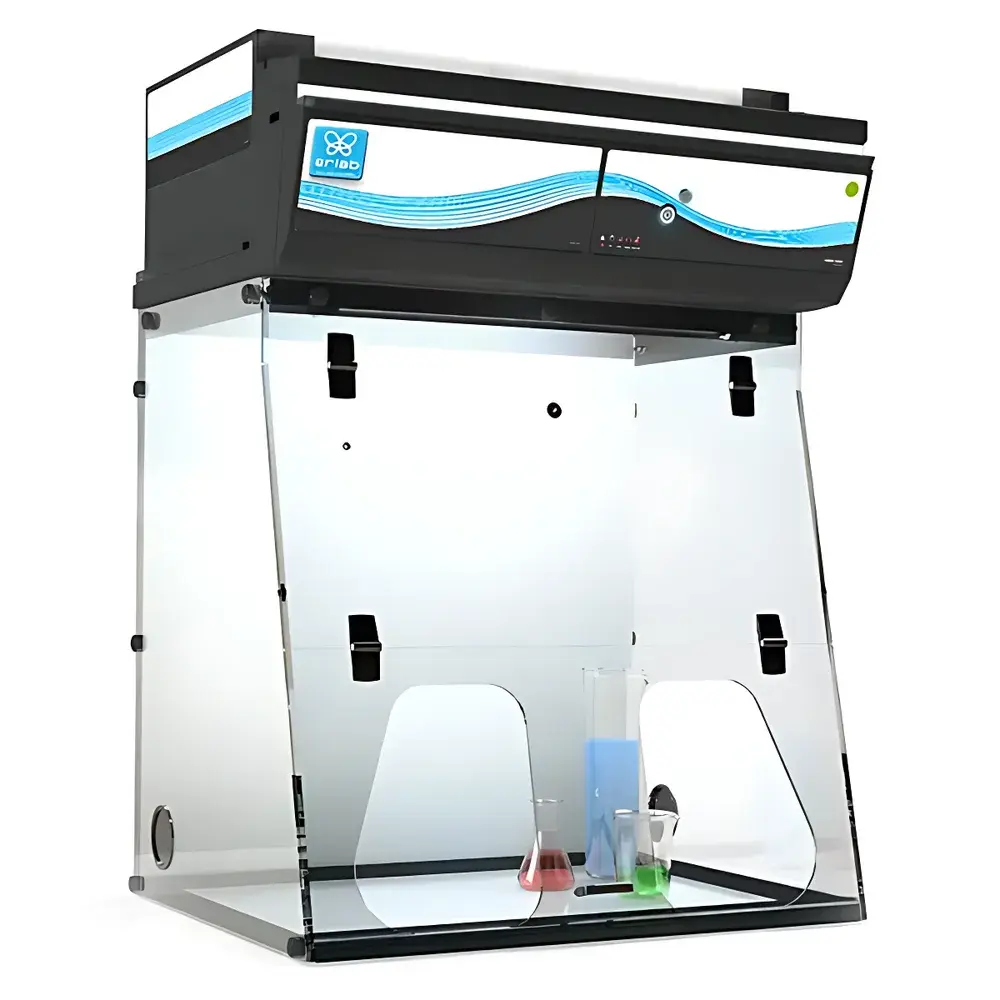
Erlab 321 Smart Air Purifying Fume Hood
| Brand | Erlab |
|---|---|
| Origin | Jiangsu, China |
| Manufacturer Type | Authorized Distributor |
| Product Category | Domestic |
| Model | 321 |
| Price Range | USD 7,000–14,000 (FOB) |
| Cabinet Material | Polypropylene (PP) |
| Design Type | Ductless (Recirculating) Fume Hood |
| Application Field | Environmental Testing & Regulatory Compliance Laboratories |
| External Dimensions (W×D×H) | 804 mm × 615 mm × 1107–1289 mm |
| Average Face Velocity | 0.4–0.6 m/s |
| Airflow Volume | 220 m³/h |
| Lighting | Integrated LED Tube |
| Rated Power Consumption | 65 W |
| Net Weight | 31.7 kg |
Overview
The Erlab 321 Smart Air Purifying Fume Hood is an engineered solution for laboratories requiring containment, operator protection, and environmental responsibility without ducted exhaust infrastructure. Unlike conventional ducted hoods that vent hazardous vapors outdoors—requiring costly HVAC integration and external venting permits—the 321 operates as a self-contained, recirculating system. It employs a dual-stage filtration architecture: a pre-filter captures particulates and aerosols, followed by a high-capacity, chemically impregnated activated carbon filter optimized for volatile organic compounds (VOCs), acid gases, aldehydes, and other low-molecular-weight contaminants common in environmental analysis, sample preparation, and chemical handling workflows. Its face velocity of 0.4–0.6 m/s complies with EN 14175-3 and ANSI/ASHRAE 110 test protocols for containment performance under dynamic operating conditions. The polypropylene (PP) cabinet ensures long-term resistance to corrosion from acids, bases, and solvents—critical for labs performing EPA Method 525.3 extractions, ASTM D3278 flash point testing, or ISO 17025-accredited water quality analysis.
Key Features
- Smart optical communication interface enables real-time status monitoring without physical wiring—supporting non-intrusive diagnostics and firmware updates.
- eGuard mobile application (iOS/Android) provides remote access to airflow verification logs, filter saturation alerts, and safety compliance dashboards—fully traceable for GLP/GMP audit readiness.
- Dual-stage filtration with certified carbon media meets ISO 10121-1 adsorption efficiency requirements for Class A and B chemical families; filter life is dynamically calculated based on cumulative exposure metrics.
- Integrated LED lighting delivers uniform 500 lux illumination across the work surface (per EN 14175-2), minimizing shadowing during volumetric glassware handling or colorimetric assays.
- Compact footprint (804 × 615 mm base) and height-adjustable sash (1107–1289 mm range) accommodate benchtop integration in space-constrained QA/QC labs and mobile environmental field stations.
- Energy-efficient operation at 65 W nominal power draw supports sustainability targets aligned with ISO 50001 energy management systems.
Sample Compatibility & Compliance
The 321 is validated for use with aqueous and organic solvent-based samples, including methanol, acetone, hydrochloric acid (≤10%), and formaldehyde solutions—common in EPA SW-846 Methods 8260, 8270, and 9060A. Its PP construction conforms to ASTM D5630 for polymer chemical resistance classification. All electrical components meet IEC 61010-1 safety standards for laboratory equipment. The system supports 21 CFR Part 11-compliant electronic records when paired with eGuard’s encrypted data logging mode—enabling signature-enabled filter change documentation and user-access audit trails required for FDA-regulated environmental monitoring programs.
Software & Data Management
eGuard software implements role-based access control (RBAC) and time-stamped event logging for all operational parameters—including sash position, airflow deviation, and filter utilization percentage. Data exports are structured in CSV and PDF formats compatible with LIMS integration via RESTful API. Historical performance reports support preventive maintenance scheduling per ISO/IEC 17025 Clause 6.4.2, ensuring metrological traceability of containment integrity over the instrument lifecycle.
Applications
- Environmental testing labs performing VOC analysis per EPA Method TO-17 and ASTM D5502.
- University teaching laboratories conducting safe chemistry demonstrations without building retrofitting.
- Pharmaceutical QC facilities handling reference standard preparations under ISO 17034 guidelines.
- Municipal water treatment labs analyzing disinfection byproducts (e.g., trihalomethanes) using GC-ECD.
- Field-deployable environmental monitoring units requiring zero-emission operation in sensitive ecological zones.
FAQ
How often must the carbon filter be replaced?
Filter replacement frequency depends on chemical type, concentration, and cumulative exposure duration; typical service intervals range from 6–12 months under moderate use (e.g., ≤2 hrs/day of low-concentration VOC handling). eGuard calculates real-time remaining service life using integrated sensor fusion.
Does the 321 require external ventilation or make-up air?
No—this is a fully recirculating ductless system. It draws ambient lab air, purifies it, and returns conditioned air to the room, eliminating need for dedicated exhaust ductwork or HVAC load compensation.
Can the unit be validated for ISO 17025 accreditation?
Yes—Erlab provides a full validation package including IQ/OQ documentation templates, ASHRAE 110 smoke visualization reports, and third-party filter efficiency certification per ISO 10121-2.
Is the polypropylene cabinet resistant to nitric acid fumes?
PP exhibits excellent resistance to dilute nitric acid (<5%) at room temperature; however, concentrated or heated HNO₃ requires evaluation per ASTM D543 immersion testing prior to routine use.
What happens if face velocity drops below 0.4 m/s?
The system triggers audible/visual alarms and automatically reduces fan speed to prevent turbulent inflow; simultaneous notification is sent via eGuard with root-cause diagnostic suggestions (e.g., clogged pre-filter, sash misalignment).
Related Products



