
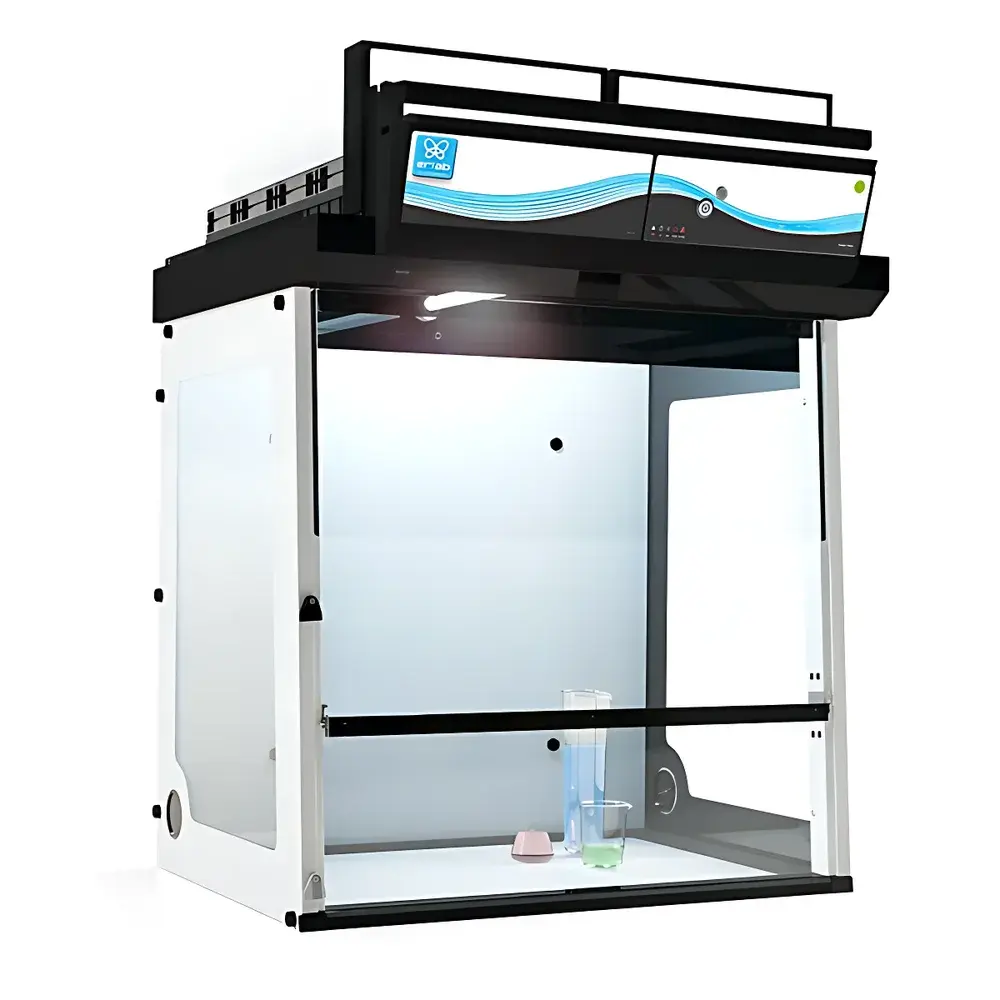
Erlab Captair 392 Smart Ductless Fume Hood
| Brand | Erlab |
|---|---|
| Origin | Jiangsu, China |
| Manufacturer Type | Authorized Distributor |
| Regional Classification | Domestic (China) |
| Model | Captair 392 Smart |
| Price Range | USD 7,000 – 14,000 (FOB) |
| Construction | All-Steel Enclosure |
| Type | Ductless (Recirculating) Fume Hood |
| Application Domain | Chemical Handling & Volatile Organic Compound (VOC) Containment |
| Ducting | Self-Contained, No External Ductwork Required |
| Dimensions (W×D×H) | 1065 mm × 751 mm × 1333–1515 mm (Height Adjustable) |
| Average Face Velocity | 0.4–0.6 m/s |
| Airflow Volume | 440 m³/h |
| Lighting | Integrated LED Tubes |
| Rated Power Consumption | 105 W |
Overview
The Erlab Captair 392 Smart is a certified ductless fume hood engineered for high-reliability chemical containment in modern laboratories where infrastructure constraints or sustainability goals preclude traditional ducted ventilation. Unlike conventional exhaust hoods that rely on building HVAC systems and external duct networks, the Captair 392 Smart employs a closed-loop recirculation architecture: ambient air is drawn across the work surface at a controlled face velocity (0.4–0.6 m/s), passed through a dual-stage filtration system—comprising a particulate pre-filter and a high-capacity activated carbon filter—and returned to the laboratory environment after >99.9% removal of targeted vapors and aerosols. This principle, grounded in ASHRAE 110-derived performance validation protocols and aligned with ISO 10993-5 cytotoxicity screening for filter effluent, ensures operator safety without thermal load penalties or structural retrofitting. Its all-steel construction meets EN 14175-3 mechanical integrity requirements, while height-adjustable sash design (1333–1515 mm) accommodates ergonomic workflows across diverse user anthropometries.
Key Features
- All-steel monocoque chassis with epoxy-powder-coated finish for corrosion resistance against common solvents including acetone, ethanol, and dilute acids.
- SmartSense™ real-time status ring: color-coded LED halo (green = operational, amber = filter saturation warning, red = airflow failure) provides immediate visual feedback without interface interaction.
- Integrated IoT module enabling secure TLS 1.2–encrypted remote monitoring via Erlab Cloud Platform—supports fleet-level oversight of filter life, runtime hours, and airflow stability across multiple units.
- Pre-calibrated anemometer and microprocessor-controlled blower ensure consistent face velocity compliance per ANSI Z9.5-2012 Section 5.3.2 and JG/T 385-2012 Clause 6.4.1, even under variable ambient pressure conditions.
- Low-power brushless DC motor (105 W rated) delivers 440 m³/h volumetric flow with acoustic output <52 dB(A) at 1 m—optimized for open-plan lab environments.
Sample Compatibility & Compliance
The Captair 392 Smart is validated for safe handling of low-to-moderate volatility chemicals (vapor pressure <10 mmHg at 20°C), including halogenated solvents, alcohols, ketones, and amine-based reagents. It is not intended for perchloric acid, hydrofluoric acid, radioactive isotopes, or nanoparticle synthesis. Filtration efficacy is certified per AFNOR NF X 15-211 (Class 1 & 2), with independent third-party testing confirming breakthrough concentrations below 1% of OSHA PELs for 38 common lab VOCs. Units shipped to North America include UL 61010-1 and CAN/CSA C22.2 No. 61010-1 certification; EU shipments carry CE marking under Directive 2014/35/EU (LVD) and 2014/30/EU (EMC). Full traceability documentation—including filter batch certificates, airflow calibration reports, and conformity declarations—is provided with each unit.
Software & Data Management
The embedded Erlab SmartLink firmware supports audit-ready data logging compliant with FDA 21 CFR Part 11 (electronic signatures, role-based access, immutable event logs). Operational parameters—including cumulative runtime, filter usage time, and daily average face velocity—are timestamped and exportable as CSV or PDF. Cloud synchronization enables automated alerts for scheduled maintenance (e.g., filter replacement at 75% saturation threshold) and generates GLP-compliant summary reports for internal QA reviews or regulatory inspections. Local USB-C port allows offline firmware updates and raw data extraction without network dependency.
Applications
- Teaching labs requiring rapid deployment and zero ducting modifications.
- QC/QA stations performing routine titrations, pH adjustments, or standard solution preparation.
- Pharmaceutical R&D labs conducting solvent-based extractions or lyophilization support operations.
- University core facilities managing shared instrumentation with multi-user scheduling and accountability tracking.
- Sustainability-focused institutions targeting LEED IEQ Credit 6.1 (Controllability of Systems) and ISO 50001 energy management integration.
FAQ
Does the Captair 392 Smart require external ductwork or building exhaust integration?
No. It operates as a fully self-contained recirculating system and requires only a standard 230 V / 50 Hz power outlet.
How often must the carbon filter be replaced?
Filter service life depends on chemical type, concentration, and daily usage duration—typically 6–12 months under average academic lab conditions. The SmartSense™ ring and cloud dashboard provide predictive alerts based on real-time adsorption modeling.
Can it be used for perchloric acid or HF handling?
No. These applications demand wash-down ducted hoods with specialized stainless-steel construction and dedicated scrubber systems per ANSI Z9.12 and NFPA 45 requirements.
Is calibration traceable to national standards?
Yes. Each unit ships with a NIST-traceable anemometer calibration certificate issued by Erlab’s ISO/IEC 17025-accredited metrology lab.
What cybersecurity measures protect remote monitoring data?
All cloud communications use AES-256 encryption, device-authenticated TLS handshakes, and OAuth 2.0 token-based session management—fully aligned with NIST SP 800-53 Rev. 5 AC-17 and IA-2 controls.



